13.09.2026
 Always Busy. But What Did You Actually Get Done?
Years ago, when I was a young manager, I took over a department and inherited three secretaries. They were approaching retirement age, had many years of work experience, and were extremely conscientious. At the same time, some of their skills had fallen behind the times, while the needs of the organisation had changed.
One day, I gave one of them a simple task: “Please call this person and arrange a meeting for Tuesday or Wednesday.” At the end of the working day, I asked: “What time is the meeting?” Instead of a time, I received a detailed account of everything she had done. “I called. Nobody answered. Then I called again. The phone went beep-beep. Then I tried once more…” Eventually, I asked: “But did you arrange the meeting?” No. The task had not been completed. There had been no shortage of effort. What was missing was the result.
That story has stayed with me for years. Not because the employee was lazy or unwilling. Quite the opposite. She had been busy and had made a genuine effort all day. The problem was elsewhere. Her attention was focused on activity. Mine was focused on the result. And the longer I have observed working life, the more often I have encountered the same phenomenon.
Busyness or just keeping busy?
In English, the word busyness usually describes having a lot to do, little free time, and a full calendar. But there is another side to busyness that interests me more. A person may be constantly doing something while the connection between all that activity and actual results remains weak. The day passes quickly, a great deal of energy is spent, yet at the end of it one question is surprisingly difficult to answer:
What did I actually get done?
Over the years, I have noticed this repeatedly in working life. Some people are constantly active. They answer phone calls, send emails, attend meetings, deal with everyday problems, and react to interruptions. Ask them what they did during the day, and you may hear a long list of activities. Much less often do you hear a list of results.
Busyness as a status symbol
Interestingly, being busy is no longer necessarily regarded as a problem. Quite the opposite. Columbia University professor Silvia Bellezza has shown that, particularly in the United States, busyness has become a status symbol. In the past, leisure could signal high status. Today, having no time at all may serve the same function. Think about how often you hear: “I’m incredibly busy.” Sometimes it no longer sounds like a description of workload. It almost sounds like an achievement - as though being constantly busy were evidence that a person is important and needed. In our study (n = 431), 61.6% of employees reported being busy often or very often.
The paradox of busyness
From a psychological perspective, there is a paradox here. Complete inactivity does not make people happy. People need goals, challenges, and activity. Meaningful work can be an important source of well-being.
But constant overload does not make people happy either. Excessive busyness is associated with stress, burnout, and problems with health and relationships. So perhaps the real question is not whether we should be busy. The more interesting question is: What are we busy with? Are our activities taking us towards a goal? Or is most of our energy being spent simply keeping busy?
Fake busyness
Research sometimes uses the term fake busyness. It describes situations in which a person is active and the activity looks productive, but the actual value created remains modest.
For example: endless emails, meetings that produce no decisions, reports nobody reads, constant reactions to interruptions, and tasks that create an impression of productivity without actually moving anything forward.
At the end of the day, a person may be genuinely tired and feel that they have worked extremely hard. And yet the question remains: What actually got done?
Can keeping busy be a psychological defence?
This is where the subject becomes even more interesting. Perhaps keeping busy does not always serve only a work-related purpose. Sometimes it may also serve a psychological function.
When a person is constantly occupied, there is less time for uncomfortable questions:
Constant activity may provide a sense of security. It may create the feeling of being needed, important, even indispensable - even when the actual results remain modest.
Something to Think About
If someone asked you at the end of your working day: “What did you get done today?” Would you answer by describing your activities or your results? Sometimes the answer to that one question may reveal surprisingly well whether the day was spent being productive or simply being busy.
Keywords: busyness, fake busyness, work performance, work psychology, management, productivity, work habits
Further reading
Teichmann, M., Murdvee, M., Randmann, L., Hellamaa, T., Malik, A. S., Ngana, W. G., Pitkanen, J. M., Shkuropat, K., Stephanou, K., Svetlicinaia, O., Tali, A., & Verano Izaguirre, J. J. (2015). Workplace busyness and multitasking. In Abstracts, European Association of Work and Organizational Psychology (EAWOP) Congress, 2015, Maastricht.
One day, I gave one of them a simple task: “Please call this person and arrange a meeting for Tuesday or Wednesday.” At the end of the working day, I asked: “What time is the meeting?” Instead of a time, I received a detailed account of everything she had done. “I called. Nobody answered. Then I called again. The phone went beep-beep. Then I tried once more…” Eventually, I asked: “But did you arrange the meeting?” No. The task had not been completed. There had been no shortage of effort. What was missing was the result.
That story has stayed with me for years. Not because the employee was lazy or unwilling. Quite the opposite. She had been busy and had made a genuine effort all day. The problem was elsewhere. Her attention was focused on activity. Mine was focused on the result. And the longer I have observed working life, the more often I have encountered the same phenomenon.
Busyness or just keeping busy?
In English, the word busyness usually describes having a lot to do, little free time, and a full calendar. But there is another side to busyness that interests me more. A person may be constantly doing something while the connection between all that activity and actual results remains weak. The day passes quickly, a great deal of energy is spent, yet at the end of it one question is surprisingly difficult to answer:
What did I actually get done?
Over the years, I have noticed this repeatedly in working life. Some people are constantly active. They answer phone calls, send emails, attend meetings, deal with everyday problems, and react to interruptions. Ask them what they did during the day, and you may hear a long list of activities. Much less often do you hear a list of results.
Busyness as a status symbol
Interestingly, being busy is no longer necessarily regarded as a problem. Quite the opposite. Columbia University professor Silvia Bellezza has shown that, particularly in the United States, busyness has become a status symbol. In the past, leisure could signal high status. Today, having no time at all may serve the same function. Think about how often you hear: “I’m incredibly busy.” Sometimes it no longer sounds like a description of workload. It almost sounds like an achievement - as though being constantly busy were evidence that a person is important and needed. In our study (n = 431), 61.6% of employees reported being busy often or very often.
The paradox of busyness
From a psychological perspective, there is a paradox here. Complete inactivity does not make people happy. People need goals, challenges, and activity. Meaningful work can be an important source of well-being.
But constant overload does not make people happy either. Excessive busyness is associated with stress, burnout, and problems with health and relationships. So perhaps the real question is not whether we should be busy. The more interesting question is: What are we busy with? Are our activities taking us towards a goal? Or is most of our energy being spent simply keeping busy?
Fake busyness
Research sometimes uses the term fake busyness. It describes situations in which a person is active and the activity looks productive, but the actual value created remains modest.
For example: endless emails, meetings that produce no decisions, reports nobody reads, constant reactions to interruptions, and tasks that create an impression of productivity without actually moving anything forward.
At the end of the day, a person may be genuinely tired and feel that they have worked extremely hard. And yet the question remains: What actually got done?
Can keeping busy be a psychological defence?
This is where the subject becomes even more interesting. Perhaps keeping busy does not always serve only a work-related purpose. Sometimes it may also serve a psychological function.
When a person is constantly occupied, there is less time for uncomfortable questions:
- Am I doing the right things?
- Is this work important to me?
- Am I satisfied with my work?
- What do I actually want to achieve?
Constant activity may provide a sense of security. It may create the feeling of being needed, important, even indispensable - even when the actual results remain modest.
Something to Think About
If someone asked you at the end of your working day: “What did you get done today?” Would you answer by describing your activities or your results? Sometimes the answer to that one question may reveal surprisingly well whether the day was spent being productive or simply being busy.
Keywords: busyness, fake busyness, work performance, work psychology, management, productivity, work habits
Further reading
Teichmann, M., Murdvee, M., Randmann, L., Hellamaa, T., Malik, A. S., Ngana, W. G., Pitkanen, J. M., Shkuropat, K., Stephanou, K., Svetlicinaia, O., Tali, A., & Verano Izaguirre, J. J. (2015). Workplace busyness and multitasking. In Abstracts, European Association of Work and Organizational Psychology (EAWOP) Congress, 2015, Maastricht.
9.09.2026
 Emotional Labour
Historically, emotional labour has been studied mainly among customer service employees. Today, the picture is much broader. Teachers, doctors, nurses, social workers, public officials and managers all do emotional labour. So does anyone whose job involves dealing with other people - both pleasant and not so pleasant ones.
We know that some working days can be emotionally difficult. Some jobs are physically demanding. Others require extensive knowledge and the ability to solve complex problems. And then there are jobs where the greatest burden comes from people: people who are worried, angry, frightened, upset or simply in a bad mood. In occupational psychology, this phenomenon is known as emotional labour.
A few years ago, I had the opportunity to study work stress among employees (n = 113) whose job involved responding to people at some of the most difficult moments in their lives. Their work regularly placed them in emotionally disturbing situations: 95% said this happened often or very often. Dealing with people facing a problem, difficulty or crisis was simply part of their everyday work.
I was interested in a simple question: What happens to employees when emotionally difficult situations are not the exception, but a normal part of the job?
Emotional Labour May Be Associated with Work Stress
The associations between emotional labour, employee health and work stress were much as one might expect.
The more frequently employees encountered emotionally disturbing situations, the higher their work stress (r = 0.35) and the poorer they rated their health (r = -0.37).
Emotional Labour Is Tiring
The strongest association was with fatigue and exhaustion (r = 0.50). The more often employees encountered emotionally disturbing situations, the more fatigue and exhaustion they reported. They also rated their work ability lower (r = -0.47).
People often think of tiredness as the result of physical or mental effort. But managing emotions also takes energy - particularly when you have to remain calm while the person you are dealing with is anything but calm.
Relationships and Perceptions of the Work Environment Also Suffer
Emotionally difficult work was also associated with poorer workplace relationships
(r = -0.37), more conflict (r = 0.32), and a stronger perception of unfairness or favouritism within the organisation (r = 0.31).
Multitasking may also be part of the problem (r = 0.44).
This does not mean that emotional labour itself causes conflict or multitasking. But constant exposure to difficult situations may make people more sensitive to everything in the work environment that is not functioning well.
Less Joy at Work
The more frequently employees encountered emotionally disturbing situations, the less they enjoyed their working life (r = -0.31), experienced positive emotions at work (r = -0.34), were satisfied with the content of their work (r = -0.34), and were satisfied with their work environment (r = -0.36).
This finding made me think. We sometimes talk about burnout as though it were primarily caused by having too much work. But sometimes the source of the burden may be emotional.
Not how much work you do, but what you experience while doing it.
The Effects Extend to Performance
Perhaps the most interesting finding was that emotionally disturbing situations were not associated only with wellbeing or job satisfaction. They were also associated with lower work motivation (r = -0.34) and poorer work performance (r = -0.33).
This means that emotional labour is not merely a personal issue for the employee. It is also an issue of organisational performance.
Something to Think About
Organisations pay a great deal of attention to workload. They measure deadlines, the amount of work and results. Emotional demands are measured much less often.
Yet emotional demands may be the invisible factor affecting a person's work motivation, relationships and ability to work. Not all jobs are difficult for the same reason. Sometimes it is not the work itself that wears people out. Sometimes it is the people.
Keywords: emotional labour, occupational psychology, work stress, work ability, work motivation, burnout, job satisfaction, emotional demands, workplace relationships, productivity
We know that some working days can be emotionally difficult. Some jobs are physically demanding. Others require extensive knowledge and the ability to solve complex problems. And then there are jobs where the greatest burden comes from people: people who are worried, angry, frightened, upset or simply in a bad mood. In occupational psychology, this phenomenon is known as emotional labour.
A few years ago, I had the opportunity to study work stress among employees (n = 113) whose job involved responding to people at some of the most difficult moments in their lives. Their work regularly placed them in emotionally disturbing situations: 95% said this happened often or very often. Dealing with people facing a problem, difficulty or crisis was simply part of their everyday work.
I was interested in a simple question: What happens to employees when emotionally difficult situations are not the exception, but a normal part of the job?
Emotional Labour May Be Associated with Work Stress
The associations between emotional labour, employee health and work stress were much as one might expect.
The more frequently employees encountered emotionally disturbing situations, the higher their work stress (r = 0.35) and the poorer they rated their health (r = -0.37).
Emotional Labour Is Tiring
The strongest association was with fatigue and exhaustion (r = 0.50). The more often employees encountered emotionally disturbing situations, the more fatigue and exhaustion they reported. They also rated their work ability lower (r = -0.47).
People often think of tiredness as the result of physical or mental effort. But managing emotions also takes energy - particularly when you have to remain calm while the person you are dealing with is anything but calm.
Relationships and Perceptions of the Work Environment Also Suffer
Emotionally difficult work was also associated with poorer workplace relationships
(r = -0.37), more conflict (r = 0.32), and a stronger perception of unfairness or favouritism within the organisation (r = 0.31).
Multitasking may also be part of the problem (r = 0.44).
This does not mean that emotional labour itself causes conflict or multitasking. But constant exposure to difficult situations may make people more sensitive to everything in the work environment that is not functioning well.
Less Joy at Work
The more frequently employees encountered emotionally disturbing situations, the less they enjoyed their working life (r = -0.31), experienced positive emotions at work (r = -0.34), were satisfied with the content of their work (r = -0.34), and were satisfied with their work environment (r = -0.36).
This finding made me think. We sometimes talk about burnout as though it were primarily caused by having too much work. But sometimes the source of the burden may be emotional.
Not how much work you do, but what you experience while doing it.
The Effects Extend to Performance
Perhaps the most interesting finding was that emotionally disturbing situations were not associated only with wellbeing or job satisfaction. They were also associated with lower work motivation (r = -0.34) and poorer work performance (r = -0.33).
This means that emotional labour is not merely a personal issue for the employee. It is also an issue of organisational performance.
Something to Think About
Organisations pay a great deal of attention to workload. They measure deadlines, the amount of work and results. Emotional demands are measured much less often.
Yet emotional demands may be the invisible factor affecting a person's work motivation, relationships and ability to work. Not all jobs are difficult for the same reason. Sometimes it is not the work itself that wears people out. Sometimes it is the people.
Keywords: emotional labour, occupational psychology, work stress, work ability, work motivation, burnout, job satisfaction, emotional demands, workplace relationships, productivity
6.09.2026
 Organisational Health
A toxic work environment is often treated as a problem between individuals - one person behaves badly, while someone else suffers. The reality is more complicated. A toxic work environment is not simply an accident or the fault of one individual. It can be a symptom of poor organisational health - a sign that something has gone wrong at a deeper level: in leadership, organisational culture, values, or all three.
A healthy organisation does more than produce good results. It creates an environment where people know what is expected of them, trust their managers, and feel able to speak honestly. When these conditions are missing, something else tends to fill the gap.
Sign No. 1 of a Toxic Work Environment: Hidden Discrimination and Favouritism
In recent years, there has been increasing discussion about toxic work environments in Estonia. The term itself is relatively new. The phenomenon is not.
A toxic work environment rarely appears overnight. It usually develops through a combination of different problems. Some are clearly visible. Others may remain unnoticed by managers and colleagues for a long time.
In the next few posts, I will look at five characteristics of the work environment that may indicate poor organisational health - five evidence-based warning signs that something is not right.
How Is a Toxic Work Environment Related to Work Performance?
Our OPSTI studies from 2018–2025 point to five important warning signs:
1. Hidden discrimination and favouritism - association with work performance: r = -0.32.
2. Poor quality of leadership: r = -0.29.
3. Workplace bullying and harassment: r = -0.27.
4. Lack of recognition: r = -0.33.
5. Poor organisational psychological climate: r = -0.39.
This first post looks at hidden discrimination and favouritism.
Discrimination Is Not the Only Problem
There has been a great deal of discussion about discrimination in recent years. My experience suggests that organisations also face another phenomenon that receives less attention: favouritism.
Sometimes no law is being broken. And yet employees still feel that people are not being treated equally. One employee gets the more interesting projects. Another is left out. One employee receives important information early. Another hears about it last. One person's mistakes are overlooked. Every mistake made by someone else is noticed. Formally, everything may appear perfectly correct. But employees begin to feel that the same rules do not apply to everyone. And that feeling may be one of the warning signs of a toxic work environment.
Discrimination and Favouritism Are Not the Same Thing
Discrimination means unequal treatment on the basis of a legally protected characteristic, such as gender, age, ethnicity, language or disability. It is a legal issue. Favouritism may have quite different origins. It may be based on personal liking, friendship, or simply the fact that a manager prefers one employee's way of working to another's. It may not be illegal. But from an employee's perspective, the most important question is not always whether something is legally permitted.
The more immediate question may be: Am I being treated fairly? How Common Is the Problem?
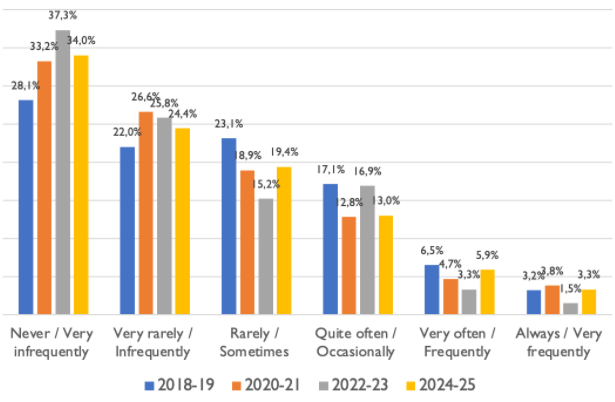
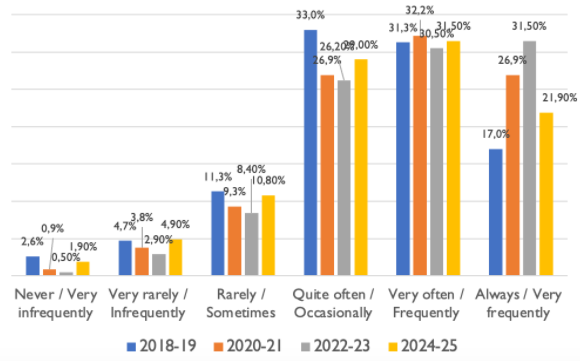
Between 2018 and 2025, we asked employees in our OPSTI studies to what extent hidden discrimination and favouritism occurred in their organisations.
Figure. Employees reporting hidden discrimination and favouritism
The results show a remarkably stable pattern. Approximately one in five employees feels that not everyone in their organisation is treated equally. This is no longer an isolated incident. It is a management problem.
Why Does It Matter?
It is sometimes assumed that hidden favouritism affects only those employees who personally feel unfairly treated. Our data suggest otherwise.
Impact on Organisational Health
Hidden discrimination and favouritism are associated with:
Impact on Employee Health and Well-Being
Hidden discrimination and favouritism are also associated with:
Why Don't Managers Always Notice It?
One reason is simple. A system of favourites rarely begins as a conscious management decision. Very few managers arrive at work in the morning thinking: “Today I am going to favour some of my employees.” It usually develops much more subtly.
We tend to like people who think like us. We tend to trust people with whom communication is easy. And we may notice the contributions of people with whom we get along well more readily.
These are ordinary human tendencies. The problem begins when personal preference starts influencing management decisions.
Something for Managers to Think About
Perhaps every manager should occasionally ask: Do all my employees have equal access to information, attention, feedback and opportunities for development?
Because a toxic work environment does not always begin with bullying or open conflict. Sometimes it begins with something much simpler. The feeling that the same rules do not apply to everyone.
Keywords: toxic work environment, discrimination, favouritism, fair treatment, leadership, organisational health, workplace bullying, occupational stress, job satisfaction, psychological climate, OPSTI
A healthy organisation does more than produce good results. It creates an environment where people know what is expected of them, trust their managers, and feel able to speak honestly. When these conditions are missing, something else tends to fill the gap.
Sign No. 1 of a Toxic Work Environment: Hidden Discrimination and Favouritism
In recent years, there has been increasing discussion about toxic work environments in Estonia. The term itself is relatively new. The phenomenon is not.
A toxic work environment rarely appears overnight. It usually develops through a combination of different problems. Some are clearly visible. Others may remain unnoticed by managers and colleagues for a long time.
In the next few posts, I will look at five characteristics of the work environment that may indicate poor organisational health - five evidence-based warning signs that something is not right.
How Is a Toxic Work Environment Related to Work Performance?
Our OPSTI studies from 2018–2025 point to five important warning signs:
1. Hidden discrimination and favouritism - association with work performance: r = -0.32.
2. Poor quality of leadership: r = -0.29.
3. Workplace bullying and harassment: r = -0.27.
4. Lack of recognition: r = -0.33.
5. Poor organisational psychological climate: r = -0.39.
This first post looks at hidden discrimination and favouritism.
Discrimination Is Not the Only Problem
There has been a great deal of discussion about discrimination in recent years. My experience suggests that organisations also face another phenomenon that receives less attention: favouritism.
Sometimes no law is being broken. And yet employees still feel that people are not being treated equally. One employee gets the more interesting projects. Another is left out. One employee receives important information early. Another hears about it last. One person's mistakes are overlooked. Every mistake made by someone else is noticed. Formally, everything may appear perfectly correct. But employees begin to feel that the same rules do not apply to everyone. And that feeling may be one of the warning signs of a toxic work environment.
Discrimination and Favouritism Are Not the Same Thing
Discrimination means unequal treatment on the basis of a legally protected characteristic, such as gender, age, ethnicity, language or disability. It is a legal issue. Favouritism may have quite different origins. It may be based on personal liking, friendship, or simply the fact that a manager prefers one employee's way of working to another's. It may not be illegal. But from an employee's perspective, the most important question is not always whether something is legally permitted.
The more immediate question may be: Am I being treated fairly? How Common Is the Problem?
Between 2018 and 2025, we asked employees in our OPSTI studies to what extent hidden discrimination and favouritism occurred in their organisations.
Period |
Sample (n) |
Employees reporting hidden discrimination and favouritism |
| 2018-2019 | 1203 | 26,8% |
| 2020-2021 | 1299 | 21,3% |
| 2022-2023 | 550 | 21,7% |
| 2024-2025 | 1143 | 22,2% |
Figure. Employees reporting hidden discrimination and favouritism
The results show a remarkably stable pattern. Approximately one in five employees feels that not everyone in their organisation is treated equally. This is no longer an isolated incident. It is a management problem.
Why Does It Matter?
It is sometimes assumed that hidden favouritism affects only those employees who personally feel unfairly treated. Our data suggest otherwise.
Impact on Organisational Health
Hidden discrimination and favouritism are associated with:
- more workplace conflict (r = 0.58);
- a poorer organisational psychological climate (r = -0.43);
- lower ratings of leadership quality (r = -0.41);
- less recognition at work (r = -0.36).
Impact on Employee Health and Well-Being
Hidden discrimination and favouritism are also associated with:
- higher occupational stress (r = 0.33);
- lower job satisfaction (r = -0.30);
- poorer work ability (r = -0.30).
Why Don't Managers Always Notice It?
One reason is simple. A system of favourites rarely begins as a conscious management decision. Very few managers arrive at work in the morning thinking: “Today I am going to favour some of my employees.” It usually develops much more subtly.
We tend to like people who think like us. We tend to trust people with whom communication is easy. And we may notice the contributions of people with whom we get along well more readily.
These are ordinary human tendencies. The problem begins when personal preference starts influencing management decisions.
Something for Managers to Think About
Perhaps every manager should occasionally ask: Do all my employees have equal access to information, attention, feedback and opportunities for development?
Because a toxic work environment does not always begin with bullying or open conflict. Sometimes it begins with something much simpler. The feeling that the same rules do not apply to everyone.
Keywords: toxic work environment, discrimination, favouritism, fair treatment, leadership, organisational health, workplace bullying, occupational stress, job satisfaction, psychological climate, OPSTI
2.09.2026
 The Alpha Male Leader - Organisational Saviour or Problem?
Years ago, I came across Kate Ludeman and Eddie Erlandson’s book Alpha Male Syndrome. According to the authors, three-quarters of top executives in the United States could be classified as so-called alpha males. It made me wonder: Do you really have to be aggressive, highly achievement-oriented, competitive and dominant to become a successful leader?
Who Is the Alpha Male Leader?
The alpha male leader is typically characterised by three traits.
First, he is extremely results-oriented. He wants to be the best and competes both with others and with himself.
Second, he is impatient. Everything needs to be done quickly, immediately and without delay.
Third, he believes that putting employees under pressure, criticising them and sometimes even creating fear are effective management tools.
Such people often stand out early in their careers. They are intelligent, self-confident, determined and willing to take responsibility. Organisations need people with these qualities. That is precisely why they often rise to leadership positions.
Why Do Problems Arise?
Paradoxically, the very qualities that help people advance in their careers may later begin to interfere with effective leadership.
If a leader is used to being the smartest person in the room, listening to others can become difficult. If a leader is accustomed to making decisions quickly, patience may disappear. And if a leader believes that pressure produces results, they may begin to use it more than necessary.
Ludeman and Erlandson describe how alpha male leaders often focus more on mistakes than on successes. The result can be an organisational culture in which people no longer dare to express their opinions. In such an environment, it is not only open communication that disappears. Learning disappears as well.
What Does Psychology Tell Us?
When I read the book years ago, I had the feeling that the authors were actually describing two phenomena that psychology had known about for a long time.
The first is the Type A personality. Type A individuals work hard, compete constantly, experience time pressure and set extremely high standards for themselves.
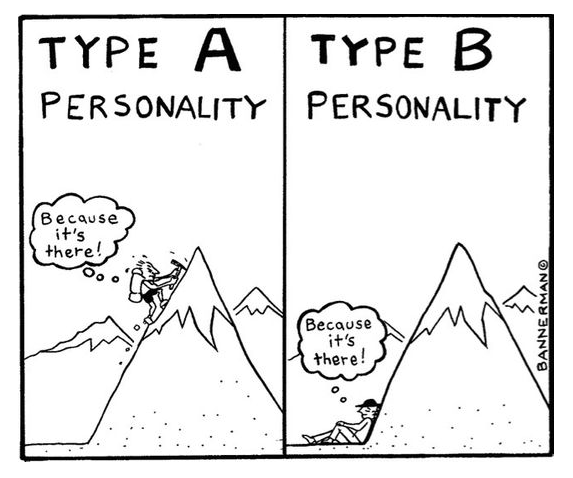
Figure. Type A climbs the mountain because it is in the way. Type B sits down at the foot of the mountain because it is in the way. A humorous illustration of the difference between Type A and Type B personalities.
The second phenomenon is authoritarian leadership.
For an authoritarian leader, control, obedience and following instructions are important. Employee involvement and joint discussion may seem slow and inefficient. Long ago, we noticed that leaders tend to remain loyal to the leadership style that brought them success during the start-up phase of an organisation.
Authoritarian leadership can be effective when an organisation is still taking shape and employees need considerable direction. But once the company has grown and its employees have become competent and independent, the same leadership style may begin to hold the organisation back.
Both phenomena are well known in psychology.
Do the Qualities That Help Someone Become a Leader Also Help Them Become a Good Leader?
Looking at earlier studies of Estonian managers, there were signs that Type A behaviour was becoming increasingly common among leaders. At the same time, Estonian managers worked long hours compared with their European counterparts, and their levels of occupational stress were increasing.
Interestingly, they were also very satisfied with their work. We participated in an international study of managers conducted across five continents (CISMS 2). The results indicated that Estonian managers were exceptionally satisfied with management as their work. Only managers in Mexico and Colombia reported higher job satisfaction.
This is not really a contradiction. Many highly demanding leaders genuinely enjoy their work. The problem begins when employees start to suffer from the effects of their leadership style.
Is the Age of the Alpha Male Over?
I am not sure. During crises, periods of change and difficult situations, organisations need leaders who are willing to make decisions and take responsibility. But modern organisations also need something else: collaboration, trust, the ability to learn and the ability to listen.
A leader who can combine decisiveness with an understanding of people is likely to be more successful than one who relies solely on pressure and control.
Our most recent research supports this conclusion (n = 714). Empathy was associated with work performance (r = 0.54). The better a person is able to understand other people’s perspectives and needs, the higher their work performance tends to be.
Perhaps the real question is not whether an alpha male leader is good or bad.
A more important question may be: Can a leader recognise the moment when their greatest strength begins to become a weakness?
Something to Think About
Which qualities do you consider most important in a leader? Have you ever worked with a leader whose greatest strength eventually became their greatest problem?
Keywords: leadership, alpha male leader, Type A personality, authoritarian leadership, occupational stress, leadership style, working life, empathy, work performance
Who Is the Alpha Male Leader?
The alpha male leader is typically characterised by three traits.
First, he is extremely results-oriented. He wants to be the best and competes both with others and with himself.
Second, he is impatient. Everything needs to be done quickly, immediately and without delay.
Third, he believes that putting employees under pressure, criticising them and sometimes even creating fear are effective management tools.
Such people often stand out early in their careers. They are intelligent, self-confident, determined and willing to take responsibility. Organisations need people with these qualities. That is precisely why they often rise to leadership positions.
Why Do Problems Arise?
Paradoxically, the very qualities that help people advance in their careers may later begin to interfere with effective leadership.
If a leader is used to being the smartest person in the room, listening to others can become difficult. If a leader is accustomed to making decisions quickly, patience may disappear. And if a leader believes that pressure produces results, they may begin to use it more than necessary.
Ludeman and Erlandson describe how alpha male leaders often focus more on mistakes than on successes. The result can be an organisational culture in which people no longer dare to express their opinions. In such an environment, it is not only open communication that disappears. Learning disappears as well.
What Does Psychology Tell Us?
When I read the book years ago, I had the feeling that the authors were actually describing two phenomena that psychology had known about for a long time.
The first is the Type A personality. Type A individuals work hard, compete constantly, experience time pressure and set extremely high standards for themselves.
Figure. Type A climbs the mountain because it is in the way. Type B sits down at the foot of the mountain because it is in the way. A humorous illustration of the difference between Type A and Type B personalities.
The second phenomenon is authoritarian leadership.
For an authoritarian leader, control, obedience and following instructions are important. Employee involvement and joint discussion may seem slow and inefficient. Long ago, we noticed that leaders tend to remain loyal to the leadership style that brought them success during the start-up phase of an organisation.
Authoritarian leadership can be effective when an organisation is still taking shape and employees need considerable direction. But once the company has grown and its employees have become competent and independent, the same leadership style may begin to hold the organisation back.
Both phenomena are well known in psychology.
Do the Qualities That Help Someone Become a Leader Also Help Them Become a Good Leader?
Looking at earlier studies of Estonian managers, there were signs that Type A behaviour was becoming increasingly common among leaders. At the same time, Estonian managers worked long hours compared with their European counterparts, and their levels of occupational stress were increasing.
Interestingly, they were also very satisfied with their work. We participated in an international study of managers conducted across five continents (CISMS 2). The results indicated that Estonian managers were exceptionally satisfied with management as their work. Only managers in Mexico and Colombia reported higher job satisfaction.
This is not really a contradiction. Many highly demanding leaders genuinely enjoy their work. The problem begins when employees start to suffer from the effects of their leadership style.
Is the Age of the Alpha Male Over?
I am not sure. During crises, periods of change and difficult situations, organisations need leaders who are willing to make decisions and take responsibility. But modern organisations also need something else: collaboration, trust, the ability to learn and the ability to listen.
A leader who can combine decisiveness with an understanding of people is likely to be more successful than one who relies solely on pressure and control.
Our most recent research supports this conclusion (n = 714). Empathy was associated with work performance (r = 0.54). The better a person is able to understand other people’s perspectives and needs, the higher their work performance tends to be.
Perhaps the real question is not whether an alpha male leader is good or bad.
A more important question may be: Can a leader recognise the moment when their greatest strength begins to become a weakness?
Something to Think About
Which qualities do you consider most important in a leader? Have you ever worked with a leader whose greatest strength eventually became their greatest problem?
Keywords: leadership, alpha male leader, Type A personality, authoritarian leadership, occupational stress, leadership style, working life, empathy, work performance
30.08.2026
 The Narcissistic Colleague
Some time ago, a photograph caught my attention. It showed a capercaillie that had fallen in love with its reflection in a glass door. The bird did not realise that it was looking at itself. As far as it was concerned, there was someone rather extraordinary staring back.
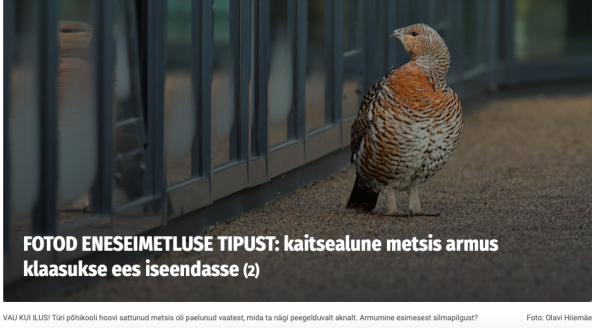
I remembered that photograph when I was going through the results of our study on narcissism at work. In Greek mythology, Narcissus was a beautiful young man known for his exceptional looks and pride. He fell in love with his own reflection in a pool of water and admired himself until he eventually died of longing.
Narcissists today do not die from admiring themselves. Their colleagues, however, may suffer quite seriously because of them at work.
What Is Narcissism at Work?
Most people have some narcissistic traits, and that is normal. Healthy self-confidence, ambition and a desire to stand out can all be useful qualities in working life. The problem begins when self-confidence turns into belittling others, empathy disappears, and the expectation of special treatment becomes part of everyday behaviour.
Narcissistic behaviour at work involves excessive and unjustified self-centredness, selfishness, vanity and a lack of empathy, behaviour that makes collaboration difficult and can create a toxic working environment.
What Does Our Research Show?
In our study (n = 677), we asked employees to evaluate their own behaviour at work. The results gave us something to think about. Narcissistic attitudes were by no means rare.
That is roughly one in eight employees.
A Surprising Finding: Does Narcissism Affect Work Performance or Perhaps Just a Little?
In our study, there was no statistically significant relationship between narcissistic workplace behaviour and work performance. At first glance, that seems surprising. But the result needs some interpretation.
I recently read Walter Isaacson’s biography of Steve Jobs. Think about Jobs for a moment. Narcissistic characteristics - a grandiose self-image, belittling others and expecting special treatment - have been associated with him. Yet his individual performance was undeniably exceptional. At the same time, there are narcissistically behaving employees whose performance is much less impressive.
Statistically, these opposing effects may cancel each other out, leaving us with no overall association. But there seems to be one similarity. Both high-performing and less successful narcissistic employees can bring conflict, declining trust and exhaustion to the team. Perhaps we need to look at three different levels.
1. The Individual
The narcissistic employee’s own performance may be high, average or low.
2. The Team
Collaboration tends to suffer. A lack of empathy, belittling others and expecting special treatment make working together more difficult.
3. The Organisation
When one person makes an exceptionally large contribution, an organisation may tolerate their behaviour for some time. In the longer term, however, the damage to the team may outweigh the individual benefit.
Where Is Narcissistic Behaviour More Common?
Fotaki’s research (2014) suggests that narcissistic behaviour may be encountered more frequently in public-sector organisations, healthcare, education and environmental organisations. Interestingly, these are precisely the kinds of settings where collaboration is particularly important and therefore where narcissistic behaviour may cause considerable damage.
Our results for a group of nurses, however, did not fully support this pattern.
Nurses - An Interesting Exception
In our study, the group of nurses (n = 108) differed from the norm group (n = 300) in two respects:
1. they rated their own exceptional qualities more highly;
2. at the same time, they had lower self-esteem.
Psychologically, this is an intriguing combination: “I am exceptional, yet my self-esteem is low.” Nursing requires a high level of competence and commitment, yet something in the working environment may be undermining self-esteem. This finding deserves separate investigation. It is possible that this is one of the mechanisms that may contribute to burnout.
When Does a Narcissistic Colleague Become a Toxic Star?
Some time ago, I wrote a post called “The Toxic Star.” The question was simple: Is outstanding performance worth tolerating terrible behaviour? The same question arises again with a narcissistic colleague.
What Does This Mean for a Manager?
A narcissistic employee presents one of the more difficult situations for a manager - precisely because their work results may be good. They can be difficult to evaluate, difficult to criticise and difficult to dismiss. But the price may be paid by the team. Quietly. Gradually. Often almost invisibly. A narcissistic colleague is not necessarily a poor performer. But they are very likely to be a difficult colleague. And sometimes the cost to the team may be greater than the value of their individual contribution.
That is how a narcissistic employee can become a toxic star - someone whose results are good, but whose impact on the team is harmful.
Something to Think About
Narcissism is easy to notice in other people. It is much harder to recognise in ourselves. Most of us occasionally feel that our contribution is not appreciated enough, that our opinion is the right one, or that perhaps we deserve better treatment than others. The question is not whether we have narcissistic traits. The question is whether those traits allow us to work well with others or begin to get in the way of collaboration.
Keywords: narcissism at work, narcissistic colleague, occupational psychology, toxic star, teamwork, leadership, organisational health, work performance
I remembered that photograph when I was going through the results of our study on narcissism at work. In Greek mythology, Narcissus was a beautiful young man known for his exceptional looks and pride. He fell in love with his own reflection in a pool of water and admired himself until he eventually died of longing.
Narcissists today do not die from admiring themselves. Their colleagues, however, may suffer quite seriously because of them at work.
What Is Narcissism at Work?
Most people have some narcissistic traits, and that is normal. Healthy self-confidence, ambition and a desire to stand out can all be useful qualities in working life. The problem begins when self-confidence turns into belittling others, empathy disappears, and the expectation of special treatment becomes part of everyday behaviour.
Narcissistic behaviour at work involves excessive and unjustified self-centredness, selfishness, vanity and a lack of empathy, behaviour that makes collaboration difficult and can create a toxic working environment.
What Does Our Research Show?
In our study (n = 677), we asked employees to evaluate their own behaviour at work. The results gave us something to think about. Narcissistic attitudes were by no means rare.
- “I am much better than my colleagues.” - 28.1% agreed.
- “I do my job considerably better than others.” - 36.6%.
- “I deserve special treatment.” - 28.2%.
- “Because I am a good professional, I should be treated better than others.” - 12.6%.
- “I dream of success and power at work.” - 53.7%.
That is roughly one in eight employees.
A Surprising Finding: Does Narcissism Affect Work Performance or Perhaps Just a Little?
In our study, there was no statistically significant relationship between narcissistic workplace behaviour and work performance. At first glance, that seems surprising. But the result needs some interpretation.
I recently read Walter Isaacson’s biography of Steve Jobs. Think about Jobs for a moment. Narcissistic characteristics - a grandiose self-image, belittling others and expecting special treatment - have been associated with him. Yet his individual performance was undeniably exceptional. At the same time, there are narcissistically behaving employees whose performance is much less impressive.
Statistically, these opposing effects may cancel each other out, leaving us with no overall association. But there seems to be one similarity. Both high-performing and less successful narcissistic employees can bring conflict, declining trust and exhaustion to the team. Perhaps we need to look at three different levels.
1. The Individual
The narcissistic employee’s own performance may be high, average or low.
2. The Team
Collaboration tends to suffer. A lack of empathy, belittling others and expecting special treatment make working together more difficult.
3. The Organisation
When one person makes an exceptionally large contribution, an organisation may tolerate their behaviour for some time. In the longer term, however, the damage to the team may outweigh the individual benefit.
Where Is Narcissistic Behaviour More Common?
Fotaki’s research (2014) suggests that narcissistic behaviour may be encountered more frequently in public-sector organisations, healthcare, education and environmental organisations. Interestingly, these are precisely the kinds of settings where collaboration is particularly important and therefore where narcissistic behaviour may cause considerable damage.
Our results for a group of nurses, however, did not fully support this pattern.
Nurses - An Interesting Exception
In our study, the group of nurses (n = 108) differed from the norm group (n = 300) in two respects:
1. they rated their own exceptional qualities more highly;
2. at the same time, they had lower self-esteem.
Psychologically, this is an intriguing combination: “I am exceptional, yet my self-esteem is low.” Nursing requires a high level of competence and commitment, yet something in the working environment may be undermining self-esteem. This finding deserves separate investigation. It is possible that this is one of the mechanisms that may contribute to burnout.
When Does a Narcissistic Colleague Become a Toxic Star?
Some time ago, I wrote a post called “The Toxic Star.” The question was simple: Is outstanding performance worth tolerating terrible behaviour? The same question arises again with a narcissistic colleague.
What Does This Mean for a Manager?
A narcissistic employee presents one of the more difficult situations for a manager - precisely because their work results may be good. They can be difficult to evaluate, difficult to criticise and difficult to dismiss. But the price may be paid by the team. Quietly. Gradually. Often almost invisibly. A narcissistic colleague is not necessarily a poor performer. But they are very likely to be a difficult colleague. And sometimes the cost to the team may be greater than the value of their individual contribution.
That is how a narcissistic employee can become a toxic star - someone whose results are good, but whose impact on the team is harmful.
Something to Think About
Narcissism is easy to notice in other people. It is much harder to recognise in ourselves. Most of us occasionally feel that our contribution is not appreciated enough, that our opinion is the right one, or that perhaps we deserve better treatment than others. The question is not whether we have narcissistic traits. The question is whether those traits allow us to work well with others or begin to get in the way of collaboration.
Keywords: narcissism at work, narcissistic colleague, occupational psychology, toxic star, teamwork, leadership, organisational health, work performance
26.08.2026
 Perhaps We Should Stop Worrying!
I am writing this post just before an important presentation. Today, I have to present the results of a study to the management team of a large international company. And I have to admit: I am worried. That made me wonder. How often do people actually worry? Fortunately, I did not have to guess. I had the data.
Do People Worry?
Yes. Most people do. Our studies show that worrying about work is very common and it does not seem to depend very much on occupation.
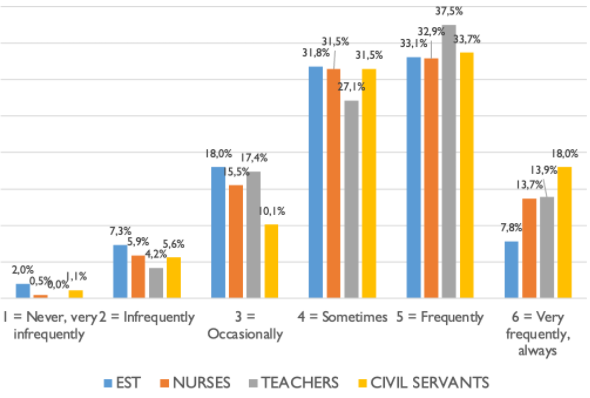
The proportion who say they often or always worry about work is:
Figure. I worry about work
In addition, 31.8% of Estonian employees said that they worry about work at least sometimes. In other words, more than half of teachers and office employees worry about work often or always. That is a lot.
The Paradox of Worrying
This brings us to an interesting paradox. Worrying is a rather deceptive phenomenon. It feels like an activity. As though we were doing something about the problem. As though we were looking for a solution. We think. We analyse. We consider different possibilities.
But are we actually getting any closer to solving the problem? Not necessarily. Worrying and problem-solving are not the same thing.
What Does Our Research Show?
Our studies show that worrying is strongly associated with negative emotions. The correlation is as high as r = 0.69. Put simply: the more people worry, the more negative emotions they experience. That is not particularly surprising.
The next finding is more interesting. Worrying has a weak negative association with work performance: r = -0.11. This means that worrying more is not associated with better performance. If anything, the relationship goes in the opposite direction.
The more people keep turning problems over and over in their minds, the less likely it is that doing so will improve their work performance.
What About Elsewhere?
Gallup's 2024 data show a remarkably similar picture among employees in the United States: 40% experienced worry related to work.
Why Doesn't Worrying Help?
Perhaps because worrying consumes energy that could otherwise be used for action. Worrying creates the feeling that we are dealing with the problem. In reality, we may simply be repeating the same thoughts again and again. The problem remains. The solution gets no closer. Only our emotional state gets worse.
So What Can We Do?
nstead of getting trapped in worried thoughts, it may help to ask yourself one simple question: Can I do anything to solve this problem?
If the answer is YES, then act. Even one small step towards a solution is more useful than an hour spent worrying.
If the answer is NO, worrying will not help either. In that case, it may be useful to create some mental distance from the problem. Do not carry work into the evening. Do not take work problems to bed with you. Do not allow them to occupy all your attention.
That sounds easier than it actually is. But with practice, it is possible.
Not Exactly a New Discovery
Interestingly, Dale Carnegie wrote about much the same problem back in 1948 in his book How to Stop Worrying and Start Living. The book has also been translated into Estonian.
More than 75 years later, our research shows a rather similar picture. Worrying does not make us happier. And it probably does not make us more productive either.
Finally
As I finish writing this post, my presentation is still ahead of me. And, to be quite honest, I am still a little worried. But now I am asking myself the same question I recommend to others: Can I do anything to solve this problem? The answer is simple. Yes. I can prepare as well as I possibly can. There is nothing more I can do. The rest is no longer a question of worrying. It is a question of acting. And perhaps that is the most important difference of all.
Keywords: worrying, work-related worry, negative emotions, work performance, problem-solving, occupational stress, mental well-being, occupational psychology, coping, work-life boundaries
Do People Worry?
Yes. Most people do. Our studies show that worrying about work is very common and it does not seem to depend very much on occupation.
The proportion who say they often or always worry about work is:
- 40.9% of Estonian employees on average;
- 46.6% of nurses;
- 51.4% of teachers;
- 51.7% of office employees.
Figure. I worry about work
In addition, 31.8% of Estonian employees said that they worry about work at least sometimes. In other words, more than half of teachers and office employees worry about work often or always. That is a lot.
The Paradox of Worrying
This brings us to an interesting paradox. Worrying is a rather deceptive phenomenon. It feels like an activity. As though we were doing something about the problem. As though we were looking for a solution. We think. We analyse. We consider different possibilities.
But are we actually getting any closer to solving the problem? Not necessarily. Worrying and problem-solving are not the same thing.
What Does Our Research Show?
Our studies show that worrying is strongly associated with negative emotions. The correlation is as high as r = 0.69. Put simply: the more people worry, the more negative emotions they experience. That is not particularly surprising.
The next finding is more interesting. Worrying has a weak negative association with work performance: r = -0.11. This means that worrying more is not associated with better performance. If anything, the relationship goes in the opposite direction.
The more people keep turning problems over and over in their minds, the less likely it is that doing so will improve their work performance.
What About Elsewhere?
Gallup's 2024 data show a remarkably similar picture among employees in the United States: 40% experienced worry related to work.
Why Doesn't Worrying Help?
Perhaps because worrying consumes energy that could otherwise be used for action. Worrying creates the feeling that we are dealing with the problem. In reality, we may simply be repeating the same thoughts again and again. The problem remains. The solution gets no closer. Only our emotional state gets worse.
So What Can We Do?
nstead of getting trapped in worried thoughts, it may help to ask yourself one simple question: Can I do anything to solve this problem?
If the answer is YES, then act. Even one small step towards a solution is more useful than an hour spent worrying.
If the answer is NO, worrying will not help either. In that case, it may be useful to create some mental distance from the problem. Do not carry work into the evening. Do not take work problems to bed with you. Do not allow them to occupy all your attention.
That sounds easier than it actually is. But with practice, it is possible.
Not Exactly a New Discovery
Interestingly, Dale Carnegie wrote about much the same problem back in 1948 in his book How to Stop Worrying and Start Living. The book has also been translated into Estonian.
More than 75 years later, our research shows a rather similar picture. Worrying does not make us happier. And it probably does not make us more productive either.
Finally
As I finish writing this post, my presentation is still ahead of me. And, to be quite honest, I am still a little worried. But now I am asking myself the same question I recommend to others: Can I do anything to solve this problem? The answer is simple. Yes. I can prepare as well as I possibly can. There is nothing more I can do. The rest is no longer a question of worrying. It is a question of acting. And perhaps that is the most important difference of all.
Keywords: worrying, work-related worry, negative emotions, work performance, problem-solving, occupational stress, mental well-being, occupational psychology, coping, work-life boundaries
23.08.2026
 Locus of Control Is Not Fate or Bad Luck - You Can Change It
Many years ago, I participated in an international study comparing managers from 24 countries. While analysing the results, I noticed something that stayed with me for decades.
Managers from Eastern Europe differed from managers in Western Europe and the United States not only in terms of stress or job satisfaction. They also differed in how they perceived control over their lives and work. In psychology, this phenomenon is known as locus of control.
Simply put, locus of control refers to whether people believe that life events are mainly influenced by their own actions and decisions, or by fate, luck, systems, or other people.
Professor Paul Spector defines work locus of control as employees' tendency to believe that events in their working lives are controlled either by themselves (internal locus of control) or by external forces such as influential people, chance, fate or organisational systems.
Me or Forces Outside Our Control?
Imagine two people facing exactly the same situation. Both lose their jobs. One thinks: "Well, fate and bad luck decided this for me." The other thinks: "This is a bad situation, but what can I do now?"
Locus of control does not determine the situation itself. What it influences is how we respond. Do we become passive? Or do we start acting?
People with a strong internal locus of control usually believe:
But they do believe that what they do makes a difference.
People with a more external locus of control are more likely to believe that important decisions are made somewhere else. Fate. Luck. The system. Other people. This does not mean that they are weaker or less intelligent. It simply means that they believe external forces play a larger role in determining what happens to them.
Research consistently shows that a more external locus of control is associated with:
Are We Measuring Personality or History?
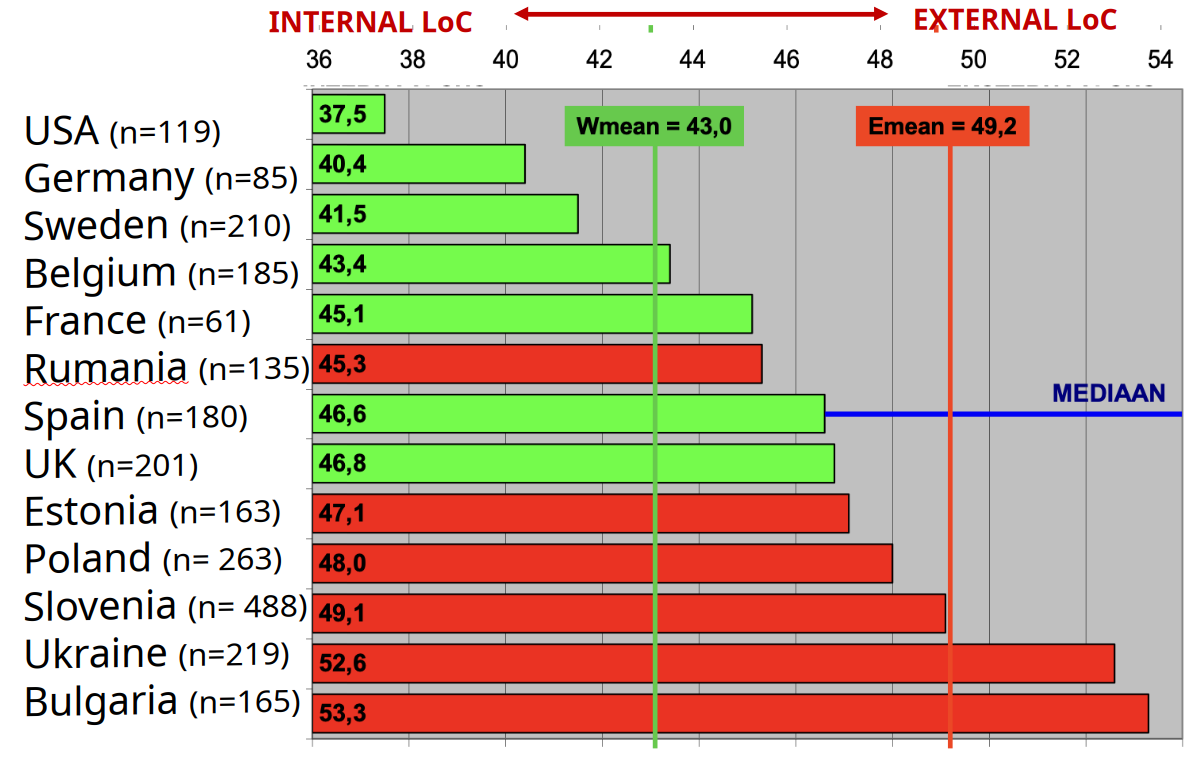
When we compared managers from different countries, a clear pattern emerged. Managers in the United States, Germany, Sweden and Belgium showed a considerably stronger internal locus of control. Estonian managers were positioned somewhere between Eastern and Western Europe.
Figure. Managers’ Locus of Control
Managers in Ukraine and Bulgaria showed the strongest tendency towards an external locus of control. This led me to an intriguing question: Are we measuring personality – or history? In Soviet society, people were not accustomed to feeling that they controlled what happened around them.
Important decisions were often made elsewhere. The system decided. The state decided. Not the individual. Experiences like this may shape the mindset of entire generations.
The Good News: Locus of Control Can Change
The topic continued to fascinate me. And later studies in Estonia produced surprising findings. Locus of control does not appear to be fixed or permanent.
A recent study among managers found that their average internal locus of control was stronger than both the Estonian norm group and the managers who participated in our earlier international study.
When we compared managers with teachers, auditors, accountants and nurses, managers showed a significantly stronger tendency towards an internal locus of control. This was not surprising.
People who carry greater responsibility and whose work requires more independence also tend to believe more strongly that their actions matter.
But another finding was even more interesting. Compared with data collected twenty years ago, Estonia as a whole appears to have moved gradually towards a more internal locus of control. Not dramatically. But noticeably. People today are more likely to believe that: Their actions matter. They have influence. They have more control over their lives and work environment than before.
Why Does This Matter?
Because an internal locus of control is not only related to success. It is also related to well-being. Over the years, I have observed a remarkably consistent pattern.
People who feel that they can influence their lives usually cope better with:
Can We Develop an Internal Locus of Control?
I believe we can. Not through slogans. Not through positive thinking. But through experience.
When people repeatedly experience that:
People sometimes say: "You make your own luck." As a psychologist, I would put it slightly differently. Not everything depends on us. But much more depends on us than we often think.
The more I have studied locus of control, the less I believe in fate – and the more I believe in learning, experience and people's ability to influence their own lives.
A Thought for All of Us
How strongly do you believe that you can influence your own life? If you do not immediately know the answer, listen carefully to yourself when talking about your successes. What do you usually say?
"I was lucky." If that is your first reaction, you may lean somewhat towards an external locus of control. Then ask yourself one more question: Where was I and what was I doing when luck found me? More often than not, you will discover that you were doing exactly those things that eventually led to a good outcome.
Keywords: locus of control, work locus of control, internal locus of control, adaptability, stress, well-being, leadership, organisational psychology
Managers from Eastern Europe differed from managers in Western Europe and the United States not only in terms of stress or job satisfaction. They also differed in how they perceived control over their lives and work. In psychology, this phenomenon is known as locus of control.
Simply put, locus of control refers to whether people believe that life events are mainly influenced by their own actions and decisions, or by fate, luck, systems, or other people.
Professor Paul Spector defines work locus of control as employees' tendency to believe that events in their working lives are controlled either by themselves (internal locus of control) or by external forces such as influential people, chance, fate or organisational systems.
Me or Forces Outside Our Control?
Imagine two people facing exactly the same situation. Both lose their jobs. One thinks: "Well, fate and bad luck decided this for me." The other thinks: "This is a bad situation, but what can I do now?"
Locus of control does not determine the situation itself. What it influences is how we respond. Do we become passive? Or do we start acting?
People with a strong internal locus of control usually believe:
- my actions influence outcomes;
- success depends largely on my efforts;
- my decisions matter.
But they do believe that what they do makes a difference.
People with a more external locus of control are more likely to believe that important decisions are made somewhere else. Fate. Luck. The system. Other people. This does not mean that they are weaker or less intelligent. It simply means that they believe external forces play a larger role in determining what happens to them.
Research consistently shows that a more external locus of control is associated with:
- higher stress levels;
- lower adaptability;
- lower self-esteem;
- greater passivity.
Are We Measuring Personality or History?
When we compared managers from different countries, a clear pattern emerged. Managers in the United States, Germany, Sweden and Belgium showed a considerably stronger internal locus of control. Estonian managers were positioned somewhere between Eastern and Western Europe.
Figure. Managers’ Locus of Control
Managers in Ukraine and Bulgaria showed the strongest tendency towards an external locus of control. This led me to an intriguing question: Are we measuring personality – or history? In Soviet society, people were not accustomed to feeling that they controlled what happened around them.
Important decisions were often made elsewhere. The system decided. The state decided. Not the individual. Experiences like this may shape the mindset of entire generations.
The Good News: Locus of Control Can Change
The topic continued to fascinate me. And later studies in Estonia produced surprising findings. Locus of control does not appear to be fixed or permanent.
A recent study among managers found that their average internal locus of control was stronger than both the Estonian norm group and the managers who participated in our earlier international study.
When we compared managers with teachers, auditors, accountants and nurses, managers showed a significantly stronger tendency towards an internal locus of control. This was not surprising.
People who carry greater responsibility and whose work requires more independence also tend to believe more strongly that their actions matter.
But another finding was even more interesting. Compared with data collected twenty years ago, Estonia as a whole appears to have moved gradually towards a more internal locus of control. Not dramatically. But noticeably. People today are more likely to believe that: Their actions matter. They have influence. They have more control over their lives and work environment than before.
Why Does This Matter?
Because an internal locus of control is not only related to success. It is also related to well-being. Over the years, I have observed a remarkably consistent pattern.
People who feel that they can influence their lives usually cope better with:
- change;
- stress;
- uncertainty;
- setbacks.
Can We Develop an Internal Locus of Control?
I believe we can. Not through slogans. Not through positive thinking. But through experience.
When people repeatedly experience that:
- their decisions have consequences;
- their actions produce results;
- their efforts change something.
People sometimes say: "You make your own luck." As a psychologist, I would put it slightly differently. Not everything depends on us. But much more depends on us than we often think.
The more I have studied locus of control, the less I believe in fate – and the more I believe in learning, experience and people's ability to influence their own lives.
A Thought for All of Us
How strongly do you believe that you can influence your own life? If you do not immediately know the answer, listen carefully to yourself when talking about your successes. What do you usually say?
"I was lucky." If that is your first reaction, you may lean somewhat towards an external locus of control. Then ask yourself one more question: Where was I and what was I doing when luck found me? More often than not, you will discover that you were doing exactly those things that eventually led to a good outcome.
Keywords: locus of control, work locus of control, internal locus of control, adaptability, stress, well-being, leadership, organisational psychology
19.08.2026
 Do We Really Like Learning?
Some time ago, I presented the results of an employee working-life survey to the managers of the Estonian branch of an international corporation.
During the discussion, we came to the topic of employees’ sleep problems. The results showed that employees were concerned about the quality of their sleep. Sleep problems were also associated with both work performance (r = -0.35) and work motivation (r = -0.34). The more sleep problems employees reported, the lower they rated their work performance and motivation.
The managers were not surprised.
Someone made the very reasonable point that a manager cannot go home with an employee and tuck them into bed. And he was right. Sleep is primarily the employee’s own responsibility. At the same time, an employee’s sleep problem can quickly become an organisational problem. A manager is responsible for work results, and when an employee sleeps poorly and is constantly tired, this inevitably affects more than motivation and performance. In our data, sleep problems were also associated with work ability (r = -0.62), health (r = -0.34), and occupational stress (r = -0.46). Then another question came up.
Why Don’t Employees Attend Training?
The organisation had invited a recognised specialist to give a lecture on sleep problems. Every employee was welcome to attend. Only a handful turned up.
The same survey revealed something interesting. When production workers and office employees were analysed separately, sleep problems were not a significant issue among production workers. The problem was mainly found among managers and office employees.
In other words, the training was offered to everyone, but the people who would probably have benefited from it most were precisely those who had the least time to attend.
That made me wonder. Do we actually like learning? My short answer is: not really. Learning requires effort.
But this immediately raises another question. Do we like the result of learning? Here the answer is probably: yes, we do.
And that is where an interesting paradox begins.
If we look at the statistics, we might conclude that Estonians love learning. PE Konsult studies conducted between 2018 and 2025 (n > 4,000) show that 62% of employees say their work often allows them to learn something new, and 62% are satisfied with their opportunities for development and career progression.
According to the 2024 European Labour Force Survey, more than half of Estonian adults had participated in training during the previous 12 months. This places Estonia, together with the Nordic countries, among the European leaders.
Looking only at the numbers, the conclusion seems obvious: Estonians like learning.
How Much Can We Learn Through Our Work?
Figure. My work allows me to learn something new
My own experience, however, tells a somewhat different story.
I have spent decades training employees and managers, teaching university students, and talking with HR professionals. And quite often I hear something very different:
Perhaps People Don’t Like Learning. Perhaps They Like Knowing How. These are not quite the same thing. Learning often means uncertainty, mistakes, practice, effort, and changing old habits. Knowing how means confidence, competence, a sense of control, and success. Naturally, the second is more appealing.
I have repeatedly noticed the same phenomenon at university. Suppose we are learning strategies for resolving conflicts. The students understand everything during the lecture. We discuss. We analyse. We agree. Then I give them a case involving an everyday workplace conflict that a manager might have to resolve. Quite often, I get answers that make it seem as though we had never just studied conflict resolution at all.
Why? Did the students fail to learn? Probably not. But the knowledge had not yet become a skill.
Knowing Something and Acting on It Are Not the Same Thing
Almost everyone knows that physical activity is good for health, smoking is harmful, stress needs to be managed, sufficient sleep is important, and we should listen to other people. But knowing something does not mean that we behave accordingly.
Sometimes I get the impression that something very similar happens to the knowledge acquired in training. It is placed on a shelf. Neatly. Systematically. Safely. And then everyday life continues exactly as before. The knowledge is there. But it never makes it into practice.
That is why, over the years, I have come to think that the biggest problem with training is not necessarily a lack of knowledge. The problem is applying that knowledge. Training can provide knowledge. Skill and results emerge only when that knowledge is put into practice.
Perhaps We Are Asking the Wrong Question
Perhaps we should not ask: Do people like learning? Perhaps the real question is: Do people like changing? Because genuine learning almost always involves change. And change requires effort. At the same time, research tells us something important. Employees value workplaces where they can develop, learn, and use their abilities. They want to be competent. They want to develop. They want to know how.
The greater the effort required for learning, the less likely people may be to undertake it voluntarily. But people very much like being someone who knows how.
Something to Think About
If you were offered training tomorrow on something that could improve your health, work ability, or work performance, would you attend? And if not, why not?
Keywords: learning, professional development, lifelong learning, sleep problems, work ability, work motivation, application of knowledge, psychology, working life, development
During the discussion, we came to the topic of employees’ sleep problems. The results showed that employees were concerned about the quality of their sleep. Sleep problems were also associated with both work performance (r = -0.35) and work motivation (r = -0.34). The more sleep problems employees reported, the lower they rated their work performance and motivation.
The managers were not surprised.
Someone made the very reasonable point that a manager cannot go home with an employee and tuck them into bed. And he was right. Sleep is primarily the employee’s own responsibility. At the same time, an employee’s sleep problem can quickly become an organisational problem. A manager is responsible for work results, and when an employee sleeps poorly and is constantly tired, this inevitably affects more than motivation and performance. In our data, sleep problems were also associated with work ability (r = -0.62), health (r = -0.34), and occupational stress (r = -0.46). Then another question came up.
Why Don’t Employees Attend Training?
The organisation had invited a recognised specialist to give a lecture on sleep problems. Every employee was welcome to attend. Only a handful turned up.
The same survey revealed something interesting. When production workers and office employees were analysed separately, sleep problems were not a significant issue among production workers. The problem was mainly found among managers and office employees.
In other words, the training was offered to everyone, but the people who would probably have benefited from it most were precisely those who had the least time to attend.
That made me wonder. Do we actually like learning? My short answer is: not really. Learning requires effort.
But this immediately raises another question. Do we like the result of learning? Here the answer is probably: yes, we do.
And that is where an interesting paradox begins.
If we look at the statistics, we might conclude that Estonians love learning. PE Konsult studies conducted between 2018 and 2025 (n > 4,000) show that 62% of employees say their work often allows them to learn something new, and 62% are satisfied with their opportunities for development and career progression.
According to the 2024 European Labour Force Survey, more than half of Estonian adults had participated in training during the previous 12 months. This places Estonia, together with the Nordic countries, among the European leaders.
Looking only at the numbers, the conclusion seems obvious: Estonians like learning.
How Much Can We Learn Through Our Work?
Period |
Sample (n) |
Work allows me to learn something new |
| 2018-2019 | 1203 | 48,3% |
| 2020-2021 | 1299 | 59,1% |
| 2022-2023 | 550 | 62% |
| 2024-2025 | 1143 | 53,4% |
Figure. My work allows me to learn something new
My own experience, however, tells a somewhat different story.
I have spent decades training employees and managers, teaching university students, and talking with HR professionals. And quite often I hear something very different:
- “I don’t have time for training.”
- “Will this actually be useful?”
- “Just tell me what I need to do.”
- “Give me the solution.”
Perhaps People Don’t Like Learning. Perhaps They Like Knowing How. These are not quite the same thing. Learning often means uncertainty, mistakes, practice, effort, and changing old habits. Knowing how means confidence, competence, a sense of control, and success. Naturally, the second is more appealing.
I have repeatedly noticed the same phenomenon at university. Suppose we are learning strategies for resolving conflicts. The students understand everything during the lecture. We discuss. We analyse. We agree. Then I give them a case involving an everyday workplace conflict that a manager might have to resolve. Quite often, I get answers that make it seem as though we had never just studied conflict resolution at all.
Why? Did the students fail to learn? Probably not. But the knowledge had not yet become a skill.
Knowing Something and Acting on It Are Not the Same Thing
Almost everyone knows that physical activity is good for health, smoking is harmful, stress needs to be managed, sufficient sleep is important, and we should listen to other people. But knowing something does not mean that we behave accordingly.
Sometimes I get the impression that something very similar happens to the knowledge acquired in training. It is placed on a shelf. Neatly. Systematically. Safely. And then everyday life continues exactly as before. The knowledge is there. But it never makes it into practice.
That is why, over the years, I have come to think that the biggest problem with training is not necessarily a lack of knowledge. The problem is applying that knowledge. Training can provide knowledge. Skill and results emerge only when that knowledge is put into practice.
Perhaps We Are Asking the Wrong Question
Perhaps we should not ask: Do people like learning? Perhaps the real question is: Do people like changing? Because genuine learning almost always involves change. And change requires effort. At the same time, research tells us something important. Employees value workplaces where they can develop, learn, and use their abilities. They want to be competent. They want to develop. They want to know how.
The greater the effort required for learning, the less likely people may be to undertake it voluntarily. But people very much like being someone who knows how.
Something to Think About
If you were offered training tomorrow on something that could improve your health, work ability, or work performance, would you attend? And if not, why not?
Keywords: learning, professional development, lifelong learning, sleep problems, work ability, work motivation, application of knowledge, psychology, working life, development
16.08.2026
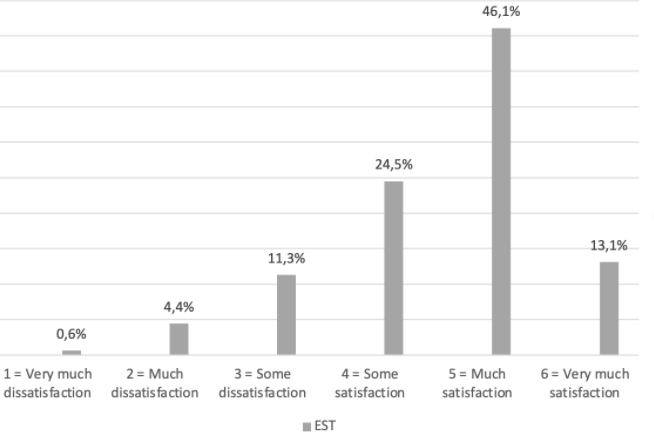 Quality of Working Life
Ask people what makes working life good, and the answers will vary. For some, salary matters most. For others, relationships with colleagues. For someone else, it is having interesting and meaningful work.
In occupational psychology, the combination of such factors is referred to as quality of working life (QWL).
What Is Quality of Working Life?
Quality of working life is not a single number or a single question. It is a broader concept that includes relationships at work, the content of the job, work pace, salary, the working environment, and many other factors.
Researchers have studied quality of working life since the 1970s. Walton’s classic model (1973) and Hackman and Oldham’s Job Characteristics Theory (1976) provided foundations on which newer models of working life continue to build. The concept is still evolving.
Yet the fundamental question remains the same:
What makes working life good?
How Do Estonian Employees Evaluate Their Quality of Working Life?
Figure. Quality of Working Life in Estonia
We examined how Estonian employees evaluate different aspects of their working life.
Overall, Estonian employees evaluate their quality of working life relatively positively. 55.7% are satisfied with their quality of working life. More than half are satisfied with their work, their work environment and occupational safety, and their relationships at work.
The lowest levels of satisfaction concern salary and work pace.
Why Does This Matter to an Organisation?
Quality of working life is sometimes regarded as a “soft” issue, it is something that matters to employees but has little to do with organisational performance.
Our results tell a different story.
Based on data from 677 employees, the correlation between quality of working life and self-rated work performance was r = 0.60. In other words, the better employees rated their quality of working life, the higher they also rated their work performance. Conversely, employees who evaluated their quality of working life more negatively also tended to rate their work performance lower.
Work performance was most strongly associated with job satisfaction (r = 0.69) and the work itself (r = 0.65).
In other words, people report better work performance when they are satisfied with their jobs and have a positive view of the work they actually do.
And What Was Least Strongly Associated With Performance?
One result may seem surprising. Of all the factors examined, salary had the weakest association with work performance (r = 0.44).
This does not mean that salary is unimportant. It does suggest, however, that simply increasing pay may not automatically improve work performance.
What Does This Mean?
A systematic review by Liang et al. (2026) concluded that quality of working life is a process rather than a state - a way of aligning efforts to improve working conditions with organisational performance goals.
Our data point in the same direction.
Quality of working life is not simply a reward employees receive for doing good work. It can also be viewed as an organisational investment in performance.
When organisations want to improve performance, they often focus on skills, technology, or work processes.
Perhaps quality of working life is not only a question of employee well-being.
Perhaps it is one of the foundations of organisational performance.
Something to Think About
How would you rate the quality of your own working life?
Keywords: quality of working life, QWL, job satisfaction, work performance, occupational psychology, work environment, work pace, salary, workplace relationships, meaning of work, organisational health, employee well-being, management
In occupational psychology, the combination of such factors is referred to as quality of working life (QWL).
What Is Quality of Working Life?
Quality of working life is not a single number or a single question. It is a broader concept that includes relationships at work, the content of the job, work pace, salary, the working environment, and many other factors.
Researchers have studied quality of working life since the 1970s. Walton’s classic model (1973) and Hackman and Oldham’s Job Characteristics Theory (1976) provided foundations on which newer models of working life continue to build. The concept is still evolving.
Yet the fundamental question remains the same:
What makes working life good?
How Do Estonian Employees Evaluate Their Quality of Working Life?
Figure. Quality of Working Life in Estonia
We examined how Estonian employees evaluate different aspects of their working life.
| Variable | Responses „+“ ja „++“ |
| Work itself | 65,1% |
| Well-being at work | 64,9% |
| Relationships at work | 64,4% |
| Job satisfaction | 60,4% |
| Work environment and occupational safety |
57,9% |
| Quality of working life | 55,7% |
| Job demands | 51,1% |
| Work pace | 43,9% |
| Salary | 39,1% |
Overall, Estonian employees evaluate their quality of working life relatively positively. 55.7% are satisfied with their quality of working life. More than half are satisfied with their work, their work environment and occupational safety, and their relationships at work.
The lowest levels of satisfaction concern salary and work pace.
Why Does This Matter to an Organisation?
Quality of working life is sometimes regarded as a “soft” issue, it is something that matters to employees but has little to do with organisational performance.
Our results tell a different story.
Based on data from 677 employees, the correlation between quality of working life and self-rated work performance was r = 0.60. In other words, the better employees rated their quality of working life, the higher they also rated their work performance. Conversely, employees who evaluated their quality of working life more negatively also tended to rate their work performance lower.
| Variable | Work performance (r; p < 0.05) |
| Job satisfaction | 0,69 |
| Work itself | 0,65 |
| Well-being at work | 0,61 |
| Quality of working life | 0,60 |
| Work environment and occupational safety |
0,58 |
| Work pace | 0,55 |
| Relationships at work | 0,52 |
| Job demands | 0,45 |
| Salary | 0,44 |
Work performance was most strongly associated with job satisfaction (r = 0.69) and the work itself (r = 0.65).
In other words, people report better work performance when they are satisfied with their jobs and have a positive view of the work they actually do.
And What Was Least Strongly Associated With Performance?
One result may seem surprising. Of all the factors examined, salary had the weakest association with work performance (r = 0.44).
This does not mean that salary is unimportant. It does suggest, however, that simply increasing pay may not automatically improve work performance.
What Does This Mean?
A systematic review by Liang et al. (2026) concluded that quality of working life is a process rather than a state - a way of aligning efforts to improve working conditions with organisational performance goals.
Our data point in the same direction.
Quality of working life is not simply a reward employees receive for doing good work. It can also be viewed as an organisational investment in performance.
When organisations want to improve performance, they often focus on skills, technology, or work processes.
Perhaps quality of working life is not only a question of employee well-being.
Perhaps it is one of the foundations of organisational performance.
Something to Think About
How would you rate the quality of your own working life?
Keywords: quality of working life, QWL, job satisfaction, work performance, occupational psychology, work environment, work pace, salary, workplace relationships, meaning of work, organisational health, employee well-being, management
12.08.2026
 Is AI Really as Smart as It Seems?
A few weeks ago, I asked AI a question about stress, a subject I know quite well. The answer was quick. Fluent. Confident. And partly wrong. If I had not known the field, I probably would have believed it.
If I had asked the same question of a psychologist colleague, I would probably have noticed that they did not know the exact answer. They might have taken longer to respond, hesitated, or revealed their uncertainty through body language. That made me wonder: Is AI really as smart as it seems?
Ask people what makes artificial intelligence special, and the answers are often similar. AI knows. AI thinks. AI is intelligent. AI is smart.
If something walks like a duck and quacks like a duck, we tend to assume it is a duck. But does the same logic apply to artificial intelligence? It knows, it thinks, it is intelligent—therefore, it must be smart. It certainly sounds impressive.
But as a psychologist, I found myself thinking about a different question: Is AI actually as smart as it seems? There is no simple answer.
First, we need to agree on what we mean by smart.
Does AI think?
In everyday language, people often say that AI thinks. A more careful formulation would be that AI processes information and generates responses based on statistical patterns—on a very large scale and at very high speed.
Is AI intelligent?
Intelligence is a concept developed to describe humans. Scientists still debate what intelligence actually means and how it should be measured.
We do not normally describe an iron, a vacuum cleaner, or a food processor as intelligent. Comparing AI intelligence with human intelligence may therefore be a little like comparing a horse with poetry. Comparisons are useful when the things being compared have at least some meaningful relationship to one another. A horse and poetry are simply too different; comparing them tells us very little.
But is AI smart?
Here things become even more complicated.
Wisdom usually involves knowledge, skills, experience, values, ethics, judgement, and practical understanding of life. These are all qualities that are difficult to attribute to a machine. Is an iron smart? Is a vacuum cleaner wise? But there is another problem. Even when talking about humans, there is no complete agreement about what it means to be smart or wise.
Imagine two people. The first can recall hundreds of laws, theories, and facts. The second knows how to make the right decision at the right moment in a difficult situation.
Which one would we call smart?
Interestingly, people do not necessarily answer this question in the same way. For some, a smart person is someone who knows how to navigate real life successfully: how to deal with public authorities and bureaucracy, how to be in the right place at the right time, and how to contact the right people when necessary.
For someone else, being smart means possessing a great deal of knowledge.
These may not even be the same people. Yet both are smart in their own way.
Why does AI seem so smart?
One thing that certainly impresses people who use AI is the speed at which it processes information.
Within seconds, AI can work through large amounts of information, identify patterns in data, compare documents, prepare summaries, translate, analyse, and help generate new ideas or computer code.
It is hardly surprising that this creates an impression of extraordinary intelligence.
AI can therefore do many things faster than humans and, in some cases, better. No wonder we interpret this ability as smartness.
But are speed, quantity of information, and skilful wording really the same thing as wisdom?
What happens when AI is convincingly wrong?
What happens if AI gives you a convincing but misleading answer about something important and you believe it?
And then you act on it?
Then the consequences may hurt.
AI does not relieve people of the responsibility to think critically. Ultimately, the human user remains responsible.
And yet AI can be remarkably pleasant to talk to. It listens. It responds quickly. It mirrors our vocabulary and ways of expressing ideas. It does not argue for the sake of its ego. It gives positive feedback.
All of this can make the interaction feel good.
But a pleasant conversational partner is not necessarily a reliable one.
When a person does not know something, they may hesitate. When AI does not know, it may still sound highly confident and convincing.
The problem is not simply that AI can sometimes mislead us. The problem is that AI can present misleading information just as convincingly as it presents the truth. And people tend to interpret confident communication as a sign of competence: surely it knows what it is talking about.
Perhaps, then, it is not so important to ask whether AI is smart.
Humans can be smart in very different ways, so perhaps we should not expect AI’s form of intelligence to resemble our own.
A more important question may be: Are we, as AI users, smart enough to recognise when AI is relying on facts, when it is relying on probabilities and when it is simply creating a convincing impression that it knows?
Keywords: artificial intelligence; AI intelligence; AI-generated information; critical thinking; AI hallucinations; human–AI interaction; trust; wisdom; AI literacyTop of Form
If I had asked the same question of a psychologist colleague, I would probably have noticed that they did not know the exact answer. They might have taken longer to respond, hesitated, or revealed their uncertainty through body language. That made me wonder: Is AI really as smart as it seems?
Ask people what makes artificial intelligence special, and the answers are often similar. AI knows. AI thinks. AI is intelligent. AI is smart.
If something walks like a duck and quacks like a duck, we tend to assume it is a duck. But does the same logic apply to artificial intelligence? It knows, it thinks, it is intelligent—therefore, it must be smart. It certainly sounds impressive.
But as a psychologist, I found myself thinking about a different question: Is AI actually as smart as it seems? There is no simple answer.
First, we need to agree on what we mean by smart.
Does AI think?
In everyday language, people often say that AI thinks. A more careful formulation would be that AI processes information and generates responses based on statistical patterns—on a very large scale and at very high speed.
Is AI intelligent?
Intelligence is a concept developed to describe humans. Scientists still debate what intelligence actually means and how it should be measured.
We do not normally describe an iron, a vacuum cleaner, or a food processor as intelligent. Comparing AI intelligence with human intelligence may therefore be a little like comparing a horse with poetry. Comparisons are useful when the things being compared have at least some meaningful relationship to one another. A horse and poetry are simply too different; comparing them tells us very little.
But is AI smart?
Here things become even more complicated.
Wisdom usually involves knowledge, skills, experience, values, ethics, judgement, and practical understanding of life. These are all qualities that are difficult to attribute to a machine. Is an iron smart? Is a vacuum cleaner wise? But there is another problem. Even when talking about humans, there is no complete agreement about what it means to be smart or wise.
Imagine two people. The first can recall hundreds of laws, theories, and facts. The second knows how to make the right decision at the right moment in a difficult situation.
Which one would we call smart?
Interestingly, people do not necessarily answer this question in the same way. For some, a smart person is someone who knows how to navigate real life successfully: how to deal with public authorities and bureaucracy, how to be in the right place at the right time, and how to contact the right people when necessary.
For someone else, being smart means possessing a great deal of knowledge.
These may not even be the same people. Yet both are smart in their own way.
Why does AI seem so smart?
One thing that certainly impresses people who use AI is the speed at which it processes information.
Within seconds, AI can work through large amounts of information, identify patterns in data, compare documents, prepare summaries, translate, analyse, and help generate new ideas or computer code.
It is hardly surprising that this creates an impression of extraordinary intelligence.
AI can therefore do many things faster than humans and, in some cases, better. No wonder we interpret this ability as smartness.
But are speed, quantity of information, and skilful wording really the same thing as wisdom?
What happens when AI is convincingly wrong?
What happens if AI gives you a convincing but misleading answer about something important and you believe it?
And then you act on it?
Then the consequences may hurt.
AI does not relieve people of the responsibility to think critically. Ultimately, the human user remains responsible.
And yet AI can be remarkably pleasant to talk to. It listens. It responds quickly. It mirrors our vocabulary and ways of expressing ideas. It does not argue for the sake of its ego. It gives positive feedback.
All of this can make the interaction feel good.
But a pleasant conversational partner is not necessarily a reliable one.
When a person does not know something, they may hesitate. When AI does not know, it may still sound highly confident and convincing.
The problem is not simply that AI can sometimes mislead us. The problem is that AI can present misleading information just as convincingly as it presents the truth. And people tend to interpret confident communication as a sign of competence: surely it knows what it is talking about.
Perhaps, then, it is not so important to ask whether AI is smart.
Humans can be smart in very different ways, so perhaps we should not expect AI’s form of intelligence to resemble our own.
A more important question may be: Are we, as AI users, smart enough to recognise when AI is relying on facts, when it is relying on probabilities and when it is simply creating a convincing impression that it knows?
Keywords: artificial intelligence; AI intelligence; AI-generated information; critical thinking; AI hallucinations; human–AI interaction; trust; wisdom; AI literacyTop of Form
9.08.2026
 Mirror, Mirror Inside the Machine
Look at two people sitting in a café having a conversation. They feel comfortable with each other. They trust one another. They are on the same wavelength.
When people enjoy each other's company, something interesting happens. One person leans forward. The other does the same. One rests their chin on their hand. A few minutes later, the other adopts a similar posture. One smiles. The other responds with a remarkably similar smile. None of this is planned. It simply happens.
Mirroring
In psychology, this phenomenon is known as mirroring. Mirroring refers to the tendency of people to unconsciously imitate each other's body language, gestures, tone of voice, conversational rhythm and even word choices during interaction.
This is not mimicry. It is synchrony. A synchrony that creates the feeling that we agree with each other and like each other. Even more importantly, mirroring creates a sense of "we-ness." Instead of "you and me," it creates a feeling of "us." Mirroring is an ancient phenomenon.
Social psychology has long shown that we tend to like people who are similar to ourselves. Mirroring is not limited to everyday conversations. It can also be observed in public life. For example, consider a photograph of Estonian President Alar Karis meeting French President Emmanuel Macron. Both men are sitting in almost identical positions: legs crossed in a similar manner and bodies slightly leaning forward. This is a classic example of dyadic mirroring. Two people in conversation unconsciously adopting synchronised postures.
What makes the example particularly interesting is that the two presidents were meeting for the first time. The mirroring likely emerged during the interaction itself.
The Darker Side of Mirroring
Mirroring is surprisingly easy to imitate deliberately. Psychologically, the effect is largely the same. Imitated mirroring also creates sympathy, trust and a sense of connection. Often without the other person noticing.
This phenomenon is sometimes referred to as the chameleon effect. It can be used very effectively in manipulation, the intentional and conscious influencing of another person. Many politicians have mastered the art of imitative mirroring and use it successfully in their everyday work.
Returning to the photograph of the two presidents, we will probably never know whether it captured genuine mirroring or a chameleon effect. Most likely, even the participants themselves no longer remember that particular moment.
AI Mirrors You. And Of Course It Feels Pleasant
Artificial intelligence does something remarkably similar. But it does so through words. If you write briefly, AI responds more briefly. If you use technical language, AI becomes more technical. If you are emotional, AI adopts a softer tone. If you argue in a certain way, AI gradually adapts to your style of argumentation.
This is verbal mirroring. One part of the broader phenomenon of mirroring.
Psychologically, AI's verbal mirroring works much like mirroring between two people. Body language is missing, of course. Yet the pleasantness of the interaction often compensates for this. The end result may be surprisingly similar. A feeling of closeness emerges. Trust increases. The conversation feels safe.
By mirroring us, AI creates an illusion of similarity. It creates trust, agreement and a sense of "we." At some point, we may even forget that we are interacting with a computer program – a linguistic chatbot based on artificial intelligence and large language models that merely simulates conversation.
AI may not necessarily understand us. It may simply be exceptionally good at mirroring us. Not intentionally. But functionally.
Something to Think About
Perhaps the greatest mystery of conversations with AI is not that AI understands us. Perhaps the real secret is that AI reflects us back to ourselves with remarkable skill.
Keywords: artificial intelligence, AI, mirroring, dyadic interaction, digital communication, psychology of AI
When people enjoy each other's company, something interesting happens. One person leans forward. The other does the same. One rests their chin on their hand. A few minutes later, the other adopts a similar posture. One smiles. The other responds with a remarkably similar smile. None of this is planned. It simply happens.
Mirroring
In psychology, this phenomenon is known as mirroring. Mirroring refers to the tendency of people to unconsciously imitate each other's body language, gestures, tone of voice, conversational rhythm and even word choices during interaction.
This is not mimicry. It is synchrony. A synchrony that creates the feeling that we agree with each other and like each other. Even more importantly, mirroring creates a sense of "we-ness." Instead of "you and me," it creates a feeling of "us." Mirroring is an ancient phenomenon.
Social psychology has long shown that we tend to like people who are similar to ourselves. Mirroring is not limited to everyday conversations. It can also be observed in public life. For example, consider a photograph of Estonian President Alar Karis meeting French President Emmanuel Macron. Both men are sitting in almost identical positions: legs crossed in a similar manner and bodies slightly leaning forward. This is a classic example of dyadic mirroring. Two people in conversation unconsciously adopting synchronised postures.
What makes the example particularly interesting is that the two presidents were meeting for the first time. The mirroring likely emerged during the interaction itself.
The Darker Side of Mirroring
Mirroring is surprisingly easy to imitate deliberately. Psychologically, the effect is largely the same. Imitated mirroring also creates sympathy, trust and a sense of connection. Often without the other person noticing.
This phenomenon is sometimes referred to as the chameleon effect. It can be used very effectively in manipulation, the intentional and conscious influencing of another person. Many politicians have mastered the art of imitative mirroring and use it successfully in their everyday work.
Returning to the photograph of the two presidents, we will probably never know whether it captured genuine mirroring or a chameleon effect. Most likely, even the participants themselves no longer remember that particular moment.
AI Mirrors You. And Of Course It Feels Pleasant
Artificial intelligence does something remarkably similar. But it does so through words. If you write briefly, AI responds more briefly. If you use technical language, AI becomes more technical. If you are emotional, AI adopts a softer tone. If you argue in a certain way, AI gradually adapts to your style of argumentation.
This is verbal mirroring. One part of the broader phenomenon of mirroring.
Psychologically, AI's verbal mirroring works much like mirroring between two people. Body language is missing, of course. Yet the pleasantness of the interaction often compensates for this. The end result may be surprisingly similar. A feeling of closeness emerges. Trust increases. The conversation feels safe.
By mirroring us, AI creates an illusion of similarity. It creates trust, agreement and a sense of "we." At some point, we may even forget that we are interacting with a computer program – a linguistic chatbot based on artificial intelligence and large language models that merely simulates conversation.
AI may not necessarily understand us. It may simply be exceptionally good at mirroring us. Not intentionally. But functionally.
Something to Think About
Perhaps the greatest mystery of conversations with AI is not that AI understands us. Perhaps the real secret is that AI reflects us back to ourselves with remarkable skill.
Keywords: artificial intelligence, AI, mirroring, dyadic interaction, digital communication, psychology of AI
5.08.2026
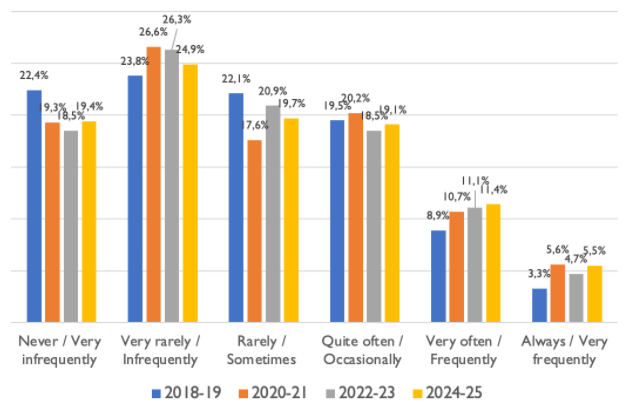 Sleep Problems. The New Normal?
During leadership training sessions, I occasionally hear the same comment: “I sleep badly. I have for years. It comes with responsibility.” Sometimes it is followed by an unspoken assumption: “If I can cope, then my employees can cope too.”
But can they? Perhaps the real issue is that we have become accustomed to treating sleep problems as a natural part of working life. That is a very human reaction—but not necessarily a wise conclusion.
When a problem becomes normal for us personally, we begin to normalize it for everyone else. "Who sleeps well these days anyway?" people ask.
According to the Mini-OPSTI study (n = 2,203), 39% of employees experiencing high levels of work stress report difficulty getting up in the morning, and 36% experience periods of sleep disturbances. However, a problem does not disappear simply because it is common.
On the contrary. When one-third of employees experience sleep problems, this is no longer an individual issue - it reflects an organisational reality. Common does not mean normal.
What do long-term data show?
Using the OPSTI questionnaire, sleep-related symptoms have been monitored continuously between 2018 and 2025.
Three indicators were followed:
Figure 1. Experiencing sleep disturbances
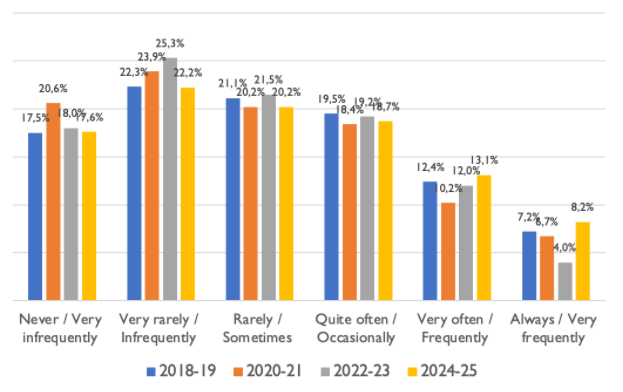
Figure 2. Worrying about sleep
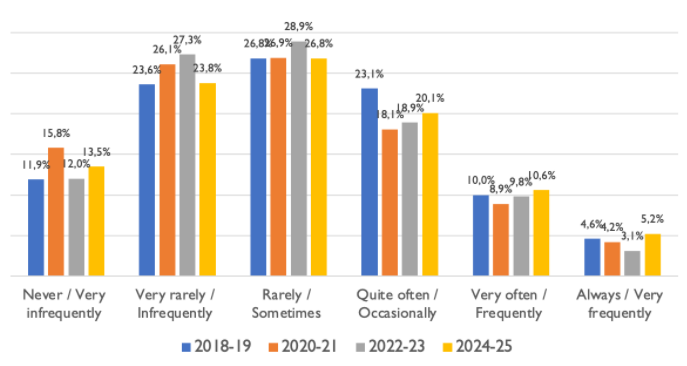
Figure 3. Difficulty getting up in the morning
Across all four measurement periods, roughly one-third of employees reported sleep disturbances, while around 35%-40% worried about their sleep. Difficulty getting up in the morning also remained common throughout the study period.
An interesting pattern emerged during the COVID-19 pandemic.
Although employees reported fewer difficulties getting up in the morning and less concern about their sleep, the prevalence of sleep disturbances actually increased. Remote work probably allowed for more flexible daily schedules, while uncertainty and anxiety reduced sleep quality.
Whose problem are employees' sleep problems?
Many organisations are reluctant to regard sleep as their responsibility. In one sense, they are right. People sleep at home.
Organisations cannot decide when employees go to bed, whether they scroll through their phones before sleeping, or how much coffee they drink in the evening. But sleep problems affect far more than an individual's well-being. Our OPSTI data show that sleep disturbances are associated with:
This means that sleep problems should not be viewed solely as a health issue. They are also an organisational performance issue. Individual responsibility and organisational responsibility
Employees naturally have responsibility for their own sleep habits. At the same time, organisations need employees who are mentally and physically well-rested.
When people arrive at work exhausted, distracted and emotionally drained, sleep problems no longer remain a purely personal matter. They influence attention, decision-making, mood, relationships with colleagues and, ultimately, job performance.
Managers are not expected to tuck employees into bed at night. But neither can they ignore a situation where a substantial proportion of employees come to work insufficiently rested, with reduced motivation and lower performance. An organisation is not responsible for how many hours an employee sleeps.
It is responsible for whether workload, work pace, work organisation and management practices support or hinder recovery.
Something to Think About
Perhaps we should ask not only why people sleep poorly. Perhaps we should also ask why we have started to accept poor sleep as an ordinary part of working life.
Keywords: sleep disturbances, sleep quality, work ability, work stress, job performance, work motivation, mental health, occupational psychology, leadership, workload, organisational health, OPSTI, Mini-OPSTI
But can they? Perhaps the real issue is that we have become accustomed to treating sleep problems as a natural part of working life. That is a very human reaction—but not necessarily a wise conclusion.
When a problem becomes normal for us personally, we begin to normalize it for everyone else. "Who sleeps well these days anyway?" people ask.
According to the Mini-OPSTI study (n = 2,203), 39% of employees experiencing high levels of work stress report difficulty getting up in the morning, and 36% experience periods of sleep disturbances. However, a problem does not disappear simply because it is common.
On the contrary. When one-third of employees experience sleep problems, this is no longer an individual issue - it reflects an organisational reality. Common does not mean normal.
What do long-term data show?
Using the OPSTI questionnaire, sleep-related symptoms have been monitored continuously between 2018 and 2025.
Three indicators were followed:
- experiencing sleep disturbances;
- worrying about sleep;
- difficulty getting up in the morning.
| Period | Sample (n) | Sleep problems | Worrying about sleep | Difficulty getting up in the morning |
| 2018-2019 | 1203 | 31,7% | 39,1% | 37,7% |
| 2020-2021 | 1299 | 36,5% | 35,3% | 31,2% |
| 2022-2023 | 550 | 34,2% | 35,2% | 31,8% |
| 2024-2025 | 1143 | 36,0% | 40,0% | 35,9% |
Figure 1. Experiencing sleep disturbances
Figure 2. Worrying about sleep
Figure 3. Difficulty getting up in the morning
Across all four measurement periods, roughly one-third of employees reported sleep disturbances, while around 35%-40% worried about their sleep. Difficulty getting up in the morning also remained common throughout the study period.
An interesting pattern emerged during the COVID-19 pandemic.
Although employees reported fewer difficulties getting up in the morning and less concern about their sleep, the prevalence of sleep disturbances actually increased. Remote work probably allowed for more flexible daily schedules, while uncertainty and anxiety reduced sleep quality.
Whose problem are employees' sleep problems?
Many organisations are reluctant to regard sleep as their responsibility. In one sense, they are right. People sleep at home.
Organisations cannot decide when employees go to bed, whether they scroll through their phones before sleeping, or how much coffee they drink in the evening. But sleep problems affect far more than an individual's well-being. Our OPSTI data show that sleep disturbances are associated with:
- higher work stress (r = -0.39);
- poorer self-rated health (r = -0.30);
- lower work motivation (r = -0.34);
- poorer job performance (r = -0.35).
This means that sleep problems should not be viewed solely as a health issue. They are also an organisational performance issue. Individual responsibility and organisational responsibility
Employees naturally have responsibility for their own sleep habits. At the same time, organisations need employees who are mentally and physically well-rested.
When people arrive at work exhausted, distracted and emotionally drained, sleep problems no longer remain a purely personal matter. They influence attention, decision-making, mood, relationships with colleagues and, ultimately, job performance.
Managers are not expected to tuck employees into bed at night. But neither can they ignore a situation where a substantial proportion of employees come to work insufficiently rested, with reduced motivation and lower performance. An organisation is not responsible for how many hours an employee sleeps.
It is responsible for whether workload, work pace, work organisation and management practices support or hinder recovery.
Something to Think About
Perhaps we should ask not only why people sleep poorly. Perhaps we should also ask why we have started to accept poor sleep as an ordinary part of working life.
Keywords: sleep disturbances, sleep quality, work ability, work stress, job performance, work motivation, mental health, occupational psychology, leadership, workload, organisational health, OPSTI, Mini-OPSTI
2.08.2026
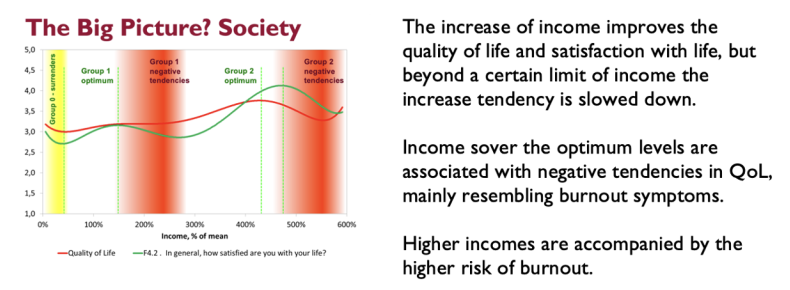 Does More Money Mean a Better Life?
Over the past two decades, Estonia has become noticeably more prosperous. Wages have risen. Living standards have improved. Consumer opportunities have expanded.
Looking at the OECD quality-of-life indicators, Estonia is no longer a poor Eastern European country. In some areas, our results are surprisingly strong, particularly in education, safety and the environment. And yet stress has not disappeared. Burnout has not disappeared. Dissatisfaction has not disappeared.
Why? As a psychologist, I have been intrigued for years by a simple question: Does more money automatically mean a better life? At first glance, the answer seems obvious.
Of course it does. When people do not have enough money to cover their daily needs, this directly affects their wellbeing, health and sense of security. But the real picture is more complicated. Money Improves
Quality of Life - But Only Up to a Point
Years ago, my colleague Mart Murdvee and I studied the relationship between income and quality of life. We used the WHO model of quality of life, which views human life much more broadly than material wellbeing alone. The results showed a fairly predictable pattern: As income increased, quality of life generally improved. But only up to a point.
The most interesting finding was that beyond a certain level, quality of life no longer improved at the same pace. In some groups, we even began to observe the opposite tendency. The higher the income, the more frequently we observed:
Figure. Quality of Life and Money
Quality of Life Is Much More Than Income
According to the World Health Organization, quality of life consists of six broad domains:
1. physical wellbeing;
2. psychological wellbeing;
3. independence;
4. social relationships;
5. environment;
6. values and beliefs.
Income directly affects only some of these domains. This is where the OECD Better Life Index becomes particularly interesting.
Looking at Estonia's profile, we see a rather balanced picture. Our strengths are not limited to income. Education, safety, community relationships, health and the living environment also play important roles. In other words: A country's quality of life is not determined by economic growth alone. The same applies to individuals. A person's quality of life is not determined by income alone.
Too Little Money Creates Stress
A study conducted by the Salary Information Agency added another important dimension. Among employees experiencing the highest levels of stress, financial problems stood out very clearly. Almost half of those struggling financially frequently experienced money-related stress, whereas among those managing well financially, this figure was several times lower.
This confirms something important: Too little income is undoubtedly a significant source of stress.
But this is where the paradox emerges. Our earlier studies suggest that very high income does not automatically guarantee a better life either. Sometimes the opposite may occur:
Higher income → more work → longer working hours → faster burnout → poorer health → declining quality of life.
Perhaps We Are Asking the Wrong Question
Perhaps we should stop asking: How much does a person earn? And instead ask: What is their quality of life?
These are not always the same question. The older I have become, the less I believe in simple formulas: More money. More success. More work. More achievements. These things may improve quality of life. But only if something else is preserved alongside them:
A Thought for All of Us
We often ask: How much money do people need to live well? Perhaps an equally important question is: How much money can people earn while still having enough time, health and energy to enjoy their lives? These are not necessarily the same thing.
Keywords: quality of life, income, wellbeing, burnout, occupational stress, OECD Better Life Index, WHO Quality of Life, work-life balance, wellbeing economics.
Looking at the OECD quality-of-life indicators, Estonia is no longer a poor Eastern European country. In some areas, our results are surprisingly strong, particularly in education, safety and the environment. And yet stress has not disappeared. Burnout has not disappeared. Dissatisfaction has not disappeared.
Why? As a psychologist, I have been intrigued for years by a simple question: Does more money automatically mean a better life? At first glance, the answer seems obvious.
Of course it does. When people do not have enough money to cover their daily needs, this directly affects their wellbeing, health and sense of security. But the real picture is more complicated. Money Improves
Quality of Life - But Only Up to a Point
Years ago, my colleague Mart Murdvee and I studied the relationship between income and quality of life. We used the WHO model of quality of life, which views human life much more broadly than material wellbeing alone. The results showed a fairly predictable pattern: As income increased, quality of life generally improved. But only up to a point.
The most interesting finding was that beyond a certain level, quality of life no longer improved at the same pace. In some groups, we even began to observe the opposite tendency. The higher the income, the more frequently we observed:
- fatigue;
- sleep problems;
- negative emotions;
- declining satisfaction with leisure time.
Figure. Quality of Life and Money
Quality of Life Is Much More Than Income
According to the World Health Organization, quality of life consists of six broad domains:
1. physical wellbeing;
2. psychological wellbeing;
3. independence;
4. social relationships;
5. environment;
6. values and beliefs.
Income directly affects only some of these domains. This is where the OECD Better Life Index becomes particularly interesting.
Looking at Estonia's profile, we see a rather balanced picture. Our strengths are not limited to income. Education, safety, community relationships, health and the living environment also play important roles. In other words: A country's quality of life is not determined by economic growth alone. The same applies to individuals. A person's quality of life is not determined by income alone.
Too Little Money Creates Stress
A study conducted by the Salary Information Agency added another important dimension. Among employees experiencing the highest levels of stress, financial problems stood out very clearly. Almost half of those struggling financially frequently experienced money-related stress, whereas among those managing well financially, this figure was several times lower.
This confirms something important: Too little income is undoubtedly a significant source of stress.
But this is where the paradox emerges. Our earlier studies suggest that very high income does not automatically guarantee a better life either. Sometimes the opposite may occur:
Higher income → more work → longer working hours → faster burnout → poorer health → declining quality of life.
Perhaps We Are Asking the Wrong Question
Perhaps we should stop asking: How much does a person earn? And instead ask: What is their quality of life?
These are not always the same question. The older I have become, the less I believe in simple formulas: More money. More success. More work. More achievements. These things may improve quality of life. But only if something else is preserved alongside them:
- health;
- relationships;
- recovery;
- a sense of security;
- and the feeling that life consists of more than work alone.
A Thought for All of Us
We often ask: How much money do people need to live well? Perhaps an equally important question is: How much money can people earn while still having enough time, health and energy to enjoy their lives? These are not necessarily the same thing.
Keywords: quality of life, income, wellbeing, burnout, occupational stress, OECD Better Life Index, WHO Quality of Life, work-life balance, wellbeing economics.
29.07.2026
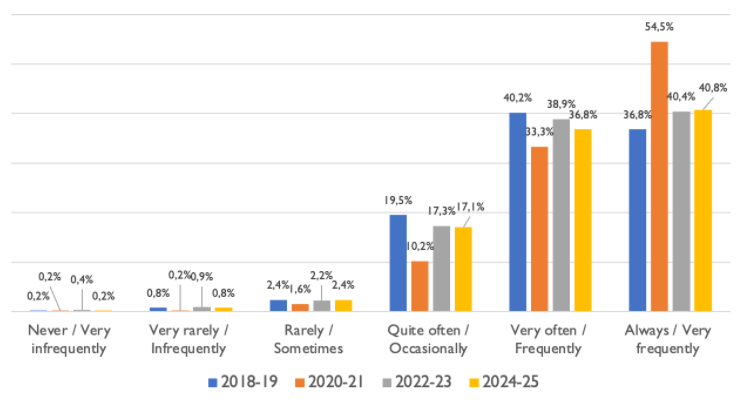 Why Is Meaningful Work So Important to Us? Really
Recently, there has been much discussion about meaningful work.
Particularly regarding Generation Z, it is often claimed that people no longer seek only an income from work. They also want their work to be meaningful, to have purpose, and to offer opportunities for growth and self-realisation.
But what do the data actually show? Based on the OPSTI database, more than 4,000 employees were asked between 2018 and 2025 to what extent they considered their work meaningful and significant. The results are surprisingly clear.
Work Is Meaningful (2018–2025)
Figure. Meaning of Work
During three of the four study periods, approximately four out of five employees considered their work meaningful and significant. The only exception was the COVID-19 period, when this figure increased to nearly 88%.
First Conclusion: Meaningful Work Is Common in Estonia
Meaningful work does not appear to be a rare experience.
Despite recent crises, economic changes, inflation, the spread of remote work and geopolitical uncertainty, perceptions of work meaningfulness have remained remarkably stable.
This suggests that, for most people, work is not merely a source of income.
Work provides something more. An opportunity to be useful. To achieve something. To apply one's abilities.
Second Conclusion: The COVID-19 Period Was Exceptional
The most interesting finding is related to the pandemic. Before COVID-19, 77% of employees considered their work meaningful. During 2020–2021, this figure rose to 87.8%. After the crisis, it returned to its previous level.
We observed similar patterns in several other indicators of working life. At the same time, work-related stress increased, yet many work-related evaluations improved. The precise reasons for this phenomenon require further study, but one possible explanation is that work became more important to people during the crisis. Perhaps we only begin to appreciate certain things when they no longer seem self-evident.
For many people, work provided stability, a sense of belonging and an opportunity to contribute at a time when many of the usual foundations of everyday life had been disrupted.
Third Conclusion: Meaningful Work Is a Complex Phenomenon
When examining the relationships between meaningful work and other indicators of working life, no single dominant factor emerges.
The strongest associations were found with:
The strongest relationship was not with salary, working conditions or even organisational climate. It was with self-esteem. These findings suggest that meaningful work does not arise from a single factor. Rather, it seems to emerge when employees enjoy the content of their work, can use their knowledge, see opportunities for growth, feel competent and needed, and experience positive emotions at work.
What Should We Take Away from This?
Discussions about meaningful work often focus on organisational mission statements, values or inspiring slogans. The data suggest something rather different. Meaningful work seems to arise at a much more practical level.
People experience work as meaningful when:
A Thought for Leaders
If you wish to increase employees' sense of meaningful work, perhaps the most important question is not: "Is our mission inspiring enough?"
Perhaps a more important question is: "Do employees see in their everyday work that their contribution is needed, valued and helps them grow?"
This is where the roots of meaningful work seem to lie.
Something to Think About
What fascinates me most about meaningful work is that its strongest relationship is not with working conditions, salary or even organisational climate. It is with self-esteem. This is followed by development opportunities and job content. This makes me wonder whether meaningful work depends not only on what we do, but also on who we feel we are when we do it.
Can I use my knowledge? Am I learning and developing? Does my contribution matter?
Perhaps meaningful work is not so much a benefit provided by organisations as it is an internal experience that emerges when work, knowledge and identity fit together. And perhaps, from time to time, it is worth asking ourselves not only: "Am I satisfied with my work?" But also:"Does what I do help me become the person I want to be?"
Keywords: meaningful work, self-esteem, job content, work motivation, career development, job performance, organisational psychological climate
Work Is Meaningful (2018–2025)
Period |
Sample (n) |
Work considered meaningful |
| 2018-2019 | 1203 | 77% |
| 2020-2021 | 1299 | 87% |
| 2022-2023 | 550 | 79,3% |
| 2024-2025 | 1143 | 77,6% |
Figure. Meaning of Work
During three of the four study periods, approximately four out of five employees considered their work meaningful and significant. The only exception was the COVID-19 period, when this figure increased to nearly 88%.
First Conclusion: Meaningful Work Is Common in Estonia
Meaningful work does not appear to be a rare experience.
Despite recent crises, economic changes, inflation, the spread of remote work and geopolitical uncertainty, perceptions of work meaningfulness have remained remarkably stable.
This suggests that, for most people, work is not merely a source of income.
Work provides something more. An opportunity to be useful. To achieve something. To apply one's abilities.
Second Conclusion: The COVID-19 Period Was Exceptional
The most interesting finding is related to the pandemic. Before COVID-19, 77% of employees considered their work meaningful. During 2020–2021, this figure rose to 87.8%. After the crisis, it returned to its previous level.
We observed similar patterns in several other indicators of working life. At the same time, work-related stress increased, yet many work-related evaluations improved. The precise reasons for this phenomenon require further study, but one possible explanation is that work became more important to people during the crisis. Perhaps we only begin to appreciate certain things when they no longer seem self-evident.
For many people, work provided stability, a sense of belonging and an opportunity to contribute at a time when many of the usual foundations of everyday life had been disrupted.
Third Conclusion: Meaningful Work Is a Complex Phenomenon
When examining the relationships between meaningful work and other indicators of working life, no single dominant factor emerges.
The strongest associations were found with:
- self-esteem (r = .53),
- development and career opportunities (r = .48),
- job content (r = .46),
- job satisfaction (r = .45),
- positive emotions at work (r = .44),
- work motivation (r = .40).
- knowledge utilisation (r = .35),
- productivity (r = .35),
- organisational psychological climate (r = .33).
The strongest relationship was not with salary, working conditions or even organisational climate. It was with self-esteem. These findings suggest that meaningful work does not arise from a single factor. Rather, it seems to emerge when employees enjoy the content of their work, can use their knowledge, see opportunities for growth, feel competent and needed, and experience positive emotions at work.
What Should We Take Away from This?
Discussions about meaningful work often focus on organisational mission statements, values or inspiring slogans. The data suggest something rather different. Meaningful work seems to arise at a much more practical level.
People experience work as meaningful when:
- the work itself is interesting,
- their skills can be utilised,
- they have opportunities to grow,
- and they feel that their contribution matters.
A Thought for Leaders
If you wish to increase employees' sense of meaningful work, perhaps the most important question is not: "Is our mission inspiring enough?"
Perhaps a more important question is: "Do employees see in their everyday work that their contribution is needed, valued and helps them grow?"
This is where the roots of meaningful work seem to lie.
Something to Think About
What fascinates me most about meaningful work is that its strongest relationship is not with working conditions, salary or even organisational climate. It is with self-esteem. This is followed by development opportunities and job content. This makes me wonder whether meaningful work depends not only on what we do, but also on who we feel we are when we do it.
Can I use my knowledge? Am I learning and developing? Does my contribution matter?
Perhaps meaningful work is not so much a benefit provided by organisations as it is an internal experience that emerges when work, knowledge and identity fit together. And perhaps, from time to time, it is worth asking ourselves not only: "Am I satisfied with my work?" But also:"Does what I do help me become the person I want to be?"
Keywords: meaningful work, self-esteem, job content, work motivation, career development, job performance, organisational psychological climate
26.07.2026
 Are We Becoming Mentally Lazy?
Some time ago, I bought myself a new fountain pen. A beautiful, comfortable and rather expensive one.
It reminded me of my university years, when I wrote down everything important in lectures by hand. Back then, I also had a favourite fountain pen. I used it for years until it eventually wore out from constant use.
The new pen is just as good. The only problem is that I have almost nowhere to use it. Most of the time, I write on a computer. I sign documents digitally. I take notes on my phone or laptop. Occasionally, I decide that this time I will write on paper like in the old days. Usually, after half a page, I move back to my computer.
Are We Losing Our Skills?
This made me think. Have I lost some of my handwriting skills? Probably. Does that make me illiterate? Probably not. When we stop using a skill, it gradually becomes rusty.
This applies to handwriting, mental arithmetic and memorising phone numbers.
Why Are People Sometimes Reluctant to Think?
Recently, there has been much discussion about artificial intelligence making people mentally lazy. If AI writes, searches for information, produces summaries and even helps with analysis, why should we think for ourselves anymore?
The more I think about this question, the less new it seems. Psychologists have long studied a phenomenon known as the cognitive miser. The idea is simple. Human beings tend to use their mental resources economically. If the same result can be achieved with less effort, we usually choose the easier path.
This is not necessarily laziness. It may simply be one way of conserving energy. If we think about it, people have been delegating parts of their mental work to tools throughout history, and every time someone has feared that thinking itself would disappear.
For example, we have delegated:
The fear, however, remains remarkably similar. If a tool performs a task for me, will I lose my ability to do it myself? The short answer is: Yes, partly. If I rarely calculate mentally anymore, my mental arithmetic skills become weaker. If I no longer need to remember phone numbers, I stop remembering them. But remembering phone numbers has never been an eternal human skill.
At one time, telephone operators connected calls manually, and no one needed to memorise numbers. Later, remembering numbers became necessary. Now smartphones remember them for us.
Technology changes. And with it, the skills we need also change.
Does Thinking Disappear?
I remember a time when I calculated correlations using a calculator. Not the calculator on a phone. I mean an era when personal computers were not yet common tools on a researcher's desk. The correlation formula is long, and the possibility of making mistakes is considerable. Therefore, I calculated the same correlation three times. If I obtained the same result all three times, I dared to believe that the answer was correct. Looking back, the calculator did not do my thinking for me. It simply took over the most mechanical part of the work. I still had to know:
Does this mean that scientists have become less intelligent?
Hardly. They spend less time calculating and more time asking questions worth answering.
AI May Be Similar
The same debate once emerged around digital learning. If study materials are available online and lectures can be watched later, will students still learn? Today we ask the same question about AI. If AI performs part of the work, does the person still think?
I increasingly feel that this question may be framed incorrectly. Perhaps we should not ask: Does the tool reduce thinking? Perhaps we should ask: Which part of thinking does the tool take over, and which part remains with the human being?
Calculators took over calculation. GPS took over remembering routes. AI may take over parts of writing, information retrieval, summarising and even the first steps of analysis.
But at least for now, it remains the human task to decide:
What Should We Conclude?
Perhaps the most important question is not whether AI is making us mentally lazy. There is actually nothing fundamentally new here.
Throughout history, people have continuously delegated parts of their mental work to tools, and every time someone has feared that thinking itself would disappear.
The real question is: Which parts of mental work are we willing to delegate, and which parts do we want to keep for ourselves? Perhaps an even more important question is: What will we do with the time, attention and mental energy that become available? Because people have always delegated work to tools. The question is not whether we will continue doing so. The question is: What are we freeing ourselves for?
Something to Think About
Which parts of thinking are you willing to delegate to tools? And which parts do you definitely want to keep in your own hands?
Keywords: mental laziness, cognitive miser, thinking, skills, learning, technology, artificial intelligence, AI, calculators, psychology
It reminded me of my university years, when I wrote down everything important in lectures by hand. Back then, I also had a favourite fountain pen. I used it for years until it eventually wore out from constant use.
The new pen is just as good. The only problem is that I have almost nowhere to use it. Most of the time, I write on a computer. I sign documents digitally. I take notes on my phone or laptop. Occasionally, I decide that this time I will write on paper like in the old days. Usually, after half a page, I move back to my computer.
Are We Losing Our Skills?
This made me think. Have I lost some of my handwriting skills? Probably. Does that make me illiterate? Probably not. When we stop using a skill, it gradually becomes rusty.
This applies to handwriting, mental arithmetic and memorising phone numbers.
Why Are People Sometimes Reluctant to Think?
Recently, there has been much discussion about artificial intelligence making people mentally lazy. If AI writes, searches for information, produces summaries and even helps with analysis, why should we think for ourselves anymore?
The more I think about this question, the less new it seems. Psychologists have long studied a phenomenon known as the cognitive miser. The idea is simple. Human beings tend to use their mental resources economically. If the same result can be achieved with less effort, we usually choose the easier path.
This is not necessarily laziness. It may simply be one way of conserving energy. If we think about it, people have been delegating parts of their mental work to tools throughout history, and every time someone has feared that thinking itself would disappear.
For example, we have delegated:
- calculation to calculators;
- remembering phone numbers to smartphones;
- navigation to GPS;
- information retrieval to search engines.
The fear, however, remains remarkably similar. If a tool performs a task for me, will I lose my ability to do it myself? The short answer is: Yes, partly. If I rarely calculate mentally anymore, my mental arithmetic skills become weaker. If I no longer need to remember phone numbers, I stop remembering them. But remembering phone numbers has never been an eternal human skill.
At one time, telephone operators connected calls manually, and no one needed to memorise numbers. Later, remembering numbers became necessary. Now smartphones remember them for us.
Technology changes. And with it, the skills we need also change.
Does Thinking Disappear?
I remember a time when I calculated correlations using a calculator. Not the calculator on a phone. I mean an era when personal computers were not yet common tools on a researcher's desk. The correlation formula is long, and the possibility of making mistakes is considerable. Therefore, I calculated the same correlation three times. If I obtained the same result all three times, I dared to believe that the answer was correct. Looking back, the calculator did not do my thinking for me. It simply took over the most mechanical part of the work. I still had to know:
- what I was calculating;
- why I was calculating it;
- whether the result was plausible;
- what it actually meant.
Does this mean that scientists have become less intelligent?
Hardly. They spend less time calculating and more time asking questions worth answering.
AI May Be Similar
The same debate once emerged around digital learning. If study materials are available online and lectures can be watched later, will students still learn? Today we ask the same question about AI. If AI performs part of the work, does the person still think?
I increasingly feel that this question may be framed incorrectly. Perhaps we should not ask: Does the tool reduce thinking? Perhaps we should ask: Which part of thinking does the tool take over, and which part remains with the human being?
Calculators took over calculation. GPS took over remembering routes. AI may take over parts of writing, information retrieval, summarising and even the first steps of analysis.
But at least for now, it remains the human task to decide:
- what to ask;
- what to believe;
- what to verify;
- and what conclusions to draw.
What Should We Conclude?
Perhaps the most important question is not whether AI is making us mentally lazy. There is actually nothing fundamentally new here.
Throughout history, people have continuously delegated parts of their mental work to tools, and every time someone has feared that thinking itself would disappear.
The real question is: Which parts of mental work are we willing to delegate, and which parts do we want to keep for ourselves? Perhaps an even more important question is: What will we do with the time, attention and mental energy that become available? Because people have always delegated work to tools. The question is not whether we will continue doing so. The question is: What are we freeing ourselves for?
Something to Think About
Which parts of thinking are you willing to delegate to tools? And which parts do you definitely want to keep in your own hands?
Keywords: mental laziness, cognitive miser, thinking, skills, learning, technology, artificial intelligence, AI, calculators, psychology
22.07.2026
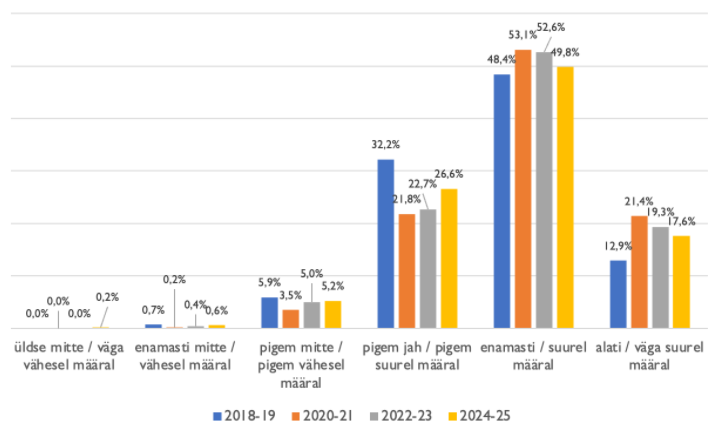 There Is More Joy at Work Than We Often Think
If we listen to public discussions about working life, we may get the impression that workplaces are full of stress, tension and burnout. We often talk about work-related stress, mental health and workload. Much less often do we ask: What emotions do people actually experience at work? Do Estonian employees experience more joy or more frustration during their working days? More satisfaction or more resentment? Is our work environment emotionally healthy?
The OPSTI studies conducted between 2018 and 2025 help provide some answers.
Positive Emotions Are Experienced Much More Frequently
The results were somewhat surprising even to me. More than half of employees reported experiencing positive emotions at work frequently or very frequently.
Positive Emotions at Work (2018–2025)
Figure. Positive Emotions at Work
At the same time, a considerably smaller proportion of employees reported experiencing negative emotions frequently or very frequently.
Negative Emotions at Work (2018–2025)
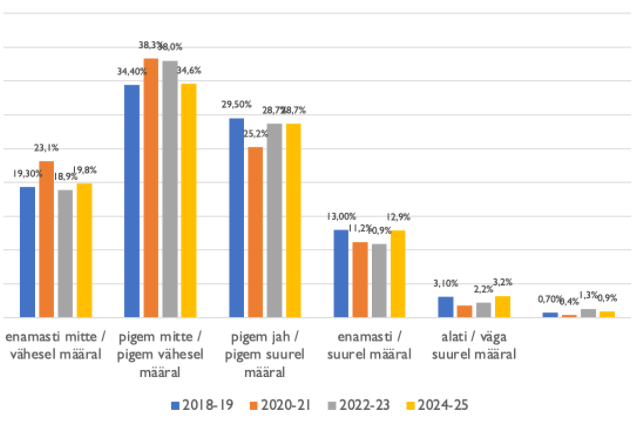
Figure. Negative Emotions at Work
Based on these findings, one can quite confidently conclude that: Estonian working life is not emotionally gloomy. Positive emotions are experienced at work far more frequently than negative ones.
This does not mean that problems do not exist. But it does suggest that work is not merely a source of stress.
COVID Brought an Unexpected Change
One additional finding deserves attention. During the COVID period, positive emotions increased while negative emotions decreased slightly. This is not the first time I have observed an unexpected improvement in COVID-related data. A similar pattern emerged in meaningful work, job satisfaction and several other indicators of working life.
Why did this happen?
At the moment, I do not have a good answer. But it is an observation that deserves further study. Perhaps crises sometimes make us appreciate aspects of working life that we normally take for granted. Work may have provided stability, social connection and a sense of purpose during a period of considerable uncertainty.
How Do Emotions at Work Compare Internationally?
Gallup (2024) reported that among U.S. employees, 51% experienced stress during the previous workday, 40% experienced worry, 22% anger and 18% sadness. All four negative emotions reached their peak in 2020 during the pandemic. Furthermore, levels of negative emotions among U.S. employees remain higher than before the pandemic, and overall life evaluations have reached record lows.
At the same time, one long-term international study found that the distribution of work-related emotions is approximately: 66% positive emotions versus 34% negative emotions.
This pattern is remarkably similar to our own findings.
Positive Emotions Are a Natural Part of Working Life
Public discussions often focus on stress and problems. Positive emotions tend to remain in the background. Our data suggest a somewhat different picture. For most Estonian employees, working life contains more positive emotions than negative ones. This does not mean that workplaces are problem-free. However, it does suggest that work is not only a source of stress. For many people, work is also a source of achievement, learning, cooperation and satisfaction.
Something to Think About
When discussing the quality of working life, we often ask: How can we reduce work-related stress? An equally important question may be: How can we increase positive emotions at work?
Keywords: work emotions, positive emotions, negative emotions, job satisfaction, work-related stress, organisational psychology, OPSTI, working life, emotionally healthy work environment
The OPSTI studies conducted between 2018 and 2025 help provide some answers.
Positive Emotions Are Experienced Much More Frequently
The results were somewhat surprising even to me. More than half of employees reported experiencing positive emotions at work frequently or very frequently.
Positive Emotions at Work (2018–2025)
Period |
Sample (n) |
Frequent Positive Emotions |
| 2018-2019 | 1203 | 61,3% |
| 2020-2021 | 1299 | 74,5% |
| 2022-2023 | 550 | 71,9% |
| 2024-2025 | 1143 | 67,3% |
Figure. Positive Emotions at Work
At the same time, a considerably smaller proportion of employees reported experiencing negative emotions frequently or very frequently.
Negative Emotions at Work (2018–2025)
Period |
Sample (n) |
Frequent Negative Emotions |
| 2018-2019 | 1203 | 16,8% |
| 2020-2021 | 1299 | 13,4% |
| 2022-2023 | 550 | 14,4% |
| 2024-2025 | 1143 | 14,4% |
Figure. Negative Emotions at Work
Based on these findings, one can quite confidently conclude that: Estonian working life is not emotionally gloomy. Positive emotions are experienced at work far more frequently than negative ones.
This does not mean that problems do not exist. But it does suggest that work is not merely a source of stress.
COVID Brought an Unexpected Change
One additional finding deserves attention. During the COVID period, positive emotions increased while negative emotions decreased slightly. This is not the first time I have observed an unexpected improvement in COVID-related data. A similar pattern emerged in meaningful work, job satisfaction and several other indicators of working life.
Why did this happen?
At the moment, I do not have a good answer. But it is an observation that deserves further study. Perhaps crises sometimes make us appreciate aspects of working life that we normally take for granted. Work may have provided stability, social connection and a sense of purpose during a period of considerable uncertainty.
How Do Emotions at Work Compare Internationally?
Gallup (2024) reported that among U.S. employees, 51% experienced stress during the previous workday, 40% experienced worry, 22% anger and 18% sadness. All four negative emotions reached their peak in 2020 during the pandemic. Furthermore, levels of negative emotions among U.S. employees remain higher than before the pandemic, and overall life evaluations have reached record lows.
At the same time, one long-term international study found that the distribution of work-related emotions is approximately: 66% positive emotions versus 34% negative emotions.
This pattern is remarkably similar to our own findings.
Positive Emotions Are a Natural Part of Working Life
Public discussions often focus on stress and problems. Positive emotions tend to remain in the background. Our data suggest a somewhat different picture. For most Estonian employees, working life contains more positive emotions than negative ones. This does not mean that workplaces are problem-free. However, it does suggest that work is not only a source of stress. For many people, work is also a source of achievement, learning, cooperation and satisfaction.
Something to Think About
When discussing the quality of working life, we often ask: How can we reduce work-related stress? An equally important question may be: How can we increase positive emotions at work?
Keywords: work emotions, positive emotions, negative emotions, job satisfaction, work-related stress, organisational psychology, OPSTI, working life, emotionally healthy work environment
19.07.2026
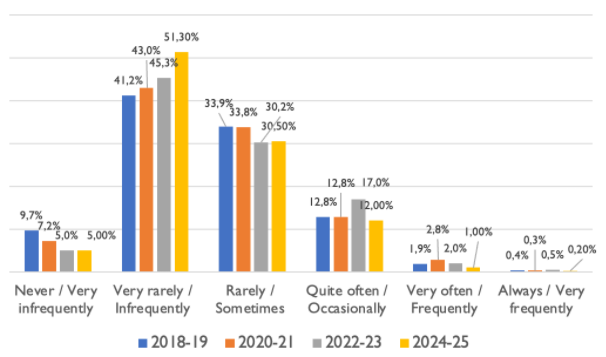 Does Work–Family Conflict Increase Because Work Follows Us Home?
For years, we have been told that work increasingly follows us home. Smartphones, e-mail, Teams, remote work and constant availability have blurred the boundaries between work and private life.
It therefore seems logical to assume that work-family conflict is increasing precisely because work is increasingly invading our homes.
However, my data tell a somewhat more complicated story.
Work-Family Conflict Is Increasing
In this study, work-family conflict was measured with questions such as:
Prevalence of Work–Family Conflict (2018-2025)
Figure. Work-Family Conflict
Over the past seven years, approximately half of all respondents (50%-56%) have experienced work-family conflict to a high or very high degree.
This is not a temporary phenomenon. It appears to be a persistent structural issue. The increase observed in 2024-2025 is particularly noteworthy.
It seems that, for Estonian employees, the boundaries between work and family life have become increasingly blurred over the past seven years, and the situation has not improved but may even have deteriorated.
The usual explanation is simple: Work increasingly follows people home. But does it?
How Often Does Work Actually Follow Us Home?
If bringing work home is indeed the main reason behind increasing work–family conflict, both indicators should move in roughly the same direction over time.
The results were somewhat surprising. Work does not appear to be following people home significantly more often.
Bringing Work Home (2018-2025)
Here we observe remarkable stability. Approximately 44%-45% of employees regularly bring work home, and this figure has remained virtually unchanged over seven years. Work–family conflict increased from 50.9% to 55.3%. Bringing work home remained stable at around 44%-45%. If bringing work home has not changed substantially while work-family conflict has increased, then something else must also have changed. The picture appears to be considerably more complex. Bringing work home may be only one part of the story.
What Is Work-Family Conflict Associated With?
We know that work–family conflict is associated with:
We know that work-family conflict has increased. We know that bringing work home has remained relatively stable. We know what work-family conflict is associated with.
But based on these data, we cannot say with certainty why work-family conflict has increased over the past decade.
Some Possible Explanations
These are not conclusions. They are hypotheses. Perhaps work has become more intensive. Perhaps working days have become longer. Perhaps people have become more sensitive to boundaries between work and private life. Perhaps expectations regarding family life have changed. Or perhaps the issue is not balance itself, but balancing. This last idea speaks to me the most.
We often talk about work-life balance as if it were a destination. As if one could achieve it once and then simply live happily ever after. Real life seems to work differently. Work changes. Families change. Children grow up. Parents get older. People change jobs. New technologies emerge. New expectations arise.
A balance that worked seven years ago may no longer work today. Balance appears to be inherently unstable.
Something to Think About
To what extent do you control whether work follows you home? And what do you do to maintain balance between work and family life?
Keywords: work-family conflict, work-life balance, workload, work organisation, work-related stress, work ability, job satisfaction, health, sleep quality
It therefore seems logical to assume that work-family conflict is increasing precisely because work is increasingly invading our homes.
However, my data tell a somewhat more complicated story.
Work-Family Conflict Is Increasing
In this study, work-family conflict was measured with questions such as:
- Does the employee have enough time for family?
- Do family-related responsibilities interfere with work?
- Does work cause employees to miss important family events?
- Do long working days make it difficult to share household responsibilities?
Prevalence of Work–Family Conflict (2018-2025)
Period |
Sample (n) |
High or Very High | Rather High |
| 2018-2019 | 1203 | 50,9% | 33,9% |
| 2020-2021 | 1299 | 50,2% | 33,8% |
| 2022-2023 | 550 | 50,3% | 30,2% |
| 2024-2025 | 1143 | 56,3% | 30,5% |
Figure. Work-Family Conflict
Over the past seven years, approximately half of all respondents (50%-56%) have experienced work-family conflict to a high or very high degree.
This is not a temporary phenomenon. It appears to be a persistent structural issue. The increase observed in 2024-2025 is particularly noteworthy.
It seems that, for Estonian employees, the boundaries between work and family life have become increasingly blurred over the past seven years, and the situation has not improved but may even have deteriorated.
The usual explanation is simple: Work increasingly follows people home. But does it?
How Often Does Work Actually Follow Us Home?
If bringing work home is indeed the main reason behind increasing work–family conflict, both indicators should move in roughly the same direction over time.
The results were somewhat surprising. Work does not appear to be following people home significantly more often.
Bringing Work Home (2018-2025)
Period |
Sample (n) |
High or Very High | Rather High |
| 2018-2019 | 1203 | 43,6% | 34% |
| 2020-2021 | 1299 | 43,3% | 34,1% |
| 2022-2023 | 550 | 44% | 34% |
| 2024-2025 | 1143 | 44,5% | 32,9% |
Here we observe remarkable stability. Approximately 44%-45% of employees regularly bring work home, and this figure has remained virtually unchanged over seven years. Work–family conflict increased from 50.9% to 55.3%. Bringing work home remained stable at around 44%-45%. If bringing work home has not changed substantially while work-family conflict has increased, then something else must also have changed. The picture appears to be considerably more complex. Bringing work home may be only one part of the story.
What Is Work-Family Conflict Associated With?
We know that work–family conflict is associated with:
- higher workload (r = .35),
- greater organisational demands (r = .22),
- higher work-related stress (r = .50),
- lower work ability (r = –.32),
- lower job satisfaction (r = –.27),
- poorer health (r = –.24),
- poorer sleep quality (r = –.23).
We know that work-family conflict has increased. We know that bringing work home has remained relatively stable. We know what work-family conflict is associated with.
But based on these data, we cannot say with certainty why work-family conflict has increased over the past decade.
Some Possible Explanations
These are not conclusions. They are hypotheses. Perhaps work has become more intensive. Perhaps working days have become longer. Perhaps people have become more sensitive to boundaries between work and private life. Perhaps expectations regarding family life have changed. Or perhaps the issue is not balance itself, but balancing. This last idea speaks to me the most.
We often talk about work-life balance as if it were a destination. As if one could achieve it once and then simply live happily ever after. Real life seems to work differently. Work changes. Families change. Children grow up. Parents get older. People change jobs. New technologies emerge. New expectations arise.
A balance that worked seven years ago may no longer work today. Balance appears to be inherently unstable.
Something to Think About
To what extent do you control whether work follows you home? And what do you do to maintain balance between work and family life?
Keywords: work-family conflict, work-life balance, workload, work organisation, work-related stress, work ability, job satisfaction, health, sleep quality
15.07.2026
 When Stress Pushes Us Towards Extremes
I've seen it happen many times. Someone goes through a stressful period. Sleep has become poor. Energy is running low. Tension is high. Eventually, they decide it's time to change something. But they don't make a small change. They make a big one. They don't decide to walk a little more, they sign up for a marathon. They don't add more vegetables to their meals, they decide to eat nothing but carrots. They don't make time to rest in the evening, they create an ambitious new training schedule.
Why does this happen?
What Does Research Show?
According to data from the Mini-OPSTI study involving 1,203 employees, the most common symptom among people experiencing high levels of work-related stress was a tendency to cope by overdoing something. Forty-two percent of highly stressed participants reported this symptom frequently.
In other words, stress seems to push many people towards extremes.
Why Might This Happen?
The Mini-OPSTI study cannot answer this question directly. It identifies the symptom, but not the psychological mechanism behind it. One possible explanation is that excessive behaviour helps people regain a sense of control.
Regaining a Sense of Control
When people are under pressure, they often feel that life is slipping beyond their control. They cannot control their workload. They cannot control deadlines. They cannot control other people's behaviour. But they can control what they eat. Or how much they exercise. Or how many hours they work. Taking action is, in itself, a good thing.
The problem begins when a small adjustment turns into an extreme one. Not: "I'll take a 20-minute walk every day." But: "I'm going to train for a marathon." Not: "I'll eat more vegetables." But: "From now on, I'm eating only carrots."
This raises an interesting psychological question. Could excessive behaviour be an attempt to restore a sense of control? Sometimes the activity itself is not the problem. Exercise is not the problem. Healthy eating is not the problem. Work is not the problem.
The problem arises when people try to reduce stress by choosing a solution that demands even more physical or mental resources at a time when those resources are already running low.
People under stress do not always choose the wrong solution. Sometimes they choose the right solution but in the wrong amount.
If Some Is Good, More Must Be Better…
There may also be another explanation. When we feel unwell, it seems perfectly logical to assume that a bigger change will produce faster results. If healthy eating is good, then eating only healthy food must be even better. If physical activity reduces stress, then marathon training should reduce it even faster.
Our bodies, however, do not always agree with this logic.
There are probably several psychological explanations for why people behave this way under stress. Understanding them may help us recognise that balance is often a better strategy than extremes.
Something to Think About
How about you? When life becomes stressful, do you find yourself overdoing something?
Some people raid the refrigerator. Some work longer hours. Some adopt strict diets. Others suddenly begin exercising far more than usual.
If you're curious about your own stress symptoms, you can try the Mini-OPSTI questionnaire below.
Mini-OPSTI test (12 kusimust)
Selgitatakse välja 12 levinumat tööstressi sümptomit. Test aitab hinnata, kas ja mil määral need sümptomid teie puhul esinevad, ning võimaldab võrrelda tulemusi Eesti normidega.
Keywords: occupational stress, stress symptoms, coping strategies, excessive behaviour, sense of control, emotional exhaustion, recovery, health behaviour, work psychology, Mini-OPSTI
Why does this happen?
What Does Research Show?
According to data from the Mini-OPSTI study involving 1,203 employees, the most common symptom among people experiencing high levels of work-related stress was a tendency to cope by overdoing something. Forty-two percent of highly stressed participants reported this symptom frequently.
In other words, stress seems to push many people towards extremes.
Why Might This Happen?
The Mini-OPSTI study cannot answer this question directly. It identifies the symptom, but not the psychological mechanism behind it. One possible explanation is that excessive behaviour helps people regain a sense of control.
Regaining a Sense of Control
When people are under pressure, they often feel that life is slipping beyond their control. They cannot control their workload. They cannot control deadlines. They cannot control other people's behaviour. But they can control what they eat. Or how much they exercise. Or how many hours they work. Taking action is, in itself, a good thing.
The problem begins when a small adjustment turns into an extreme one. Not: "I'll take a 20-minute walk every day." But: "I'm going to train for a marathon." Not: "I'll eat more vegetables." But: "From now on, I'm eating only carrots."
This raises an interesting psychological question. Could excessive behaviour be an attempt to restore a sense of control? Sometimes the activity itself is not the problem. Exercise is not the problem. Healthy eating is not the problem. Work is not the problem.
The problem arises when people try to reduce stress by choosing a solution that demands even more physical or mental resources at a time when those resources are already running low.
People under stress do not always choose the wrong solution. Sometimes they choose the right solution but in the wrong amount.
If Some Is Good, More Must Be Better…
There may also be another explanation. When we feel unwell, it seems perfectly logical to assume that a bigger change will produce faster results. If healthy eating is good, then eating only healthy food must be even better. If physical activity reduces stress, then marathon training should reduce it even faster.
Our bodies, however, do not always agree with this logic.
There are probably several psychological explanations for why people behave this way under stress. Understanding them may help us recognise that balance is often a better strategy than extremes.
Something to Think About
How about you? When life becomes stressful, do you find yourself overdoing something?
Some people raid the refrigerator. Some work longer hours. Some adopt strict diets. Others suddenly begin exercising far more than usual.
If you're curious about your own stress symptoms, you can try the Mini-OPSTI questionnaire below.
Mini-OPSTI test (12 kusimust)
Selgitatakse välja 12 levinumat tööstressi sümptomit. Test aitab hinnata, kas ja mil määral need sümptomid teie puhul esinevad, ning võimaldab võrrelda tulemusi Eesti normidega.
Keywords: occupational stress, stress symptoms, coping strategies, excessive behaviour, sense of control, emotional exhaustion, recovery, health behaviour, work psychology, Mini-OPSTI
12.07.2026
 The Toxic Star
Over the years, managers have repeatedly told me about the same problem. Admittedly, in different words. "He is our best employee, but..." It is usually this "but" that makes managers sigh.
One very experienced manager once told me a story about a toxic star employee that I have never forgotten. In his company, there was a person who generated substantial profits. Clients liked him. His work results were excellent. The numbers were impeccable. At the same time, he was extremely difficult to work with. He created tension. Conflicts. Dissatisfaction. When I asked the manager how long this had lasted, he replied: "Fifteen years." Then he added: "I thought almost every working day that he should be fired." I asked how the story ended. The answer surprised me. After fifteen years, the company created a new department, hired a new manager, and transferred the problematic employee there. The problem was solved. Or at least moved onto someone else's desk.
In the world of management, this is sometimes also called a solution. Such stories are not uncommon. I suspect many managers will recognise this situation.
Organisations are often willing to tolerate highly problematic behaviour when an individual produces exceptionally good results. This raises an important question: How much bad behaviour are organisations willing to tolerate in exchange for outstanding performance?
In organisations, we often measure what is easiest to measure: sales, profit, productivity, turnover. Much more difficult to measure are declining trust, tensions within teams, additional managerial burden, or employees leaving the organisation. Yet these costs exist. Even when no Excel spreadsheet shows them.
In our studies of emotional and social intelligence, we have found that job performance correlates with both work-related emotional competencies (r = .47) and work-related social competencies (r = .43). This is hardly surprising. Work is not only about tasks. Work is also about relationships.
And here we arrive at a paradox. Organisations often talk about collaboration, respect and values. Then an employee appears who violates these principles every day. But delivers excellent results. Suddenly, all principles become negotiable.
One of the most difficult questions in management is not: How do we achieve good results? A much more difficult question is: How do we achieve good results in such a way that people still want to work here tomorrow?
A drop of tar does not immediately spoil a pot of honey. But if tar is added year after year, everyone eventually begins to taste it. And sometimes the most expensive issue for an organisation is not the problematic employee himself, but how long the organisation ignores his influence.
Something to Think About
When does an organisation's best employee become its most expensive problem?
Keywords: toxic star, leadership, job performance, emotional intelligence, social intelligence, teamwork, employee well-being, organisational psychology
One very experienced manager once told me a story about a toxic star employee that I have never forgotten. In his company, there was a person who generated substantial profits. Clients liked him. His work results were excellent. The numbers were impeccable. At the same time, he was extremely difficult to work with. He created tension. Conflicts. Dissatisfaction. When I asked the manager how long this had lasted, he replied: "Fifteen years." Then he added: "I thought almost every working day that he should be fired." I asked how the story ended. The answer surprised me. After fifteen years, the company created a new department, hired a new manager, and transferred the problematic employee there. The problem was solved. Or at least moved onto someone else's desk.
In the world of management, this is sometimes also called a solution. Such stories are not uncommon. I suspect many managers will recognise this situation.
Organisations are often willing to tolerate highly problematic behaviour when an individual produces exceptionally good results. This raises an important question: How much bad behaviour are organisations willing to tolerate in exchange for outstanding performance?
In organisations, we often measure what is easiest to measure: sales, profit, productivity, turnover. Much more difficult to measure are declining trust, tensions within teams, additional managerial burden, or employees leaving the organisation. Yet these costs exist. Even when no Excel spreadsheet shows them.
In our studies of emotional and social intelligence, we have found that job performance correlates with both work-related emotional competencies (r = .47) and work-related social competencies (r = .43). This is hardly surprising. Work is not only about tasks. Work is also about relationships.
And here we arrive at a paradox. Organisations often talk about collaboration, respect and values. Then an employee appears who violates these principles every day. But delivers excellent results. Suddenly, all principles become negotiable.
One of the most difficult questions in management is not: How do we achieve good results? A much more difficult question is: How do we achieve good results in such a way that people still want to work here tomorrow?
A drop of tar does not immediately spoil a pot of honey. But if tar is added year after year, everyone eventually begins to taste it. And sometimes the most expensive issue for an organisation is not the problematic employee himself, but how long the organisation ignores his influence.
Something to Think About
When does an organisation's best employee become its most expensive problem?
Keywords: toxic star, leadership, job performance, emotional intelligence, social intelligence, teamwork, employee well-being, organisational psychology
8.07.2026
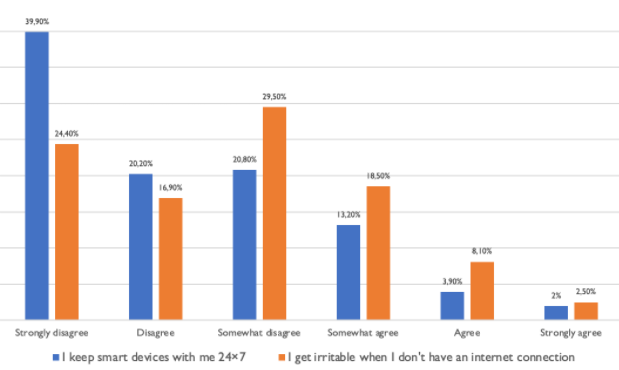 Cyberloafing: Laziness or a Way of Coping with Stress?
You've probably done it yourself. Or noticed a colleague doing it. A meeting is in progress. Spreadsheets and reports are open on the screen. Hidden behind them is a news website, social media, or an online store.
Psychologists have a name for this behaviour: cyberloafing.
Cyberloafing refers to employees using workplace internet access or digital devices for personal, non-work-related activities during working hours. Browsing the news, checking social media, reading personal emails, watching videos, or shopping online all fall under this definition.
Studies suggest that employees spend, on average, nearly one quarter of their working day on cyberloafing. That amounts to almost two hours in a typical eight-hour workday.
Is Cyberloafing Always a Problem?
This is where the story becomes more interesting.
The first reaction is often straightforward: "People are simply being lazy." Research, however, paints a more nuanced picture.
Several studies suggest that cyberloafing may function as a buffer against work-related stress. It can help employees cope with boredom, mental fatigue, emotional strain, and other negative workplace experiences.
In other words, cyberloafing may sometimes be nothing more than a brief mental break. Just as one employee steps away for a cup of coffee, another may spend five minutes browsing the news before returning to work.
At the same time, research has also identified important risks. Cyberloafing has been associated with weaker cybersecurity behaviour. Employees who frequently browse non-work-related websites on work devices are, on average, more likely to click suspicious links, use weak passwords, or unintentionally expose sensitive information.
Cyberloafing as Palliative Coping with Stress
This leads to an important distinction.
Cyberloafing may reduce the symptoms of stress without addressing its underlying cause. In that sense, it resembles palliative treatment in medicine: it provides temporary relief without eliminating the condition itself.
In working life, the process may look something like this:
Feeling overloaded or bored → browsing social media → experiencing temporary relief → returning to the same unresolved problem → stress returns.
This raises an important question.
Is cyberloafing:
If cyberloafing begins to reduce work quality, undermine productivity, increase cybersecurity risks, or replace work altogether, it deserves attention. But the most useful response may not be stricter rules or outright bans. It may be understanding why employees cyberloaf in the first place.
What Did We Find?
In one of our studies involving 356 Estonian employees, we examined attitudes towards smart devices and internet connectivity.
Figure. Attitude towards smart devices and internet connectivity
The results were revealing.
What Can We Learn from This?
Cyberloafing is unlikely to disappear, nor should the goal necessarily be to eliminate it completely. People need opportunities to recover during the working day. Sometimes those recovery breaks happen in the digital world.
The more important question is not whether employees occasionally cyberloaf. It is whether cyberloafing represents healthy recovery or signals that something in the work environment requires attention.
Understanding that difference may be more valuable than simply trying to prevent the behaviour.
Something to Think About
When was the last time you caught yourself cyberloafing at work? Was it simply a short mental break or a sign that something else was going on?
Keywords: cyberloafing, occupational stress, coping strategies, recovery, avoidance, workplace wellbeing, digital behaviour, internet use, cybersecurity, work psychology
Psychologists have a name for this behaviour: cyberloafing.
Cyberloafing refers to employees using workplace internet access or digital devices for personal, non-work-related activities during working hours. Browsing the news, checking social media, reading personal emails, watching videos, or shopping online all fall under this definition.
Studies suggest that employees spend, on average, nearly one quarter of their working day on cyberloafing. That amounts to almost two hours in a typical eight-hour workday.
Is Cyberloafing Always a Problem?
This is where the story becomes more interesting.
The first reaction is often straightforward: "People are simply being lazy." Research, however, paints a more nuanced picture.
Several studies suggest that cyberloafing may function as a buffer against work-related stress. It can help employees cope with boredom, mental fatigue, emotional strain, and other negative workplace experiences.
In other words, cyberloafing may sometimes be nothing more than a brief mental break. Just as one employee steps away for a cup of coffee, another may spend five minutes browsing the news before returning to work.
At the same time, research has also identified important risks. Cyberloafing has been associated with weaker cybersecurity behaviour. Employees who frequently browse non-work-related websites on work devices are, on average, more likely to click suspicious links, use weak passwords, or unintentionally expose sensitive information.
Cyberloafing as Palliative Coping with Stress
This leads to an important distinction.
Cyberloafing may reduce the symptoms of stress without addressing its underlying cause. In that sense, it resembles palliative treatment in medicine: it provides temporary relief without eliminating the condition itself.
In working life, the process may look something like this:
Feeling overloaded or bored → browsing social media → experiencing temporary relief → returning to the same unresolved problem → stress returns.
This raises an important question.
Is cyberloafing:
- Recovery? A short, deliberate break that helps employees return to work mentally refreshed. or
- Avoidance? A way of escaping an unpleasant situation without solving the underlying problem.
If cyberloafing begins to reduce work quality, undermine productivity, increase cybersecurity risks, or replace work altogether, it deserves attention. But the most useful response may not be stricter rules or outright bans. It may be understanding why employees cyberloaf in the first place.
What Did We Find?
In one of our studies involving 356 Estonian employees, we examined attitudes towards smart devices and internet connectivity.
Figure. Attitude towards smart devices and internet connectivity
The results were revealing.
- Nearly one in three employees (29.1%) reported becoming irritated when they had no internet connection.
- Almost one in five (19.2%) said they keep their smartphones within reach 24 hours a day, seven days a week.
What Can We Learn from This?
Cyberloafing is unlikely to disappear, nor should the goal necessarily be to eliminate it completely. People need opportunities to recover during the working day. Sometimes those recovery breaks happen in the digital world.
The more important question is not whether employees occasionally cyberloaf. It is whether cyberloafing represents healthy recovery or signals that something in the work environment requires attention.
Understanding that difference may be more valuable than simply trying to prevent the behaviour.
Something to Think About
When was the last time you caught yourself cyberloafing at work? Was it simply a short mental break or a sign that something else was going on?
Keywords: cyberloafing, occupational stress, coping strategies, recovery, avoidance, workplace wellbeing, digital behaviour, internet use, cybersecurity, work psychology
5.07.2026
 AI Brain Fry: When More AI Doesn't Mean Less Cognitive Load
Have you ever reached the end of the day feeling that your brain was simply fried?
Not because you were physically tired. You spent the day at your computer. You didn't lift anything heavy. Yet by the evening your mind feels empty. Your thoughts simply won't move anymore.
In recent years, one more source of pressure has been added to that experience: AI. AI is often presented as a way to work faster. Often it does. But at the same time, it can present us with more information, more choices, and more AI-generated outputs you need to check before you can trust them. that have to be checked before you can rely on them.
One thing became increasingly clear. The real question was not how much AI we use, but how much cognitive load we ask people to carry.
There Is an Optimal Level for Everyone
Psychology has long known that more is not always better. But too little isn't either. I learned that lesson years ago after spending seven hours on telephone duty during the summer holidays. The phone never rang. By the evening I was exhausted.Human wellbeing depends on finding the level of demand that is right for each individual.
Too much work is not good. Too little work is not good either. The same applies to information, emotions, social interaction, food and now, AI.
There is no single level that works for everyone. Some people do their best work when they can focus on one task at a time. Others are comfortable using AI throughout the day. Some begin to feel mentally overloaded after only thirty minutes. The question is not who is better. The question is what is optimal for that individual.
What Does Research Suggest?
I started looking for research that might answer this question. One pattern kept appearing. The studies did not suggest using more AI or more powerful AI. Instead, they pointed to something else: how work is organised between people and AI.
One finding was surprisingly consistent. Productivity does not continue to increase as people add more and more AI conversations or tools. At some point, often after about three simultaneous AI contexts, it begins to decline. Not because AI becomes less capable, but because people have to remember what one AI already knows, what another one suggested, and what still needs to be checked.
The experience is not unique to AI. Think about trying to manage several text or email conversations with different people at the same time. Sooner or later, it becomes difficult to remember who said what.
Another finding concerned the role AI actually plays. When AI takes over routine work - drafting text or describing data, for example - it can free people's attention for more demanding tasks.
The problem is not that AI generates alternatives. The problem begins when it generates more alternatives than we can meaningfully evaluate.
Research also suggests that continuous AI interaction is not necessarily the best way to work. Attention recovers more effectively when work has natural beginnings and endings, separated by genuine breaks.
One more finding caught my attention. Discussing AI-generated output with a colleague does more than provide emotional support. It also shares the burden of evaluation and reduces the cognitive load carried by one person alone.
Perhaps the most interesting finding appeared at the organisational level.
If the organisational message is, "You now have AI. Do more," AI itself can become another source of pressure. If, however, AI adoption is accompanied by changes in work design and expectations, the same technology may actually reduce cognitive overload.
Which tasks should be done by people, and which by AI?
This is not a new question. Human factors researchers have been asking it for decades. Which functions should be assigned to people? Which to machines? No universal answer has ever been found. Machines evolve. People learn. As both change, so does the way we work. AI is evolving even faster than earlier technologies.
Perhaps searching for a final answer about who should do what is the wrong question. Perhaps good human - AI collaboration begins somewhere else. It begins when both partners understand not only their own strengths and limitations, but also those of the other. Only then can work be organised in ways that reduce unnecessary cognitive overload and allow people to focus their thinking where it matters most.
Something to Think About
AI does not free people from thinking. Good human–AI collaboration may help reduce cognitive overload.
Keywords: Artificial Intelligence (AI), AI Stress, Cognitive Overload, AI Brain Fry, Human–AI Collaboration, Critical Thinking, Attention, Occupational Psychology, Workplace Well-being, Work Design
In recent years, one more source of pressure has been added to that experience: AI. AI is often presented as a way to work faster. Often it does. But at the same time, it can present us with more information, more choices, and more AI-generated outputs you need to check before you can trust them. that have to be checked before you can rely on them.
One thing became increasingly clear. The real question was not how much AI we use, but how much cognitive load we ask people to carry.
There Is an Optimal Level for Everyone
Psychology has long known that more is not always better. But too little isn't either. I learned that lesson years ago after spending seven hours on telephone duty during the summer holidays. The phone never rang. By the evening I was exhausted.Human wellbeing depends on finding the level of demand that is right for each individual.
Too much work is not good. Too little work is not good either. The same applies to information, emotions, social interaction, food and now, AI.
There is no single level that works for everyone. Some people do their best work when they can focus on one task at a time. Others are comfortable using AI throughout the day. Some begin to feel mentally overloaded after only thirty minutes. The question is not who is better. The question is what is optimal for that individual.
What Does Research Suggest?
I started looking for research that might answer this question. One pattern kept appearing. The studies did not suggest using more AI or more powerful AI. Instead, they pointed to something else: how work is organised between people and AI.
One finding was surprisingly consistent. Productivity does not continue to increase as people add more and more AI conversations or tools. At some point, often after about three simultaneous AI contexts, it begins to decline. Not because AI becomes less capable, but because people have to remember what one AI already knows, what another one suggested, and what still needs to be checked.
The experience is not unique to AI. Think about trying to manage several text or email conversations with different people at the same time. Sooner or later, it becomes difficult to remember who said what.
Another finding concerned the role AI actually plays. When AI takes over routine work - drafting text or describing data, for example - it can free people's attention for more demanding tasks.
The problem is not that AI generates alternatives. The problem begins when it generates more alternatives than we can meaningfully evaluate.
Research also suggests that continuous AI interaction is not necessarily the best way to work. Attention recovers more effectively when work has natural beginnings and endings, separated by genuine breaks.
One more finding caught my attention. Discussing AI-generated output with a colleague does more than provide emotional support. It also shares the burden of evaluation and reduces the cognitive load carried by one person alone.
Perhaps the most interesting finding appeared at the organisational level.
If the organisational message is, "You now have AI. Do more," AI itself can become another source of pressure. If, however, AI adoption is accompanied by changes in work design and expectations, the same technology may actually reduce cognitive overload.
Which tasks should be done by people, and which by AI?
This is not a new question. Human factors researchers have been asking it for decades. Which functions should be assigned to people? Which to machines? No universal answer has ever been found. Machines evolve. People learn. As both change, so does the way we work. AI is evolving even faster than earlier technologies.
Perhaps searching for a final answer about who should do what is the wrong question. Perhaps good human - AI collaboration begins somewhere else. It begins when both partners understand not only their own strengths and limitations, but also those of the other. Only then can work be organised in ways that reduce unnecessary cognitive overload and allow people to focus their thinking where it matters most.
Something to Think About
AI does not free people from thinking. Good human–AI collaboration may help reduce cognitive overload.
Keywords: Artificial Intelligence (AI), AI Stress, Cognitive Overload, AI Brain Fry, Human–AI Collaboration, Critical Thinking, Attention, Occupational Psychology, Workplace Well-being, Work Design
1.07.2026
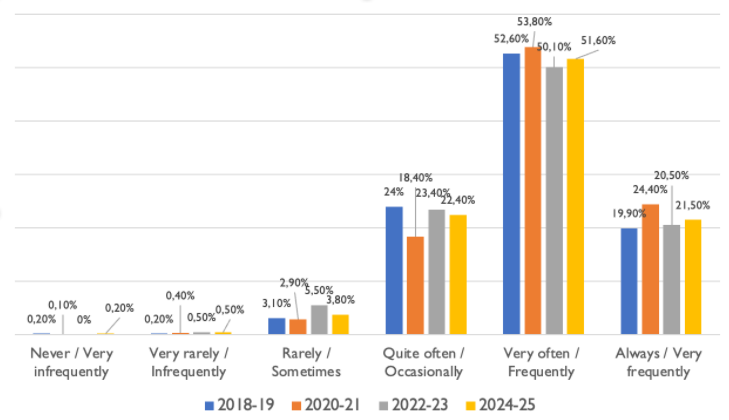 21st-Century Machine Breakers
I recently took part in an international research project where a curious phenomenon came up. In high-tech factories across several European countries, a strange pattern is spreading: workers are deliberately breaking industrial robots — to prove that the machines are not reliable or fit for use.
It is hard not to notice the historical parallel. In Industrial Revolution–era England, the Luddites smashed the weaving machines that threatened their trade. History has often portrayed them as foolish and backward, unable to grasp progress.
But as a psychologist, I see it differently. The Luddites were not afraid of machines. They may have feared something far more significant: losing the meaning of their skills, or their place in society. Perhaps what they were really protecting was their professional self-esteem.
It does seem that history is repeating itself — a remarkably similar question is surfacing today. If a robot can do my job faster, more accurately and more cheaply, the question is no longer just about technology. The real question becomes: why am I needed at all? And that question may be precisely what flattens a worker's professional self-esteem.
What Does the Research Show?
For nearly a decade, we have been studying what happens to people's professional self-esteem in a rapidly changing world of work. Professional self-esteem reflects the extent to which employees feel that they and their work matter; how confident they feel in their professional role; and how satisfied they are with themselves and with the results of their work. The findings have remained consistent over the years.
Table. Employees' Professional Self-Esteem (2018–2025)
Figure. Professional self-esteem.
So, for the majority of employees, professional self-esteem remains high. That is good news.
Should we expect a Luddite-style revolt in Estonia? Probably not - at least not in that form. Our data show that most Estonian employees' professional self-esteem has remained stable and high over the years. This suggests that, so far, technological development has not significantly undermined employees' professional self-esteem - at least not enough to trigger open resistance to machines.
Why Does Professional Self-Esteem Matter So Much?
Because high professional self-esteem is associated (correlations ranging from 0.22 to 0.28) with employee well-being, including:
But the strongest association by far was with the meaning of work (r = 0.53). This is a striking finding. Employees do not need just a salary. They need the feeling that their work has meaning - and that this meaning matters to others too. That their knowledge is needed (r = 0.28). That their work brings satisfaction (r = 0.34). That it brings positive emotions (r = 0.45). That negative emotions at work do not dominate (r = −0.33). That their contribution matters (r = 0.26). When these feelings tied to professional self-esteem disappear, work-related stress increases (r = −0.22), motivation drops (r = −0.28), and job performance declines (r = −0.26).
Employees do not wake up in the morning thinking, “My professional self-esteem is under threat today.”
They are more likely to think: “My work matters to others too.”
“I have the knowledge I need to do this job.”
“I want to do this work.”
“My work produces genuinely good results.”
Perhaps 19th-century English workers were never afraid of machines alone. And perhaps today's factory workers are not simply afraid of robots either. Perhaps what is truly feared is losing the high professional self-esteem that gives a person the sense of being needed and of doing something that matters.
And these feelings are, psychologically, very close to exactly what our professional self-esteem scale was designed to measure.
In an upcoming post, I will turn to the meaning of work itself. I'll go back into our research database and take a closer look at what we actually know about it - based on data, not opinions.
Something to Think About
How meaningful do you find your own work?
Keywords: technological change, psychology, meaning of work, self-esteem, positive emotions at work, job satisfaction
It is hard not to notice the historical parallel. In Industrial Revolution–era England, the Luddites smashed the weaving machines that threatened their trade. History has often portrayed them as foolish and backward, unable to grasp progress.
But as a psychologist, I see it differently. The Luddites were not afraid of machines. They may have feared something far more significant: losing the meaning of their skills, or their place in society. Perhaps what they were really protecting was their professional self-esteem.
It does seem that history is repeating itself — a remarkably similar question is surfacing today. If a robot can do my job faster, more accurately and more cheaply, the question is no longer just about technology. The real question becomes: why am I needed at all? And that question may be precisely what flattens a worker's professional self-esteem.
What Does the Research Show?
For nearly a decade, we have been studying what happens to people's professional self-esteem in a rapidly changing world of work. Professional self-esteem reflects the extent to which employees feel that they and their work matter; how confident they feel in their professional role; and how satisfied they are with themselves and with the results of their work. The findings have remained consistent over the years.
Table. Employees' Professional Self-Esteem (2018–2025)
Period |
Sample (n) |
Employees with High Professional Self-Esteem |
| 2018-2019 | 1203 | 72,5% |
| 2020-2021 | 1299 | 78,2% |
| 2022-2023 | 550 | 67,7% |
| 2024-2025 | 1143 | 73,1% |
Figure. Professional self-esteem.
So, for the majority of employees, professional self-esteem remains high. That is good news.
Should we expect a Luddite-style revolt in Estonia? Probably not - at least not in that form. Our data show that most Estonian employees' professional self-esteem has remained stable and high over the years. This suggests that, so far, technological development has not significantly undermined employees' professional self-esteem - at least not enough to trigger open resistance to machines.
Why Does Professional Self-Esteem Matter So Much?
Because high professional self-esteem is associated (correlations ranging from 0.22 to 0.28) with employee well-being, including:
- better health and work ability;
- lower work-related stress;
- less work-family conflict.
But the strongest association by far was with the meaning of work (r = 0.53). This is a striking finding. Employees do not need just a salary. They need the feeling that their work has meaning - and that this meaning matters to others too. That their knowledge is needed (r = 0.28). That their work brings satisfaction (r = 0.34). That it brings positive emotions (r = 0.45). That negative emotions at work do not dominate (r = −0.33). That their contribution matters (r = 0.26). When these feelings tied to professional self-esteem disappear, work-related stress increases (r = −0.22), motivation drops (r = −0.28), and job performance declines (r = −0.26).
Employees do not wake up in the morning thinking, “My professional self-esteem is under threat today.”
They are more likely to think: “My work matters to others too.”
“I have the knowledge I need to do this job.”
“I want to do this work.”
“My work produces genuinely good results.”
Perhaps 19th-century English workers were never afraid of machines alone. And perhaps today's factory workers are not simply afraid of robots either. Perhaps what is truly feared is losing the high professional self-esteem that gives a person the sense of being needed and of doing something that matters.
And these feelings are, psychologically, very close to exactly what our professional self-esteem scale was designed to measure.
In an upcoming post, I will turn to the meaning of work itself. I'll go back into our research database and take a closer look at what we actually know about it - based on data, not opinions.
Something to Think About
How meaningful do you find your own work?
Keywords: technological change, psychology, meaning of work, self-esteem, positive emotions at work, job satisfaction
28.06.2026
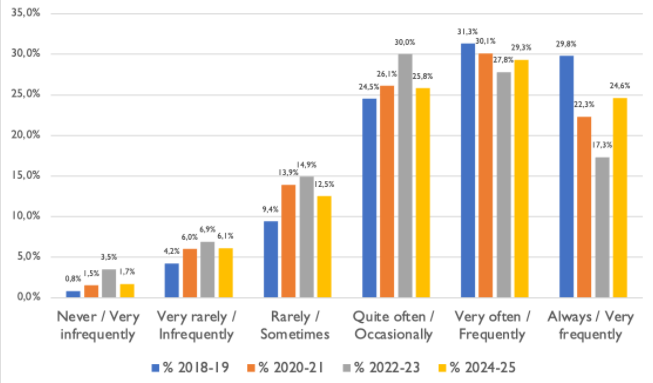 The Age of Constant Adaptation: Technostress, Cyberstress and AI Stress
When I studied psychology at the University of Tartu, one of our courses was called Programming. Computers back then were bigger than the room they stood in. When I started my career, new technology arrived at the workplace only occasionally, and not all of it was particularly convenient or relevant to use.
Today, it feels as though new technology arrives before we have even adopted the last one. New software. New information systems. New security requirements. New applications. New AI tools. And then the next one. Technological change has accelerated so much that we no longer notice only its new possibilities — we also fail to pay enough attention to its downsides. Many people say, “I'm not afraid of technology.” And in most cases, they are right. The problem is not the technology itself. The problem is the need to adapt constantly, and quickly.
Stress Does Not Come From the Computer
This may sound strange, but stress does not come from a computer, a smartphone or artificial intelligence. Stress arises when a person feels that their resources are no longer sufficient to cope with a situation. That is precisely why the same piece of technology can feel exciting to one person and exhausting to another. One person sees an opportunity. Another sees yet another thing they have to learn. Both may be equally intelligent and competent. They simply experience the change differently.
Technostress: When Technology Starts Dictating the Pace
Years ago, we studied employees' attitudes toward technology. Our most recent research, however, points to something different. People no longer complain only about complicated systems. They complain about the pace. Many employees feel that technology is pushing them to work faster, respond faster and stay constantly connected. More than half of employees feel that they need to be permanently visible and available.
Table 1. Employees' Need to Be Constantly Visible and Available (2018–2025)
Figure. Does your job require you to be always visible and available?
What is this connected to?
Table 2. Correlates of the Need to Be Constantly Visible and Available (2018–2025)
Our research (n = 623) shows that almost a quarter of employees feel that technology forces them to work faster or longer (23.7%). The complexity of digital solutions adds further pressure (22.4%). Every new system means learning, relearning, and sometimes the feeling of falling behind (21.8%). It is hardly surprising, then, that some employees even feel anxious about job security (14.5%). And when more than half of people feel they must be permanently “visible and available” (52.4%), this is no longer an exception — it is the new norm.
To me, this is one of the most significant shifts in working life over the past decade. The working day used to end when the working day ended. Today, work travels home in your pocket.
Cyberstress: When Uncertainty Becomes a Source of Tension
While technostress is tied to the use of technology itself, cyberstress creeps in through uncertainty. It is the feeling that something is happening in the background that you do not control.
Our cyberstress study (n = 277) found that most employees (65.3%) worry about how much information is being collected about them, and where it ultimately ends up. Fear of data breaches, malware and cyberattacks is no longer just an IT department's concern — it has become a personal source of tension for everyone.
On top of this, the constant burden of meeting security requirements is exhausting in itself. Passwords, multi-factor authentication, endless updates - these are meant to create a sense of security, but they often produce worry and fatigue instead (59.2% of employees). People worry that their phone or smartwatch may collect and share more information than they realise (61.3%). There is also concern that smart devices at home might pass information on to third parties: 18.3% of employees believe a baby monitor could transmit private conversations, 26.6% fear the same about smart TVs, and 28.6% worry that a car's driver-assistance system collects and shares data about routes and driving style. This is where cyberstress takes hold — even home no longer feels entirely private when smart devices seem to be “listening and watching.”
Just a few years ago, most people never thought about where their personal data travels in cyberspace. Today, we do. And for good reason. Who is collecting data about me? Who sees it? What is it used for? How much of my life is actually private? Cyberstress does not require having been the victim of an actual cyberattack. It is enough to feel that control is slipping away.
AI Stress: A New Phenomenon Against an Old Psychological Backdrop
The newest form of stress is tied to artificial intelligence. AI is no longer science fiction — it is today's everyday work tool. But alongside it, a new form of stress has emerged: AI stress.
Our AI stress study found that more than a quarter of employees (25.7%) fear that technology may take over their role. At the same time, more than half of employees (56.7%) feel pressure to use AI, learn it, and keep pace with constant updates. This creates a contradictory situation: you must embrace something you simultaneously fear. There is also a question of trust (31% of employees) — how much can AI's decisions be trusted? And what happens when AI gets it wrong? Even more intriguing, some employees (37.5%) have noticed changes in themselves: in their own assessment, frequent AI use may be leading to mental laziness and a decline in critical thinking.
Some people fear that AI will take over their job. Others fear that they will not be able to use AI well enough. A third group does not trust AI's decisions. And some have started noticing something else entirely: they feel that AI is doing part of their thinking for them. As a psychologist, this last question interests me the most. What happens to human thinking once part of the mental workload is delegated to a machine? This is a topic I will certainly return to in this blog.
Maybe the Problem Isn't the Technology After All
Looking at technostress, cyberstress and AI stress together, one common thread stands out. All three phenomena are, in fact, talking about the same thing. Not technology. People. Specifically, how people adapt to rapidly occurring technological change.
And perhaps the most important question is not: How is technology changing? but rather: How are we changing alongside it? This is a question I intend to explore further in future posts. What is already clear, however, is that no technology — present or future — relieves a person of the need for critical thinking and responsibility.
Where Do We Go From Here?
Technostress, cyberstress and AI stress are not passing phenomena. Our findings clearly suggest that stress in the digital age is not the exception — it is a systemic issue. The solution is not to abandon technology. Nor is the solution to uncritically embrace every new technological possibility. What is clear is that we need to learn to cope better with constant change. To adapt. To learn. To unlearn and relearn. Both organisations and employees.
The digital age does not have to lead to burnout — but research suggests that, without conscious action, it can get there surprisingly fast.
Something to Think About
Have you ever been in a situation where the printer won't connect to your computer, the computer won't behave as expected, and the whole mess simply “doesn't compute” anymore? What did you do? How did you manage your stress in that moment?
Further Reading
Teichmann, M. (2020). Tehnostress ja töö tulemuslikkus // Lege Artis : ajakiri Eesti arstidele, lk. 85-87 : ill. 285.
Martínez-Córcoles, M., Teichmann, M., & Murdvee, M. (2017). Assessing technophobia and technophilia: Development and validation of a questionnaire. Technology in Society, 51, 183–188. https://doi.org/10.1016/j.techsoc.2017.09.007
Today, it feels as though new technology arrives before we have even adopted the last one. New software. New information systems. New security requirements. New applications. New AI tools. And then the next one. Technological change has accelerated so much that we no longer notice only its new possibilities — we also fail to pay enough attention to its downsides. Many people say, “I'm not afraid of technology.” And in most cases, they are right. The problem is not the technology itself. The problem is the need to adapt constantly, and quickly.
Stress Does Not Come From the Computer
This may sound strange, but stress does not come from a computer, a smartphone or artificial intelligence. Stress arises when a person feels that their resources are no longer sufficient to cope with a situation. That is precisely why the same piece of technology can feel exciting to one person and exhausting to another. One person sees an opportunity. Another sees yet another thing they have to learn. Both may be equally intelligent and competent. They simply experience the change differently.
Technostress: When Technology Starts Dictating the Pace
Years ago, we studied employees' attitudes toward technology. Our most recent research, however, points to something different. People no longer complain only about complicated systems. They complain about the pace. Many employees feel that technology is pushing them to work faster, respond faster and stay constantly connected. More than half of employees feel that they need to be permanently visible and available.
Table 1. Employees' Need to Be Constantly Visible and Available (2018–2025)
| Period | Sample (n) | % of Employees |
| 2018-2019 | 1203 | 61,1% |
| 2020-2021 | 1299 | 52,4% |
| 2022-2023 | 550 | 55,1% |
| 2024-2025 | 1143 | 53,9% |
Figure. Does your job require you to be always visible and available?
What is this connected to?
Table 2. Correlates of the Need to Be Constantly Visible and Available (2018–2025)
| Indicator | r |
| Higher work-related stress | 0,31 |
| Reduced work ability | 0,29 |
| Higher work-related demands | 0,57 |
| Sensory demands | 0,43 |
| Poorer work organisation | -0,30 |
| Reduced meaning of work | -0,28 |
| Lower work motivation | -0,37 |
Our research (n = 623) shows that almost a quarter of employees feel that technology forces them to work faster or longer (23.7%). The complexity of digital solutions adds further pressure (22.4%). Every new system means learning, relearning, and sometimes the feeling of falling behind (21.8%). It is hardly surprising, then, that some employees even feel anxious about job security (14.5%). And when more than half of people feel they must be permanently “visible and available” (52.4%), this is no longer an exception — it is the new norm.
To me, this is one of the most significant shifts in working life over the past decade. The working day used to end when the working day ended. Today, work travels home in your pocket.
Cyberstress: When Uncertainty Becomes a Source of Tension
While technostress is tied to the use of technology itself, cyberstress creeps in through uncertainty. It is the feeling that something is happening in the background that you do not control.
Our cyberstress study (n = 277) found that most employees (65.3%) worry about how much information is being collected about them, and where it ultimately ends up. Fear of data breaches, malware and cyberattacks is no longer just an IT department's concern — it has become a personal source of tension for everyone.
On top of this, the constant burden of meeting security requirements is exhausting in itself. Passwords, multi-factor authentication, endless updates - these are meant to create a sense of security, but they often produce worry and fatigue instead (59.2% of employees). People worry that their phone or smartwatch may collect and share more information than they realise (61.3%). There is also concern that smart devices at home might pass information on to third parties: 18.3% of employees believe a baby monitor could transmit private conversations, 26.6% fear the same about smart TVs, and 28.6% worry that a car's driver-assistance system collects and shares data about routes and driving style. This is where cyberstress takes hold — even home no longer feels entirely private when smart devices seem to be “listening and watching.”
Just a few years ago, most people never thought about where their personal data travels in cyberspace. Today, we do. And for good reason. Who is collecting data about me? Who sees it? What is it used for? How much of my life is actually private? Cyberstress does not require having been the victim of an actual cyberattack. It is enough to feel that control is slipping away.
AI Stress: A New Phenomenon Against an Old Psychological Backdrop
The newest form of stress is tied to artificial intelligence. AI is no longer science fiction — it is today's everyday work tool. But alongside it, a new form of stress has emerged: AI stress.
Our AI stress study found that more than a quarter of employees (25.7%) fear that technology may take over their role. At the same time, more than half of employees (56.7%) feel pressure to use AI, learn it, and keep pace with constant updates. This creates a contradictory situation: you must embrace something you simultaneously fear. There is also a question of trust (31% of employees) — how much can AI's decisions be trusted? And what happens when AI gets it wrong? Even more intriguing, some employees (37.5%) have noticed changes in themselves: in their own assessment, frequent AI use may be leading to mental laziness and a decline in critical thinking.
Some people fear that AI will take over their job. Others fear that they will not be able to use AI well enough. A third group does not trust AI's decisions. And some have started noticing something else entirely: they feel that AI is doing part of their thinking for them. As a psychologist, this last question interests me the most. What happens to human thinking once part of the mental workload is delegated to a machine? This is a topic I will certainly return to in this blog.
Maybe the Problem Isn't the Technology After All
Looking at technostress, cyberstress and AI stress together, one common thread stands out. All three phenomena are, in fact, talking about the same thing. Not technology. People. Specifically, how people adapt to rapidly occurring technological change.
And perhaps the most important question is not: How is technology changing? but rather: How are we changing alongside it? This is a question I intend to explore further in future posts. What is already clear, however, is that no technology — present or future — relieves a person of the need for critical thinking and responsibility.
Where Do We Go From Here?
Technostress, cyberstress and AI stress are not passing phenomena. Our findings clearly suggest that stress in the digital age is not the exception — it is a systemic issue. The solution is not to abandon technology. Nor is the solution to uncritically embrace every new technological possibility. What is clear is that we need to learn to cope better with constant change. To adapt. To learn. To unlearn and relearn. Both organisations and employees.
The digital age does not have to lead to burnout — but research suggests that, without conscious action, it can get there surprisingly fast.
Something to Think About
Have you ever been in a situation where the printer won't connect to your computer, the computer won't behave as expected, and the whole mess simply “doesn't compute” anymore? What did you do? How did you manage your stress in that moment?
Further Reading
Teichmann, M. (2020). Tehnostress ja töö tulemuslikkus // Lege Artis : ajakiri Eesti arstidele, lk. 85-87 : ill. 285.
Martínez-Córcoles, M., Teichmann, M., & Murdvee, M. (2017). Assessing technophobia and technophilia: Development and validation of a questionnaire. Technology in Society, 51, 183–188. https://doi.org/10.1016/j.techsoc.2017.09.007
24.06.2026
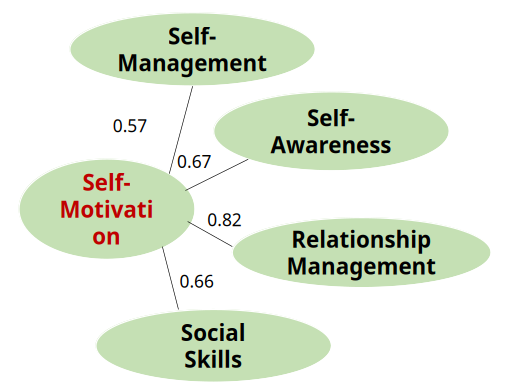 Do We Have Too Narrow View of Self-Motivation?
Every spring, the same story repeats itself. Before the examination period begins, there is almost always a Master's student who has somehow lost their motivation. Then we begin searching for it together - under the table, on top of the table, and everywhere in between.
When people are asked what self-motivation means, the answers are usually quite similar. Determination. Persistence. Moving towards goals. Wanting to achieve something.
For many years, I would have answered in much the same way. But several studies have gradually made me wonder whether our view of self-motivation might be somewhat too narrow.
Self-Motivation Requires Knowledge and Skills
The first clue came from our OPSTI studies conducted between 2018 and 2025 (n > 4000), where we examined the relationship between self-motivation and job performance. The finding that self-motivation was associated with job performance (r = 0.50) will probably surprise no one. If I am motivated to do something, it is hardly unexpected that I perform better.
More interesting were the relationships with knowledge (r = 0.44), skills (r = 0.42), and capability (r = 0.42). This made me wonder. Perhaps motivated people do not simply work harder. Perhaps they learn more. Perhaps they develop their skills more actively. Perhaps they make better use of their abilities.
If so, self-motivation may be less a consequence of competence and more one of the engines that drives competence development.
Another finding was equally interesting. Self-motivation was only modestly associated with having the opportunity to perform one's work well (r = 0.29). One might assume that motivated employees would naturally see more opportunities to succeed. Yet the data suggest something different. An employee may be highly motivated, but if the organisation does not provide the conditions for good work, motivation alone is not enough.
Self-Motivation and Stress Do Not Make Good Partners
The second clue also came from our OPSTI studies (n < 4000), where we examined the relationship between self-motivation and psychosocial risk factors. The pattern was remarkably consistent. Higher self-motivation was associated with better perceived health (r = 0.50), better work ability (r = 0.48), and better sleep quality (r = 0.45). And the reverse was also true. The higher the level of stress, the lower self-motivation tended to be.
This finding is important because organisations often talk about motivation as if it were solely an individual characteristic. The data point in another direction. Motivation does not emerge in a vacuum. It appears to be influenced by the environment in which people work. For example, higher motivation was associated with meaningful work (r = 0.50), recognition (r = 0.48), leadership quality (r = 0.44), and organisational psychological climate (r = 0.52).
Perhaps, then, we should ask not only: How can we motivate employees? but also: What kind of work environment allows motivation to survive?
Self-Motivation May Be More Social Than We Think
The third study (n = 714) was, for me, the most fascinating. We examined the relationship between self-motivation and emotional intelligence, including the social skills people use in their everyday work (see Figure).
Figure. Self-Motivation
The results were unexpected. Naturally, self-motivation was associated with self-awareness (r = 0.57) and self-management (r = 0.67). It was also associated with social skills (r = 0.66). But the strongest relationship emerged elsewhere. It was with relationship management (r = 0.82). In practical terms, this includes communication skills, the ability to build relationships, conflict management skills, coping with change, and collaboration and teamwork skills.
This finding genuinely surprised me. Had I been asked beforehand which component of emotional intelligence would be most strongly associated with self-motivation, I would almost certainly have chosen self-management. Not relationship management. Yet the data suggested otherwise. Perhaps our image of a motivated person is incomplete. We usually imagine someone who sets goals, works hard and keeps moving forward. Less often do we imagine someone who is also good at building relationships, maintaining cooperation and working effectively with other people.
What Did We Learn?
Looking across all three studies, one pattern stood out. Self-motivation was not associated with just one domain. It was associated with knowledge, skills, capability, self-management, social skills and relationship management.
In other words:
Perhaps self-motivation is not simply the desire to achieve something. Perhaps it reflects, more broadly, how people learn, develop and collaborate with others.
What Is Worth Remembering?
The next time you feel that your motivation has disappeared, it may be worth asking a few questions before blaming yourself for a lack of willpower. Do I have sufficient knowledge and skills for this task? Does my work environment support good performance? Are my working relationships functioning well?
Motivation is not merely a matter of willpower. It may be a signal that competence, environment and relationships are or are not in balance. When one of these elements is weakened, motivation often declines, regardless of how hard we try to "push ourselves". Understanding this may provide a useful key to understanding ourselves better.
Something to Think About
When someone says that a person is highly motivated, what do they actually mean? Determination? Good self-management? Strong relationships? Or perhaps all of these at the same time?
Keywords: self-motivation, work motivation, job performance, organisational psychology, emotional intelligence, self-management, workplace relationships, work ability, occupational stress, organisational health, professional development
Teichmann,M. (2020). Mapping and assessing psychosocial risk factors for individual- and organizational-level occupational stress intervention. EAWOP IN PRACTICE, 2020/12. https://openjournals.ugent.be/ewopinpractice/article/id/87120/
Teichmann, M., Ilvest, K., and Ilvest, J. (2022). Job satisfaction before the covid-19 pandemic period (2018 - 2019) and during the pandemic (2020 - 2021). In: 2022 IEEE Conference on Cognitive and Computational Aspects of Situation Management (CogSIMA), 115–117. https://ieeexplore.ieee.org/document/9830691
When people are asked what self-motivation means, the answers are usually quite similar. Determination. Persistence. Moving towards goals. Wanting to achieve something.
For many years, I would have answered in much the same way. But several studies have gradually made me wonder whether our view of self-motivation might be somewhat too narrow.
Self-Motivation Requires Knowledge and Skills
The first clue came from our OPSTI studies conducted between 2018 and 2025 (n > 4000), where we examined the relationship between self-motivation and job performance. The finding that self-motivation was associated with job performance (r = 0.50) will probably surprise no one. If I am motivated to do something, it is hardly unexpected that I perform better.
More interesting were the relationships with knowledge (r = 0.44), skills (r = 0.42), and capability (r = 0.42). This made me wonder. Perhaps motivated people do not simply work harder. Perhaps they learn more. Perhaps they develop their skills more actively. Perhaps they make better use of their abilities.
If so, self-motivation may be less a consequence of competence and more one of the engines that drives competence development.
Another finding was equally interesting. Self-motivation was only modestly associated with having the opportunity to perform one's work well (r = 0.29). One might assume that motivated employees would naturally see more opportunities to succeed. Yet the data suggest something different. An employee may be highly motivated, but if the organisation does not provide the conditions for good work, motivation alone is not enough.
Self-Motivation and Stress Do Not Make Good Partners
The second clue also came from our OPSTI studies (n < 4000), where we examined the relationship between self-motivation and psychosocial risk factors. The pattern was remarkably consistent. Higher self-motivation was associated with better perceived health (r = 0.50), better work ability (r = 0.48), and better sleep quality (r = 0.45). And the reverse was also true. The higher the level of stress, the lower self-motivation tended to be.
This finding is important because organisations often talk about motivation as if it were solely an individual characteristic. The data point in another direction. Motivation does not emerge in a vacuum. It appears to be influenced by the environment in which people work. For example, higher motivation was associated with meaningful work (r = 0.50), recognition (r = 0.48), leadership quality (r = 0.44), and organisational psychological climate (r = 0.52).
Perhaps, then, we should ask not only: How can we motivate employees? but also: What kind of work environment allows motivation to survive?
Self-Motivation May Be More Social Than We Think
The third study (n = 714) was, for me, the most fascinating. We examined the relationship between self-motivation and emotional intelligence, including the social skills people use in their everyday work (see Figure).
Figure. Self-Motivation
The results were unexpected. Naturally, self-motivation was associated with self-awareness (r = 0.57) and self-management (r = 0.67). It was also associated with social skills (r = 0.66). But the strongest relationship emerged elsewhere. It was with relationship management (r = 0.82). In practical terms, this includes communication skills, the ability to build relationships, conflict management skills, coping with change, and collaboration and teamwork skills.
This finding genuinely surprised me. Had I been asked beforehand which component of emotional intelligence would be most strongly associated with self-motivation, I would almost certainly have chosen self-management. Not relationship management. Yet the data suggested otherwise. Perhaps our image of a motivated person is incomplete. We usually imagine someone who sets goals, works hard and keeps moving forward. Less often do we imagine someone who is also good at building relationships, maintaining cooperation and working effectively with other people.
What Did We Learn?
Looking across all three studies, one pattern stood out. Self-motivation was not associated with just one domain. It was associated with knowledge, skills, capability, self-management, social skills and relationship management.
In other words:
- when people know what they are doing, motivation tends to increase;
- when they have the skills needed to perform well, motivation tends to increase;
- when they understand their strengths and limitations realistically, motivation tends to increase;
- when they are able to build and maintain good relationships, motivation tends to increase.
Perhaps self-motivation is not simply the desire to achieve something. Perhaps it reflects, more broadly, how people learn, develop and collaborate with others.
What Is Worth Remembering?
The next time you feel that your motivation has disappeared, it may be worth asking a few questions before blaming yourself for a lack of willpower. Do I have sufficient knowledge and skills for this task? Does my work environment support good performance? Are my working relationships functioning well?
Motivation is not merely a matter of willpower. It may be a signal that competence, environment and relationships are or are not in balance. When one of these elements is weakened, motivation often declines, regardless of how hard we try to "push ourselves". Understanding this may provide a useful key to understanding ourselves better.
Something to Think About
When someone says that a person is highly motivated, what do they actually mean? Determination? Good self-management? Strong relationships? Or perhaps all of these at the same time?
Keywords: self-motivation, work motivation, job performance, organisational psychology, emotional intelligence, self-management, workplace relationships, work ability, occupational stress, organisational health, professional development
Teichmann,M. (2020). Mapping and assessing psychosocial risk factors for individual- and organizational-level occupational stress intervention. EAWOP IN PRACTICE, 2020/12. https://openjournals.ugent.be/ewopinpractice/article/id/87120/
Teichmann, M., Ilvest, K., and Ilvest, J. (2022). Job satisfaction before the covid-19 pandemic period (2018 - 2019) and during the pandemic (2020 - 2021). In: 2022 IEEE Conference on Cognitive and Computational Aspects of Situation Management (CogSIMA), 115–117. https://ieeexplore.ieee.org/document/9830691
21.06.2026
 Where Did "Please" Go?
Recently, I was discussing the results of one of our social intelligence studies with students. The findings were largely what we expected. Work-related social skills showed a substantial association with job performance (r = 0.43). People who were better at understanding and interacting with others tended to perform better at work.
One result, however, stood out. Basic social manners - things such as saying hello, please, thank you, and goodbye - showed virtually no relationship with job performance (r = 0.04). People knew these behaviours. They simply did not use them consistently.
Before the next lecture, one of the students approached me and shared an observation. She had been watching her mother teach her grandchild to be polite. The child said: "Give me something to drink." The grandmother immediately replied: "Where did please go?" A few minutes later, the grandmother turned to the child and said: "Bring me a towel." Not: "Please bring me a towel." The student smiled and said: "The interesting thing is that my mother knows perfectly well how to speak politely." And that is exactly where the interesting question begins.
If people know how they should behave, why do they so often behave differently?
Psychologists encounter this phenomenon everywhere. Most people know that physical activity is good for them. Most people know that smoking is harmful. Most people know that stress should be managed. Most people know that listening is important. Most people know that saying thank you and hello is polite. The problem is rarely a lack of knowledge. More often, the challenge lies in translating knowledge into everyday behaviour. We often assume that if people know something, they will automatically do it. Reality is usually more complicated.
Perhaps we should ask a different question. Instead of asking: Do people know? we might ask: Do people use what they know? Those are two very different questions. And often they lead to two very different answers.
The longer I have worked in psychology, the less surprised I am when people behave in ways that contradict what they know. What surprises me more is how rarely we notice it. The grandmother knew perfectly well when to use the word please. The 593 employees who participated in our social intelligence study knew as well. And yet, perhaps we can ask ourselves the same question the grandmother asked her grandchild: Where did "please" go? Perhaps it is a question worth asking ourselves from time to time.
Something to Think About
What do you know that you do not consistently practise? Does your list include something as simple as saying: hello, please, or thank you?
Keywords: social intelligence, social skills, job performance, behaviour change, habits, politeness, organisational psychology, self-regulation, communication skills
One result, however, stood out. Basic social manners - things such as saying hello, please, thank you, and goodbye - showed virtually no relationship with job performance (r = 0.04). People knew these behaviours. They simply did not use them consistently.
Before the next lecture, one of the students approached me and shared an observation. She had been watching her mother teach her grandchild to be polite. The child said: "Give me something to drink." The grandmother immediately replied: "Where did please go?" A few minutes later, the grandmother turned to the child and said: "Bring me a towel." Not: "Please bring me a towel." The student smiled and said: "The interesting thing is that my mother knows perfectly well how to speak politely." And that is exactly where the interesting question begins.
If people know how they should behave, why do they so often behave differently?
Psychologists encounter this phenomenon everywhere. Most people know that physical activity is good for them. Most people know that smoking is harmful. Most people know that stress should be managed. Most people know that listening is important. Most people know that saying thank you and hello is polite. The problem is rarely a lack of knowledge. More often, the challenge lies in translating knowledge into everyday behaviour. We often assume that if people know something, they will automatically do it. Reality is usually more complicated.
Perhaps we should ask a different question. Instead of asking: Do people know? we might ask: Do people use what they know? Those are two very different questions. And often they lead to two very different answers.
The longer I have worked in psychology, the less surprised I am when people behave in ways that contradict what they know. What surprises me more is how rarely we notice it. The grandmother knew perfectly well when to use the word please. The 593 employees who participated in our social intelligence study knew as well. And yet, perhaps we can ask ourselves the same question the grandmother asked her grandchild: Where did "please" go? Perhaps it is a question worth asking ourselves from time to time.
Something to Think About
What do you know that you do not consistently practise? Does your list include something as simple as saying: hello, please, or thank you?
Keywords: social intelligence, social skills, job performance, behaviour change, habits, politeness, organisational psychology, self-regulation, communication skills
17.06.2026
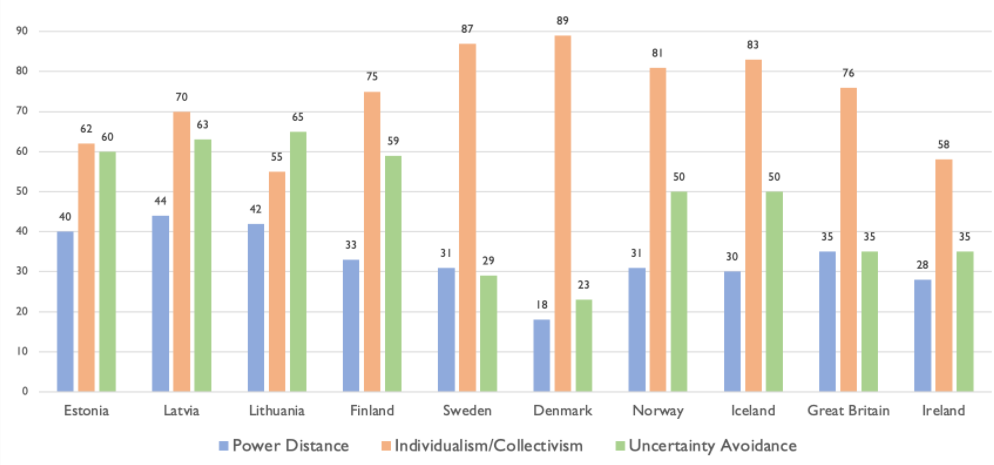 Why Is It Easier for Us to Communicate with Scandinavians than with Slavs?
Recently, I spent an afternoon entertaining myself. Not by watching television or solving crossword puzzles, but by comparing cultural behaviour patterns across countries using Geert Hofstede’s cultural comparison tool. Some readers may consider this an unusual hobby. I found it surprisingly thought-provoking.
One question in particular caught my attention. Why do Estonians often seem to communicate more easily with Finns, Swedes and Danes than with Russians, Ukrainians or even Poles?
Of course, this is not an absolute truth. People differ, and culture does not determine the behaviour of every individual all the time. Yet after many years of working in international teams, I have noticed this pattern repeatedly. Could there be a scientific explanation for it?
Can We Trust Hofstede's Model?
Before comparing cultures, it is worth asking a more basic question: Can Hofstede's model itself be trusted? I have had reasons to be sceptical.
Several decades ago, I participated in an international study of managerial occupational stress that included an evaluation of the psychometric properties of Hofstede's Values Survey Module across 24 countries. The results showed that not all Hofstede scales performed equally well. We later published these findings in Applied Psychology: An International Review.
A few years ago, while studying behavioural responses in crisis situations, we again needed an instrument capable of distinguishing cultural behaviour patterns I consulted an American colleague, Professor Paul Spector, who told me that Hofstede's model is currently the most commonly used instrument for this purpose and expressed hope that significant work might have gone into further developing the tool in the meantime. I decided to check for myself. Our conclusion was that three dimensions appeared sufficiently robust:
For the remaining dimensions, we found insufficient evidence to reach equally confident conclusions. The results were later reported at CogSIMA 2022.
For that reason, I will focus only on these three dimensions.
Three Ways Cultures Differ
Power Distance
Power Distance reflects the extent to which unequal distributions of power are accepted as natural. In high power-distance cultures, hierarchy is expected. Managers give instructions. Subordinates follow them. Children are expected to obey parents.
In low power-distance cultures, greater equality is assumed. People are more comfortable questioning authority and expressing disagreement.
Individualism versus Collectivism
Individualistic cultures emphasise personal responsibility, self-expression and individual goals. Collectivist cultures place greater emphasis on loyalty, belonging and shared responsibility. The focus shifts from "I" to "we".
Uncertainty Avoidance
Some cultures feel more comfortable when rules are clear and situations are predictable. Others tolerate ambiguity more easily and tend to view change as an opportunity rather than a threat.
Is Estonia Culturally Closer to Northern or Eastern Europe?
In the UN's statistical regional classification, Estonia belongs to Northern Europe, together with Finland, Sweden, Denmark, Norway, Iceland, the United Kingdom, and Ireland. The figure compares the cultural behaviour patterns of Estonia and other Northern European countries in terms of power distance, individualism, and uncertainty avoidance.
In the same UN classification, the following countries belong to Eastern Europe: Russia, Ukraine, Belarus, Poland, the Czech Republic, Slovakia, Hungary, Romania, Moldova, and Bulgaria. It should be noted that, for historical and political reasons, Estonia and the other Baltic states are also often considered to belong to Eastern Europe.
Using these three Hofstede dimensions, the picture becomes surprisingly clear (see Figure 1 and Figure 2).
Figure 1. Estonia compared with Northern European countries based on Hofstede's three cultural dimensions
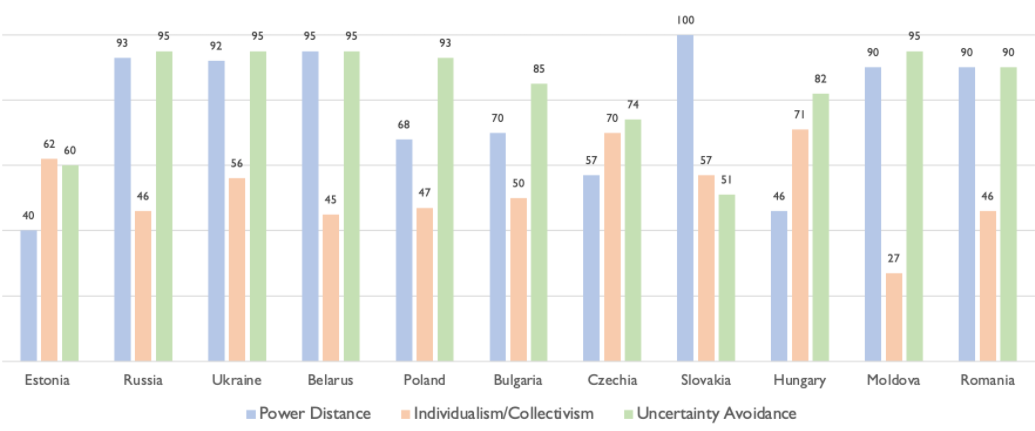
Figure 2. Estonia compared with Eastern European countries based on Hofstede's three cultural dimensions
On Power Distance, Estonia (40) is much closer to Finland (33), Sweden (31) and Denmark (18) than to Russia (93), Ukraine (92) or Poland (68). The same pattern appears for Individualism. Estonia scores 62, Finland 75, Sweden 87 and Denmark 89, while Russia scores 46 and Ukraine 56. On Uncertainty Avoidance, Estonia scores 60, almost identical to Finland's 59, but substantially lower than Russia's 95, Ukraine's 95 and Poland's 93. Based on these three dimensions, Estonia appears culturally closer to Northern Europe than to most Eastern European countries.
Perhaps this helps explain why many Estonians intuitively understand Scandinavian communication and working styles more easily than those commonly found in Slavic cultures.
How Does Power Distance Look in Everyday Life?
Some years ago, I taught Management Psychology as a visiting professor at the University of Silesia in Poland. There I noticed an interesting difference. An email from an Estonian student might look something like this: "Hello. I missed your lecture. What did you talk about? Ants"
Polish students often wrote very differently. A visiting professor might be addressed with a lengthy list of titles: 'Pani Profesor, Doktor Mare Teichmann...' Only after that would the actual question follow. At first, I found this unfamiliar and slightly uncomfortable.
Later, I realised that neither approach was more polite than the other. They simply reflected different assumptions about authority and status. In lower power-distance cultures, direct communication with professors or managers feels natural. In higher power-distance cultures, more formal expressions of respect are expected.
Individualism: The Individual or the Group?
Estonia is a relatively individualistic society. Finland, Sweden and especially Denmark are even more individualistic. Russia, Ukraine and Poland occupy a more collectivistic position.
This may help explain why identical workplace situations are sometimes interpreted differently. An Estonian manager may expect employees to make independent decisions and take responsibility for them. Someone from a more collectivist background may expect greater guidance and support from the team or manager.
Which approach is better? Probably neither. Or perhaps both. They are simply different cultural habits that occasionally create misunderstandings.
How Comfortable Are We with Uncertainty?
This dimension interests me particularly in today's rapidly changing world. Uncertainty Avoidance reflects how comfortable people feel when the future is unclear. Cultures with high scores tend to prefer rules, structure and predictability. Cultures with lower scores generally tolerate ambiguity more comfortably and experience less anxiety when things change.
Estonia occupies an interesting position. Our score differs from Finland's by only one point (60 versus 59), yet differs markedly from most Slavic countries. Perhaps this partly explains why both Estonians and Finns have adapted relatively quickly to digitalisation and technological change. Although, to be fair, Sweden and Denmark appear even more comfortable with uncertainty than either Estonia or Finland.
Something to Think About
Have you ever worked or studied with people from very different cultural backgrounds? Do cultural differences create more problems, or do they simply make collaboration more interesting?
Mõttekoht lugejale Kas sina oled töötanud või õppinud koos erineva kultuuritaustaga inimestega? Kas kultuurilised erinevused tekitavad rohkem probleeme või muudavad nad koostöö lihtsalt huvitavamaks?
Link
Spector, P.E.; Cooper, C.L.; Sparks, K.; Bernin, P.; Büssing, A.; Dewe, P.; Lu, L.; De Moraes, L:R.; O`Driscoll, M.; Pagon, M.; Pitariu, H.; Poelmans, S.; Radhakrishnan, P.; Russinova, V.; Salamatov, V.; Salgado, J.; Sanchez, J.I.; Shima, S.; Siu, L.O.; Stora, J.B.; Teichmann, M.; Theorell, T.; Vlerick, P.; Westman, M.; Widerszal-Bazyl, M.; Wong, P.; Yu, S. (2001). An international study of the psychometric properties of the Hofstede Values Survey Module 1994: a comparison of individual and country/province level results. Applied Psychology: An International Review, 50, No. 2, pp. 269 – 281. https://iaap-journals.onlinelibrary.wiley.com/doi/abs/10.1111/1464-0597.00058
M. Teichmann, J. Kaugerand, J. Ehala, M. Meriste, K. Rannat, “Effects of Culture on Public Behavior Patterns in Crisis Situations“, 2022 IEEE Conference on Cognitive and Computational Aspects of Situation Management (CogSIMA). https://easychair.org/publications/paper/sVrd/open
Keywords: culture, cultural differences, Hofstede, Estonia, Northern Europe, Eastern Europe, Nordic countries, individualism, collectivism, power distance, uncertainty avoidance, psychology
Hofstede’ Model: https://www.theculturefactor.com/country-comparison-tool?countries=
One question in particular caught my attention. Why do Estonians often seem to communicate more easily with Finns, Swedes and Danes than with Russians, Ukrainians or even Poles?
Of course, this is not an absolute truth. People differ, and culture does not determine the behaviour of every individual all the time. Yet after many years of working in international teams, I have noticed this pattern repeatedly. Could there be a scientific explanation for it?
Can We Trust Hofstede's Model?
Before comparing cultures, it is worth asking a more basic question: Can Hofstede's model itself be trusted? I have had reasons to be sceptical.
Several decades ago, I participated in an international study of managerial occupational stress that included an evaluation of the psychometric properties of Hofstede's Values Survey Module across 24 countries. The results showed that not all Hofstede scales performed equally well. We later published these findings in Applied Psychology: An International Review.
A few years ago, while studying behavioural responses in crisis situations, we again needed an instrument capable of distinguishing cultural behaviour patterns I consulted an American colleague, Professor Paul Spector, who told me that Hofstede's model is currently the most commonly used instrument for this purpose and expressed hope that significant work might have gone into further developing the tool in the meantime. I decided to check for myself. Our conclusion was that three dimensions appeared sufficiently robust:
- Power Distance
- Individualism versus Collectivism
- Uncertainty Avoidance
For the remaining dimensions, we found insufficient evidence to reach equally confident conclusions. The results were later reported at CogSIMA 2022.
For that reason, I will focus only on these three dimensions.
Three Ways Cultures Differ
Power Distance
Power Distance reflects the extent to which unequal distributions of power are accepted as natural. In high power-distance cultures, hierarchy is expected. Managers give instructions. Subordinates follow them. Children are expected to obey parents.
In low power-distance cultures, greater equality is assumed. People are more comfortable questioning authority and expressing disagreement.
Individualism versus Collectivism
Individualistic cultures emphasise personal responsibility, self-expression and individual goals. Collectivist cultures place greater emphasis on loyalty, belonging and shared responsibility. The focus shifts from "I" to "we".
Uncertainty Avoidance
Some cultures feel more comfortable when rules are clear and situations are predictable. Others tolerate ambiguity more easily and tend to view change as an opportunity rather than a threat.
Is Estonia Culturally Closer to Northern or Eastern Europe?
In the UN's statistical regional classification, Estonia belongs to Northern Europe, together with Finland, Sweden, Denmark, Norway, Iceland, the United Kingdom, and Ireland. The figure compares the cultural behaviour patterns of Estonia and other Northern European countries in terms of power distance, individualism, and uncertainty avoidance.
In the same UN classification, the following countries belong to Eastern Europe: Russia, Ukraine, Belarus, Poland, the Czech Republic, Slovakia, Hungary, Romania, Moldova, and Bulgaria. It should be noted that, for historical and political reasons, Estonia and the other Baltic states are also often considered to belong to Eastern Europe.
Using these three Hofstede dimensions, the picture becomes surprisingly clear (see Figure 1 and Figure 2).
Figure 1. Estonia compared with Northern European countries based on Hofstede's three cultural dimensions
Figure 2. Estonia compared with Eastern European countries based on Hofstede's three cultural dimensions
On Power Distance, Estonia (40) is much closer to Finland (33), Sweden (31) and Denmark (18) than to Russia (93), Ukraine (92) or Poland (68). The same pattern appears for Individualism. Estonia scores 62, Finland 75, Sweden 87 and Denmark 89, while Russia scores 46 and Ukraine 56. On Uncertainty Avoidance, Estonia scores 60, almost identical to Finland's 59, but substantially lower than Russia's 95, Ukraine's 95 and Poland's 93. Based on these three dimensions, Estonia appears culturally closer to Northern Europe than to most Eastern European countries.
Perhaps this helps explain why many Estonians intuitively understand Scandinavian communication and working styles more easily than those commonly found in Slavic cultures.
How Does Power Distance Look in Everyday Life?
Some years ago, I taught Management Psychology as a visiting professor at the University of Silesia in Poland. There I noticed an interesting difference. An email from an Estonian student might look something like this: "Hello. I missed your lecture. What did you talk about? Ants"
Polish students often wrote very differently. A visiting professor might be addressed with a lengthy list of titles: 'Pani Profesor, Doktor Mare Teichmann...' Only after that would the actual question follow. At first, I found this unfamiliar and slightly uncomfortable.
Later, I realised that neither approach was more polite than the other. They simply reflected different assumptions about authority and status. In lower power-distance cultures, direct communication with professors or managers feels natural. In higher power-distance cultures, more formal expressions of respect are expected.
Individualism: The Individual or the Group?
Estonia is a relatively individualistic society. Finland, Sweden and especially Denmark are even more individualistic. Russia, Ukraine and Poland occupy a more collectivistic position.
This may help explain why identical workplace situations are sometimes interpreted differently. An Estonian manager may expect employees to make independent decisions and take responsibility for them. Someone from a more collectivist background may expect greater guidance and support from the team or manager.
Which approach is better? Probably neither. Or perhaps both. They are simply different cultural habits that occasionally create misunderstandings.
How Comfortable Are We with Uncertainty?
This dimension interests me particularly in today's rapidly changing world. Uncertainty Avoidance reflects how comfortable people feel when the future is unclear. Cultures with high scores tend to prefer rules, structure and predictability. Cultures with lower scores generally tolerate ambiguity more comfortably and experience less anxiety when things change.
Estonia occupies an interesting position. Our score differs from Finland's by only one point (60 versus 59), yet differs markedly from most Slavic countries. Perhaps this partly explains why both Estonians and Finns have adapted relatively quickly to digitalisation and technological change. Although, to be fair, Sweden and Denmark appear even more comfortable with uncertainty than either Estonia or Finland.
Something to Think About
Have you ever worked or studied with people from very different cultural backgrounds? Do cultural differences create more problems, or do they simply make collaboration more interesting?
Mõttekoht lugejale Kas sina oled töötanud või õppinud koos erineva kultuuritaustaga inimestega? Kas kultuurilised erinevused tekitavad rohkem probleeme või muudavad nad koostöö lihtsalt huvitavamaks?
Link
Spector, P.E.; Cooper, C.L.; Sparks, K.; Bernin, P.; Büssing, A.; Dewe, P.; Lu, L.; De Moraes, L:R.; O`Driscoll, M.; Pagon, M.; Pitariu, H.; Poelmans, S.; Radhakrishnan, P.; Russinova, V.; Salamatov, V.; Salgado, J.; Sanchez, J.I.; Shima, S.; Siu, L.O.; Stora, J.B.; Teichmann, M.; Theorell, T.; Vlerick, P.; Westman, M.; Widerszal-Bazyl, M.; Wong, P.; Yu, S. (2001). An international study of the psychometric properties of the Hofstede Values Survey Module 1994: a comparison of individual and country/province level results. Applied Psychology: An International Review, 50, No. 2, pp. 269 – 281. https://iaap-journals.onlinelibrary.wiley.com/doi/abs/10.1111/1464-0597.00058
M. Teichmann, J. Kaugerand, J. Ehala, M. Meriste, K. Rannat, “Effects of Culture on Public Behavior Patterns in Crisis Situations“, 2022 IEEE Conference on Cognitive and Computational Aspects of Situation Management (CogSIMA). https://easychair.org/publications/paper/sVrd/open
Keywords: culture, cultural differences, Hofstede, Estonia, Northern Europe, Eastern Europe, Nordic countries, individualism, collectivism, power distance, uncertainty avoidance, psychology
Hofstede’ Model: https://www.theculturefactor.com/country-comparison-tool?countries=
14.06.2026
 Help! I'm Forgetting. Alzheimer's?
I have heard this cry of alarm more than once. Usually, it is followed by a list of things that have been forgotten. The keys have disappeared. Someone cannot remember which level she parked her car on. Or he walks into the kitchen and suddenly realise they have no idea why he went there in the first place.
Whenever this happens, many people immediately wonder: Is my memory getting worse? Could it be Alzheimer's disease? Perhaps the problem is not memory at all. Perhaps it is attention. Maybe the person never really noticed where the keys were placed. Perhaps she never looked at whether the car was parked on level A, B or C.
And this brings us to an important point. Most of the time, such situations simply mean that attention was occupied by something else. That does not necessarily indicate poor memory.
You cannot remember what you never noticed in the first place.
What Does Research Tell Us?
Research consistently shows that attention problems, forgetfulness and absent-mindedness are not random complaints among people experiencing high levels of stress. They are biologically grounded and measurable cognitive effects associated with chronic stress.
In other words: people are not necessarily lazy, careless or irresponsible. Their brains may simply be overloaded.
The Biological Mechanism
To understand why this happens, it helps to look briefly at the biology. Under chronic stress, including occupational stress, the body releases cortisol, a stress hormone that directly affects brain regions involved in attention and memory.
Two areas are particularly important: the prefrontal cortex, which helps us focus and direct attention, and the hippocampus, which plays a central role in memory formation. When chronic stress affects these systems, concentrating, maintaining attention and remembering information become more difficult.
Stress, Attention and Forgetfulness
When people are under stress, worries and problems tend to compete for attention. As a result, it becomes harder to focus on work and other important activities.
International research has repeatedly shown that occupational stress is associated with reduced cognitive functioning, including both attention and memory. This is not merely a theoretical idea. Nor is it simply a matter of personal experience.
Our own studies using the mini-OPSTI questionnaire (n = 2203) indicate that among people reporting high levels of stress:
High stress appears to affect not only everyday life but also cognitive functioning at work.
What Should We Take Away From This?
If you have recently become more forgetful, more absent-minded or find it harder to concentrate, this does not automatically mean that your memory is deteriorating or that you are developing a serious illness. Often, the explanation is far more ordinary.
Stress affects attention. And when attention deteriorates, we fail to notice things. If we do not notice them, we cannot remember them later. Perhaps we talk so much about memory because the consequences of forgetting are easy to see. The keys really are missing. The car really is difficult to find.
Perhaps the question is not always: Why am I forgetting? Perhaps a better question is: What am I paying attention to right now?
A Few Practical Strategies
During stressful periods, I try to rely less on memory and attention alone. Instead, I use simple external supports. For example, keeping keys in the same place, writing important things down, consciously noting where the car is parked, and deliberately directing attention to information that will matter later. Simple habits often compensate remarkably well for stressed attention systems.
Stress Rarely Comes Alone
Attention and memory difficulties are only part of the picture. Our mini-OPSTI studies suggest that high stress is also associated with excessive use of tension-reducing activities.
These may include overeating, excessive alcohol consumption, immersion in computer games, excessive exercise or highly restrictive dieting.
High stress is also associated with sleep problems. Sometimes people become irritable, nervous or start looking for someone to blame. Several of these findings are interesting enough to deserve separate posts in the future.
Something to Think About
Have you recently become more forgetful? If so, before blaming your memory, consider another possibility. Could stress be affecting your attention? And if attention is elsewhere, what exactly is occupying it?
Mini-OPSTI test (13 kusimust)
Selgitatakse välja mitmed kõige enam levinumat tööstressi sümptomit. Test aitab hinnata, kas ja mil määral need sümptomid esinevad, ning võimaldab võrrelda tulemusi Eesti normidega.
Keywords: occupational stress, attention, memory, forgetfulness, concentration difficulties, cognitive functioning, stress symptoms, absent-mindedness, mini-OPSTI, psychology
Whenever this happens, many people immediately wonder: Is my memory getting worse? Could it be Alzheimer's disease? Perhaps the problem is not memory at all. Perhaps it is attention. Maybe the person never really noticed where the keys were placed. Perhaps she never looked at whether the car was parked on level A, B or C.
And this brings us to an important point. Most of the time, such situations simply mean that attention was occupied by something else. That does not necessarily indicate poor memory.
You cannot remember what you never noticed in the first place.
What Does Research Tell Us?
Research consistently shows that attention problems, forgetfulness and absent-mindedness are not random complaints among people experiencing high levels of stress. They are biologically grounded and measurable cognitive effects associated with chronic stress.
In other words: people are not necessarily lazy, careless or irresponsible. Their brains may simply be overloaded.
The Biological Mechanism
To understand why this happens, it helps to look briefly at the biology. Under chronic stress, including occupational stress, the body releases cortisol, a stress hormone that directly affects brain regions involved in attention and memory.
Two areas are particularly important: the prefrontal cortex, which helps us focus and direct attention, and the hippocampus, which plays a central role in memory formation. When chronic stress affects these systems, concentrating, maintaining attention and remembering information become more difficult.
Stress, Attention and Forgetfulness
When people are under stress, worries and problems tend to compete for attention. As a result, it becomes harder to focus on work and other important activities.
International research has repeatedly shown that occupational stress is associated with reduced cognitive functioning, including both attention and memory. This is not merely a theoretical idea. Nor is it simply a matter of personal experience.
Our own studies using the mini-OPSTI questionnaire (n = 2203) indicate that among people reporting high levels of stress:
- 20% frequently experienced absent-mindedness and forgetfulness;
- 17% reported difficulties maintaining attention and concentrating.
High stress appears to affect not only everyday life but also cognitive functioning at work.
What Should We Take Away From This?
If you have recently become more forgetful, more absent-minded or find it harder to concentrate, this does not automatically mean that your memory is deteriorating or that you are developing a serious illness. Often, the explanation is far more ordinary.
Stress affects attention. And when attention deteriorates, we fail to notice things. If we do not notice them, we cannot remember them later. Perhaps we talk so much about memory because the consequences of forgetting are easy to see. The keys really are missing. The car really is difficult to find.
Perhaps the question is not always: Why am I forgetting? Perhaps a better question is: What am I paying attention to right now?
A Few Practical Strategies
During stressful periods, I try to rely less on memory and attention alone. Instead, I use simple external supports. For example, keeping keys in the same place, writing important things down, consciously noting where the car is parked, and deliberately directing attention to information that will matter later. Simple habits often compensate remarkably well for stressed attention systems.
Stress Rarely Comes Alone
Attention and memory difficulties are only part of the picture. Our mini-OPSTI studies suggest that high stress is also associated with excessive use of tension-reducing activities.
These may include overeating, excessive alcohol consumption, immersion in computer games, excessive exercise or highly restrictive dieting.
High stress is also associated with sleep problems. Sometimes people become irritable, nervous or start looking for someone to blame. Several of these findings are interesting enough to deserve separate posts in the future.
Something to Think About
Have you recently become more forgetful? If so, before blaming your memory, consider another possibility. Could stress be affecting your attention? And if attention is elsewhere, what exactly is occupying it?
Mini-OPSTI test (13 kusimust)
Selgitatakse välja mitmed kõige enam levinumat tööstressi sümptomit. Test aitab hinnata, kas ja mil määral need sümptomid esinevad, ning võimaldab võrrelda tulemusi Eesti normidega.
Keywords: occupational stress, attention, memory, forgetfulness, concentration difficulties, cognitive functioning, stress symptoms, absent-mindedness, mini-OPSTI, psychology
12.06.2026
 Does the Language of AI Mislead Us?
In recent years, artificial intelligence has become part of everyday conversation. We say that AI learns, understands, decides, knows, answers, is smart, is intelligent, can do things, and sometimes even that it thinks or wants something. These expressions sound perfectly natural. They make a complex technology easier to understand.
But as a psychologist, I have started to wonder: Is AI itself misleading us? Or is it the language we use to describe AI?
Language Does More Than Describe the World
Psychologists have long known that language is not merely a tool for communication. Language influences how we understand phenomena, how we think, what attitudes we develop, and how we interpret the world. It is one of our most important thinking tools. Language does not simply describe reality. It shapes how we think about reality.
When we use language created to describe people to describe machines, we may stop noticing where description ends and illusion begins. Once we start using human words for machines, we inevitably begin to see more humanity in them than is actually there. For example, we say AI learned, AI understands text, AI thinks, AI knows. These expressions are convenient. But every time we use them, we add a little bit of humanity to the system.
Does AI Have Opinions?
One can debate whether AI "has opinions" in the human sense. A more accurate description might be that it models and predicts possible responses.
Although that raises another question: What exactly is a genuine opinion? That, too, remains a widely debated topic in science. In introductory psychology courses, students learn very early on that humans do not perceive the world in its entirety.
We see fragments. The brain constructs the whole.
Figure. Perceptual completion
The lion image is a classic example. We see only parts, fill in the missing information, end up perceiving a complete object. And most of the time, we do this remarkably well.
With AI, something similar happens - something that, in humans, we might call perceptual completion or model construction.
A person says: "I saw a lion." Even though only part of the information reached the retina. AI might say: "I think the user is interested in an object that may be a lion." Even though only a small part of the lion is visible. In both cases, the process looks something like this: partial information → model → complete interpretation
There is, however, an important difference. Human perception is a subjective experience. An AI model is a mathematical operation.
So What Is the Main Difference Between Humans and AI?
To compare these concepts meaningfully, it helps to start with simple working definitions.
When I look at this comparison, one difference stands out immediately. Human definitions repeatedly contain words such as experience, meaning, goals, choice, or subjective state. AI definitions repeatedly contain words such as input, pattern, processing, mathematical mechanism, optimisation. And that may be one reason why discussions about AI become so confusing.
Why Does This Matter?
The problem is not terminology itself. The problem is what those words do to our thinking. When we talk about AI as if it were human, we gradually begin attributing human qualities to it. This is where anthropomorphism begins - the tendency to see human characteristics where they may not actually exist.
Perhaps we should stop automatically using human-centred language when describing AI.
Because words such as:
easily create the illusion that AI is a person.
A pleasant conversational partner is not necessarily a trustworthy one.
Yet AI is often pleasant to talk to.
All of this creates a pleasant feeling. Psychologists know that people tend to trust those who seem similar to themselves. And that is where the danger lies. Signals that create trust are not the same thing as actual trustworthiness. Illusions can be pleasant.
As a scientist, I have learned to be cautious about illusions - even pleasant ones. If someone feels: "AI understands me" that may be a completely genuine experience. But it does not automatically mean that AI understands a person in the same way another human being does. Those are not the same thing.
Perhaps We Need a New Vocabulary
It seems to me that the rise of AI has created a need for more precise terminology. Not because we want to diminish or underestimate the technology. But because we want to think more clearly.
At the moment, we are using concepts created to describe humans in order to describe machines. Perhaps we need new concepts for phenomena that are not quite human, yet are no longer just machines in the traditional sense.
And finally. The more I use AI, the less interested I become in the question: Is AI intelligent? And the more interested I become in another: Does the language we use help us understand AI or does it mislead us? Perhaps the greatest misunderstandings do not come from the technology itself. Perhaps they come from the words we use to describe it.
Something to Think About
When you say that AI learns, understands, knows, or thinks: are you describing the technology, or are you describing it using words originally created to describe people? And does that distinction matter?
Further Reading
Teichmann, M., Kaugerand, J., Rannat, K., Priisalu J., Mõtus, L., Meriste., M. (2026). Does AI Language Mislead Us? Anthropomorphism in Human–AI Interaction: A Psychological Perspective. (In press).
Keywords: artificial intelligence, anthropomorphism, AI language, human - AI interaction, psychology of language, perception, thinking, machine learning, trust, work psychology
But as a psychologist, I have started to wonder: Is AI itself misleading us? Or is it the language we use to describe AI?
Language Does More Than Describe the World
Psychologists have long known that language is not merely a tool for communication. Language influences how we understand phenomena, how we think, what attitudes we develop, and how we interpret the world. It is one of our most important thinking tools. Language does not simply describe reality. It shapes how we think about reality.
When we use language created to describe people to describe machines, we may stop noticing where description ends and illusion begins. Once we start using human words for machines, we inevitably begin to see more humanity in them than is actually there. For example, we say AI learned, AI understands text, AI thinks, AI knows. These expressions are convenient. But every time we use them, we add a little bit of humanity to the system.
Does AI Have Opinions?
One can debate whether AI "has opinions" in the human sense. A more accurate description might be that it models and predicts possible responses.
Although that raises another question: What exactly is a genuine opinion? That, too, remains a widely debated topic in science. In introductory psychology courses, students learn very early on that humans do not perceive the world in its entirety.
We see fragments. The brain constructs the whole.
Figure. Perceptual completion
The lion image is a classic example. We see only parts, fill in the missing information, end up perceiving a complete object. And most of the time, we do this remarkably well.
With AI, something similar happens - something that, in humans, we might call perceptual completion or model construction.
- It is not knowledge.
- It is not an opinion.
- It is a model.
- In fact, the parallel goes even further.
A person says: "I saw a lion." Even though only part of the information reached the retina. AI might say: "I think the user is interested in an object that may be a lion." Even though only a small part of the lion is visible. In both cases, the process looks something like this: partial information → model → complete interpretation
There is, however, an important difference. Human perception is a subjective experience. An AI model is a mathematical operation.
So What Is the Main Difference Between Humans and AI?
To compare these concepts meaningfully, it helps to start with simple working definitions.
| Psychological phenomenon |
Human | AI |
| Sensation | Raw information received through the senses | Input signals such as text, images, or sound |
| Perception | Organising and interpreting sensations into meaningful wholes | Pattern processing and classification through a model |
| Attention | Directing limited mental resources toward selected objects or tasks | A mathematical mechanism that determines which inputs are most important for generating a response |
| Memory | Encoding, storing, recalling, and forgetting information | Learned patterns plus temporary use of conversational context |
| Thinking | Processing information, reasoning, solving problems, making decisions | Generating outputs and modelling relationships based on patterns |
| Emotions | Psychophysiological states that influence behaviour, attention, and decisions | Description or simulation of emotions without subjective experience |
| Motivation | Internal and external forces that guide behaviour toward goals | No internal goals or desires; optimisation of predefined tasks |
When I look at this comparison, one difference stands out immediately. Human definitions repeatedly contain words such as experience, meaning, goals, choice, or subjective state. AI definitions repeatedly contain words such as input, pattern, processing, mathematical mechanism, optimisation. And that may be one reason why discussions about AI become so confusing.
Why Does This Matter?
The problem is not terminology itself. The problem is what those words do to our thinking. When we talk about AI as if it were human, we gradually begin attributing human qualities to it. This is where anthropomorphism begins - the tendency to see human characteristics where they may not actually exist.
Perhaps we should stop automatically using human-centred language when describing AI.
Because words such as:
- thinking;
- learning;
- understanding;
- intelligence;
- wisdom;
- will;
- emotions;
easily create the illusion that AI is a person.
A pleasant conversational partner is not necessarily a trustworthy one.
Yet AI is often pleasant to talk to.
- It listens.
- It responds quickly.
- It mirrors our vocabulary and way of thinking.
- It does not argue for the sake of ego.
- It offers positive feedback.
All of this creates a pleasant feeling. Psychologists know that people tend to trust those who seem similar to themselves. And that is where the danger lies. Signals that create trust are not the same thing as actual trustworthiness. Illusions can be pleasant.
As a scientist, I have learned to be cautious about illusions - even pleasant ones. If someone feels: "AI understands me" that may be a completely genuine experience. But it does not automatically mean that AI understands a person in the same way another human being does. Those are not the same thing.
Perhaps We Need a New Vocabulary
It seems to me that the rise of AI has created a need for more precise terminology. Not because we want to diminish or underestimate the technology. But because we want to think more clearly.
At the moment, we are using concepts created to describe humans in order to describe machines. Perhaps we need new concepts for phenomena that are not quite human, yet are no longer just machines in the traditional sense.
And finally. The more I use AI, the less interested I become in the question: Is AI intelligent? And the more interested I become in another: Does the language we use help us understand AI or does it mislead us? Perhaps the greatest misunderstandings do not come from the technology itself. Perhaps they come from the words we use to describe it.
Something to Think About
When you say that AI learns, understands, knows, or thinks: are you describing the technology, or are you describing it using words originally created to describe people? And does that distinction matter?
Further Reading
Teichmann, M., Kaugerand, J., Rannat, K., Priisalu J., Mõtus, L., Meriste., M. (2026). Does AI Language Mislead Us? Anthropomorphism in Human–AI Interaction: A Psychological Perspective. (In press).
Keywords: artificial intelligence, anthropomorphism, AI language, human - AI interaction, psychology of language, perception, thinking, machine learning, trust, work psychology
10.06.2026
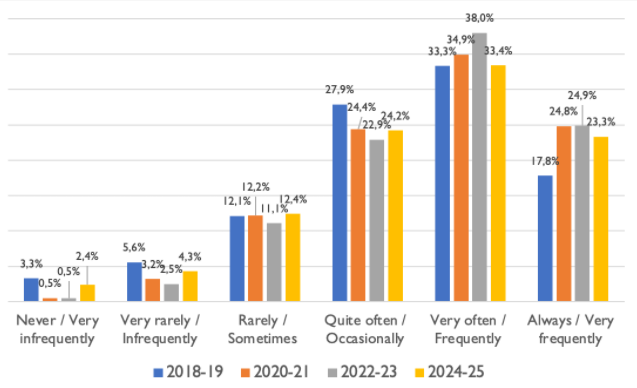 Multitasking as a Work Design Problem
The phone rings. Teams starts flashing. A new email arrives. At the same time, you are trying to finish a report that was actually due yesterday. Most of us recognise this situation.
The Myth of Multitasking
Over the years, a persistent myth has emerged: Successful people are good at multitasking. Some even consider it an essential skill in modern working life.
Research tells a rather different story. The human brain is not particularly good at performing two attention-demanding tasks simultaneously. What we usually call multitasking is actually rapid switching between tasks - again and again.
Each switch requires time and mental effort. Studies consistently show that multitasking increases errors, prolongs task completion and reduces efficiency.
A Small Experiment
Many years ago, together with students from an international Master's programme in Work and Organisational Psychology, we decided to explore this phenomenon.
Participants were asked to perform both simple and more complex office-work simulations. For example, they had to type text into an email while simultaneously answering simple arithmetic questions over the telephone. The results were later presented at the European Association of Work and Organisational Psychology (EAWOP) Congress in Maastricht.
The findings were clear. When multitasking, participants worked more slowly and made more errors than when completing the same tasks sequentially. Performing multiple tasks simultaneously did not improve efficiency.
Facts Are Stubborn
Research findings are remarkably consistent.
There is one important exception. Automated activities are different. Walking while talking works perfectly well because walking has become automatic.
Trying to perform two cognitively demanding tasks at the same time is another matter entirely. The digital workplace makes this problem even worse. Notifications, emails and instant messages create a continuous chain of interruptions.
More Than Half of Employees Multitask
Our OPSTI studies suggest that multitasking is not an unusual phenomenon. It has become a normal part of modern working life.
Frequent multitasking in OPSTI studies
Figure. Frequent multitasking in OPSTI studies
Multitasking was significantly associated with occupational stress (r = 0.31). The more multitasking employees reported, the higher their stress levels tended to be.
For nearly a decade, more than half of employees have described their work as a situation where several things must be handled simultaneously.
Is the Problem the Employee, the Job, or the Way Work Is Organised?
This is where the findings become particularly interesting. Multitasking was associated with:
In other words, the greater the demands, the more multitasking occurred. Work organisation included situations where employees "...could not determine the order of their tasks; were expected to meet unrealistic deadlines; received instructions from several people simultaneously; and were expected to respond immediately to calls and emails."
These are not personality traits. They are characteristics of work design. Perhaps we have been asking the wrong question. Instead of asking: How can employees become better multitaskers? we might ask: Why is work organised in a way that forces people to multitask in the first place? That is a very different question.
If an employee's day consists of constant interruptions, time pressure and competing demands, multitasking may not be a conscious choice at all. It may simply be a consequence of how work is organised.
Another Paradox
Multitasking was negatively associated with:
This finding should make every manager think. The more knowledgeable employees were, the less multitasking they reported. The higher their motivation, the less multitasking they reported. The higher their job performance, the less multitasking they reported.
Of course, correlations do not prove causation. We cannot say whether multitasking reduces performance or whether less effective employees find themselves more often in multitasking situations. The data do not allow that conclusion.
What the Data Suggest
Multitasking is widespread in modern working life. It is associated with workload, emotional demands, work organisation and occupational stress.
Some organisations may unintentionally produce multitasking - not because employees want it, but because work is organised in a way that makes it almost unavoidable.
The opposite explanation is also possible. Less experienced employees or those with less effective work habits may find themselves more often handling multiple demands simultaneously.
Correlations alone cannot answer that question. One thing, however, seems fairly clear. Year after year, more than half of employees multitask. And research consistently suggests that multitasking does not improve performance.
Something to Think About
What is one activity you have practised so extensively that you could almost do it with your eyes closed? And how often do you multitask at work?
If multitasking occupies a large part of your working day, could some aspects of your work be organised differently?
Keywords: multitasking, workplace interruptions, work design, job performance, work motivation, occupational stress, emotional demands, workload, organisational psychology, workplace productivity
Link
Teicimann, M.; Murdvee M.; Randmann, L.; Hellamaa, T.; Malik, A.S.; Ngana, W.G.; Pitkanen, J.M.; Shkuropat, K.; Stephanou, K.; Svetlicinaia, O.; Tali, A.; Verano Izaguirre, J.J. (2015). Workplace Busyness and Multitasking. In: Abstracts, European Association of Work and Organizational Psychology (EAWOP) Congress, 2015, Maastricht.
The Myth of Multitasking
Over the years, a persistent myth has emerged: Successful people are good at multitasking. Some even consider it an essential skill in modern working life.
Research tells a rather different story. The human brain is not particularly good at performing two attention-demanding tasks simultaneously. What we usually call multitasking is actually rapid switching between tasks - again and again.
Each switch requires time and mental effort. Studies consistently show that multitasking increases errors, prolongs task completion and reduces efficiency.
A Small Experiment
Many years ago, together with students from an international Master's programme in Work and Organisational Psychology, we decided to explore this phenomenon.
Participants were asked to perform both simple and more complex office-work simulations. For example, they had to type text into an email while simultaneously answering simple arithmetic questions over the telephone. The results were later presented at the European Association of Work and Organisational Psychology (EAWOP) Congress in Maastricht.
The findings were clear. When multitasking, participants worked more slowly and made more errors than when completing the same tasks sequentially. Performing multiple tasks simultaneously did not improve efficiency.
Facts Are Stubborn
Research findings are remarkably consistent.
- Multitasking may increase completion time by as much as 40% compared with focusing on one task at a time.
- Error rates increase substantially, particularly when tasks become more complex.
- Women are not necessarily better multitaskers. Despite the popular stereotype, research has not consistently supported this claim.
- Practice helps less than people think. Frequent multitaskers often believe they are good at it, yet studies suggest otherwise.
There is one important exception. Automated activities are different. Walking while talking works perfectly well because walking has become automatic.
Trying to perform two cognitively demanding tasks at the same time is another matter entirely. The digital workplace makes this problem even worse. Notifications, emails and instant messages create a continuous chain of interruptions.
More Than Half of Employees Multitask
Our OPSTI studies suggest that multitasking is not an unusual phenomenon. It has become a normal part of modern working life.
Frequent multitasking in OPSTI studies
Period |
Sample (n) |
Frequent multitasking |
| 2018-2019 | 1203 | 51,1% |
| 2020-2021 | 1299 | 59,3% |
| 2022-2023 | 550 | 59,9% |
| 2024-2025 | 1143 | 56,7% |
Figure. Frequent multitasking in OPSTI studies
Multitasking was significantly associated with occupational stress (r = 0.31). The more multitasking employees reported, the higher their stress levels tended to be.
For nearly a decade, more than half of employees have described their work as a situation where several things must be handled simultaneously.
Is the Problem the Employee, the Job, or the Way Work Is Organised?
This is where the findings become particularly interesting. Multitasking was associated with:
- emotional job demands (r = 0,39);
- quantitative workload and work pace (r = 0,32);
- organisational demands and work organisation (r = 0,32);
In other words, the greater the demands, the more multitasking occurred. Work organisation included situations where employees "...could not determine the order of their tasks; were expected to meet unrealistic deadlines; received instructions from several people simultaneously; and were expected to respond immediately to calls and emails."
These are not personality traits. They are characteristics of work design. Perhaps we have been asking the wrong question. Instead of asking: How can employees become better multitaskers? we might ask: Why is work organised in a way that forces people to multitask in the first place? That is a very different question.
If an employee's day consists of constant interruptions, time pressure and competing demands, multitasking may not be a conscious choice at all. It may simply be a consequence of how work is organised.
Another Paradox
Multitasking was negatively associated with:
- knowledge (r = –0.38);
- work motivation (r = –0.25);
- job performance (r = –0.27).
This finding should make every manager think. The more knowledgeable employees were, the less multitasking they reported. The higher their motivation, the less multitasking they reported. The higher their job performance, the less multitasking they reported.
Of course, correlations do not prove causation. We cannot say whether multitasking reduces performance or whether less effective employees find themselves more often in multitasking situations. The data do not allow that conclusion.
What the Data Suggest
Multitasking is widespread in modern working life. It is associated with workload, emotional demands, work organisation and occupational stress.
Some organisations may unintentionally produce multitasking - not because employees want it, but because work is organised in a way that makes it almost unavoidable.
The opposite explanation is also possible. Less experienced employees or those with less effective work habits may find themselves more often handling multiple demands simultaneously.
Correlations alone cannot answer that question. One thing, however, seems fairly clear. Year after year, more than half of employees multitask. And research consistently suggests that multitasking does not improve performance.
Something to Think About
What is one activity you have practised so extensively that you could almost do it with your eyes closed? And how often do you multitask at work?
If multitasking occupies a large part of your working day, could some aspects of your work be organised differently?
Keywords: multitasking, workplace interruptions, work design, job performance, work motivation, occupational stress, emotional demands, workload, organisational psychology, workplace productivity
Link
Teicimann, M.; Murdvee M.; Randmann, L.; Hellamaa, T.; Malik, A.S.; Ngana, W.G.; Pitkanen, J.M.; Shkuropat, K.; Stephanou, K.; Svetlicinaia, O.; Tali, A.; Verano Izaguirre, J.J. (2015). Workplace Busyness and Multitasking. In: Abstracts, European Association of Work and Organizational Psychology (EAWOP) Congress, 2015, Maastricht.
7.06.2026
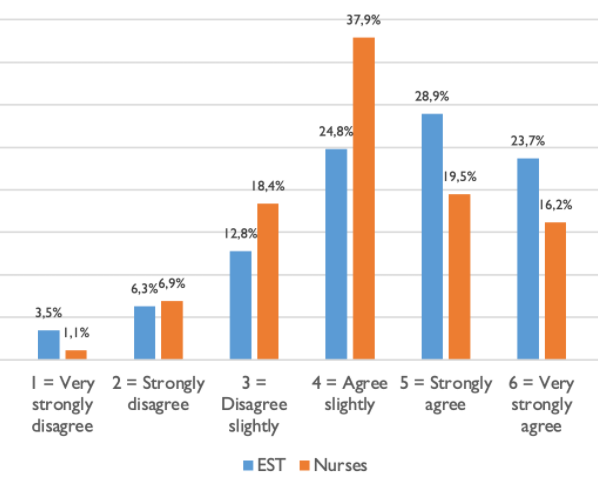 Technophiles, Technophobes and Everyone in Between
Over the past few years, I have noticed an interesting pattern. Whenever organisations introduce a new technology or an AI-based tool, people react very differently. One person says: "Excellent. Finally, something new." Another asks: "Does this mean I have to learn yet another system?" A third quietly wonders: "Is my job now at risk?" And a fourth has already downloaded the new application before the meeting has even finished.
Why do people react so differently to the same technology?
Our research suggests that part of the answer lies in people's attitudes towards technology. With some simplification, we can place individuals on a continuum, with technophilia at one end and technophobia at the other.
Who Is a Technophile?
A technophile is not simply someone who knows how to use technology. A technophile is genuinely interested in new technologies and often excited by them.
When a new smartphone, AI application or digital service appears, technophiles usually want to try it immediately or at least explore it. Often not because they need it, but because they find new technology fascinating.
Our research revealed something interesting. Technophiles are not necessarily people who love gadgets. Rather, they tend to see technology as something that makes life easier - a way to stay connected, work more flexibly, and get things done more efficiently.
If you recognise yourself in this description, there is no need for concern.
Technophilia is not a disease.
Who Is a Technophobe?
Neither does technophobia mean that a person is unintelligent or incapable of using technology. More often, it reflects discomfort, anxiety or scepticism towards new technologies. A technophobe may think: "What if I cannot cope with it?" "Why do we need to change things again?" "Will this new system actually make anything better?"
Sometimes these are perfectly reasonable questions. Not every new technology is automatically a good technology.
Estonia Is Not a Paradise for Technophobes
When we developed and validated a questionnaire measuring technophilia and technophobia, we also examined how common these attitudes were among Estonian employees. The results were interesting. In our sample (n = 625), only 3.5% of respondents could be classified as technophobes, while 23.7% could be classified as technophiles.
Figure. Employees who are highly enthusiastic about new tools or technology
In other words, technophiles outnumbered technophobes by almost seven to one.
More broadly, 77.4% of employees reported generally positive attitudes towards new tools and technologies, whereas only 22.6% reported predominantly negative attitudes. This may help explain why Estonia has been so receptive to digital solutions over the past decades.
An Unexpected Finding
Many people assume that technophiles must be more successful employees. Likewise, they often assume that technophobes perform less well. Our data did not support either assumption.
For me, this was one of the most interesting findings. Simply loving the latest technology does not automatically make someone a better employee, a more productive worker or a more motivated person. Likewise, being cautious about new technologies does not automatically make someone less competent or less motivated.
Who Are the Technophiles?
The relationship between age and technophilia was expected. Younger people tended to be somewhat more technophilic (r = -0.26).
What surprised us was that technophilia was not related to gender or marital status. It was, however, associated with having children (r = 0.22). Parents tended to view new technologies more positively than non-parents.
Why might that be? Our data cannot provide a definitive answer. Perhaps children bring new technologies, applications and digital solutions into the household before adults encounter them elsewhere. Perhaps parents are more motivated to find ways of organising their time efficiently. Or perhaps this reflects a broader generational effect.
Technophilia Is Not About Performance
Our results suggest that technophilia is primarily associated with technology use itself (r = 0.47) and with the belief that technology creates mobility (r = 0.45), improves communication (r = 0.41), enhances collaboration (r = 0.39) and increases efficiency (r = 0.39). This suggests that technophilia is not simply enthusiasm for technology. Technophiles see technology as an opportunity to do things differently and perhaps better.
People Respond to Technology Differently
Take AI as an example. Some people believe AI will solve many of our problems. Others worry that it will create more problems than it solves. Some see opportunities. Others see risks. And many people remain largely indifferent.
As a psychologist, I am less interested in the question: Is AI good or bad? I am much more interested in another question: Why do people answer that question so differently? Why does one person adopt a new technology on the first day, another a year later, and a third never at all? Why do some people see opportunities while others see threats? And how do these attitudes influence our decisions, our work, our learning and our everyday lives? Perhaps people do not respond differently because technologies are different. Perhaps they respond differently because people are different.
Something to Think About
Would you describe yourself as more of a technophile or a technophobe? If your organisation introduced a new technology, an advanced robot or an AI tool tomorrow, what would your first reaction be? That question may tell you something interesting about yourself.
Keywords: echnophilia, technophobia, technology attitudes, workplace technology, technology adoption, artificial intelligence, digital transformation, human–technology interaction, work psychology, organisational psychology
Link
Martínez-Córcoles, M.; Teichmann; M. Murdvee, M. (2017). Assessing technophobia and technophilia: Development and validation of a questionnaire. Technology in Society, 51, 183-188. https://www.sciencedirect.com/science/article/abs/pii/S0160791X17301793
Why do people react so differently to the same technology?
Our research suggests that part of the answer lies in people's attitudes towards technology. With some simplification, we can place individuals on a continuum, with technophilia at one end and technophobia at the other.
Who Is a Technophile?
A technophile is not simply someone who knows how to use technology. A technophile is genuinely interested in new technologies and often excited by them.
When a new smartphone, AI application or digital service appears, technophiles usually want to try it immediately or at least explore it. Often not because they need it, but because they find new technology fascinating.
Our research revealed something interesting. Technophiles are not necessarily people who love gadgets. Rather, they tend to see technology as something that makes life easier - a way to stay connected, work more flexibly, and get things done more efficiently.
If you recognise yourself in this description, there is no need for concern.
Technophilia is not a disease.
Who Is a Technophobe?
Neither does technophobia mean that a person is unintelligent or incapable of using technology. More often, it reflects discomfort, anxiety or scepticism towards new technologies. A technophobe may think: "What if I cannot cope with it?" "Why do we need to change things again?" "Will this new system actually make anything better?"
Sometimes these are perfectly reasonable questions. Not every new technology is automatically a good technology.
Estonia Is Not a Paradise for Technophobes
When we developed and validated a questionnaire measuring technophilia and technophobia, we also examined how common these attitudes were among Estonian employees. The results were interesting. In our sample (n = 625), only 3.5% of respondents could be classified as technophobes, while 23.7% could be classified as technophiles.
Figure. Employees who are highly enthusiastic about new tools or technology
In other words, technophiles outnumbered technophobes by almost seven to one.
More broadly, 77.4% of employees reported generally positive attitudes towards new tools and technologies, whereas only 22.6% reported predominantly negative attitudes. This may help explain why Estonia has been so receptive to digital solutions over the past decades.
An Unexpected Finding
Many people assume that technophiles must be more successful employees. Likewise, they often assume that technophobes perform less well. Our data did not support either assumption.
For me, this was one of the most interesting findings. Simply loving the latest technology does not automatically make someone a better employee, a more productive worker or a more motivated person. Likewise, being cautious about new technologies does not automatically make someone less competent or less motivated.
Who Are the Technophiles?
The relationship between age and technophilia was expected. Younger people tended to be somewhat more technophilic (r = -0.26).
What surprised us was that technophilia was not related to gender or marital status. It was, however, associated with having children (r = 0.22). Parents tended to view new technologies more positively than non-parents.
Why might that be? Our data cannot provide a definitive answer. Perhaps children bring new technologies, applications and digital solutions into the household before adults encounter them elsewhere. Perhaps parents are more motivated to find ways of organising their time efficiently. Or perhaps this reflects a broader generational effect.
Technophilia Is Not About Performance
Our results suggest that technophilia is primarily associated with technology use itself (r = 0.47) and with the belief that technology creates mobility (r = 0.45), improves communication (r = 0.41), enhances collaboration (r = 0.39) and increases efficiency (r = 0.39). This suggests that technophilia is not simply enthusiasm for technology. Technophiles see technology as an opportunity to do things differently and perhaps better.
People Respond to Technology Differently
Take AI as an example. Some people believe AI will solve many of our problems. Others worry that it will create more problems than it solves. Some see opportunities. Others see risks. And many people remain largely indifferent.
As a psychologist, I am less interested in the question: Is AI good or bad? I am much more interested in another question: Why do people answer that question so differently? Why does one person adopt a new technology on the first day, another a year later, and a third never at all? Why do some people see opportunities while others see threats? And how do these attitudes influence our decisions, our work, our learning and our everyday lives? Perhaps people do not respond differently because technologies are different. Perhaps they respond differently because people are different.
Something to Think About
Would you describe yourself as more of a technophile or a technophobe? If your organisation introduced a new technology, an advanced robot or an AI tool tomorrow, what would your first reaction be? That question may tell you something interesting about yourself.
Keywords: echnophilia, technophobia, technology attitudes, workplace technology, technology adoption, artificial intelligence, digital transformation, human–technology interaction, work psychology, organisational psychology
Link
Martínez-Córcoles, M.; Teichmann; M. Murdvee, M. (2017). Assessing technophobia and technophilia: Development and validation of a questionnaire. Technology in Society, 51, 183-188. https://www.sciencedirect.com/science/article/abs/pii/S0160791X17301793
3.06.2026
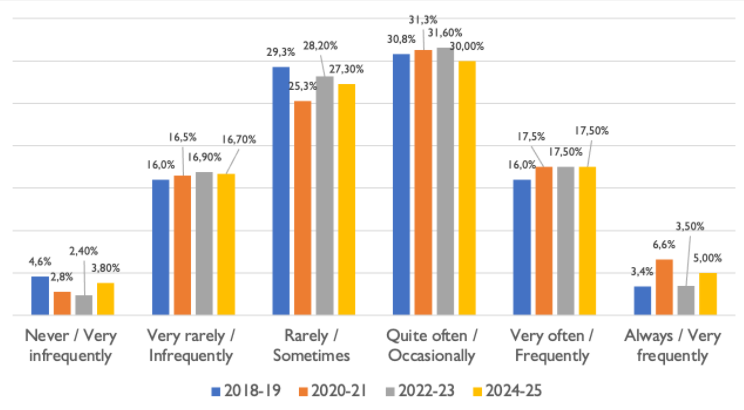 Occupational Stress Is Here to Stay
Whenever I say that occupational stress is here to stay, many people immediately become a little uncomfortable.
Nobody likes to hear that. We would much rather believe that somewhere out there exists an organisation where people work without pressure, feel good all the time, and happily go to work every day.
Unfortunately, decades of workplace research suggest a rather different picture. Across several OPSTI studies conducted between 2018 and 2025, roughly one in five employees reported high levels of occupational stress.
Occupational Stress studied by OPSTI (Organizational Psychosocial Factors Indicator, 2018-2025)
Figure. Occupational stress levels among employees
I have spent a large part of my professional life studying occupational stress. During that time, I have never encountered a single organisation where occupational stress was completely absent.
There can be dozens, sometimes even hundreds, of potential sources of stress at work. Fortunately, not all of them affect the same person at the same time. And fortunately, not everyone reacts to the same stressors in the same way. I have often seen situations where the very same manager is experienced as supportive by one employee and highly stressful by another. This is one of the reasons occupational stress can never be fully eliminated.
This illustrates an important point that occupational stress does not arise solely from the work environment itself. Stress emerges from the interaction between a person and a situation.
That is precisely why occupational stress can never be completely eliminated from an organisation. What we can do is understand its causes and reduce its harmful effects.
Sources of Pressure
Our research shows that, on average, employees are affected by around eight to ten different stressors simultaneously. Some are related to workload, some to work organisation, some to management practices, and others to interpersonal relationships.
That is why the most important question is not: Is there stress in the organisation? Or even: How much stress is there? A far more important question is: What are we going to do about it?
To answer that question, we first need to understand how to recognise stress, what the main sources of occupational stress are, how those sources can be reduced, how to lessen the impact of stress on people, how to prevent burnout.
Perhaps that is why occupational stress continues to fascinate me after all these years. The challenge is not to create stress-free organisations. Such organisations do not exist. The challenge is to understand stress well enough to recognise it early, reduce its harmful effects, and prevent it from turning into burnout.
Occupational stress is here to stay.
The question is how we choose to live and work with it. What we can do is learn to understand it better, reduce its impact, and recognise the warning signs early - before they develop into burnout.
You may also be interested in the following publications:
Teichmann, M., (2020) “Mapping and assessing psychosocial risk factors for individual- and organizational-level occupational stress intervention”, EWOP in Practice 12(1), 25–38. doi: https://doi.org/10.21825/ewopinpractice.87120
Teichmann, M., Ilvest, J. Jr. (2010). Sources of occupational stress in technical university academics. Proceedings of the WSEAS International Conferences: 7th WSEAS International Conference on Engineering Education (EDUCATION '10), Corfu Island, Greece, July 22-25, 2010. Ed. Masttoraka, N.; Misdanov, V. et al. Greece: WSEAS, CD. https://www.researchgate.net/publication/234783868_Sources_of_occupational_stress_in_technical_university_academics
Keywords: occupational stress, burnout, workplace well-being, psychosocial risk factors, OPSTI (Organizational Psychosocial Factors Indicator), occupational health, management
Nobody likes to hear that. We would much rather believe that somewhere out there exists an organisation where people work without pressure, feel good all the time, and happily go to work every day.
Unfortunately, decades of workplace research suggest a rather different picture. Across several OPSTI studies conducted between 2018 and 2025, roughly one in five employees reported high levels of occupational stress.
Occupational Stress studied by OPSTI (Organizational Psychosocial Factors Indicator, 2018-2025)
Period |
Sample (n) |
Employees with high stress levels |
| 2018-2019 | 1203 | 19,4% |
| 2020-2021 | 1299 | 24,1% |
| 2022-2023 | 550 | 21% |
| 2024-2025 | 1143 | 22,5% |
Figure. Occupational stress levels among employees
I have spent a large part of my professional life studying occupational stress. During that time, I have never encountered a single organisation where occupational stress was completely absent.
There can be dozens, sometimes even hundreds, of potential sources of stress at work. Fortunately, not all of them affect the same person at the same time. And fortunately, not everyone reacts to the same stressors in the same way. I have often seen situations where the very same manager is experienced as supportive by one employee and highly stressful by another. This is one of the reasons occupational stress can never be fully eliminated.
This illustrates an important point that occupational stress does not arise solely from the work environment itself. Stress emerges from the interaction between a person and a situation.
That is precisely why occupational stress can never be completely eliminated from an organisation. What we can do is understand its causes and reduce its harmful effects.
Sources of Pressure
Our research shows that, on average, employees are affected by around eight to ten different stressors simultaneously. Some are related to workload, some to work organisation, some to management practices, and others to interpersonal relationships.
That is why the most important question is not: Is there stress in the organisation? Or even: How much stress is there? A far more important question is: What are we going to do about it?
To answer that question, we first need to understand how to recognise stress, what the main sources of occupational stress are, how those sources can be reduced, how to lessen the impact of stress on people, how to prevent burnout.
Perhaps that is why occupational stress continues to fascinate me after all these years. The challenge is not to create stress-free organisations. Such organisations do not exist. The challenge is to understand stress well enough to recognise it early, reduce its harmful effects, and prevent it from turning into burnout.
Occupational stress is here to stay.
The question is how we choose to live and work with it. What we can do is learn to understand it better, reduce its impact, and recognise the warning signs early - before they develop into burnout.
You may also be interested in the following publications:
Teichmann, M., (2020) “Mapping and assessing psychosocial risk factors for individual- and organizational-level occupational stress intervention”, EWOP in Practice 12(1), 25–38. doi: https://doi.org/10.21825/ewopinpractice.87120
Teichmann, M., Ilvest, J. Jr. (2010). Sources of occupational stress in technical university academics. Proceedings of the WSEAS International Conferences: 7th WSEAS International Conference on Engineering Education (EDUCATION '10), Corfu Island, Greece, July 22-25, 2010. Ed. Masttoraka, N.; Misdanov, V. et al. Greece: WSEAS, CD. https://www.researchgate.net/publication/234783868_Sources_of_occupational_stress_in_technical_university_academics
Keywords: occupational stress, burnout, workplace well-being, psychosocial risk factors, OPSTI (Organizational Psychosocial Factors Indicator), occupational health, management
31.05.2026
Why Did I Start Writing a Blog?
For most of my professional life, I have done what most researchers do. I have conducted studies, written papers, presented findings at conferences, taught students, developed psychological assessment tools, and worked with organizations trying to understand people and improve working life.
So why start a blog now?
Not because I need more visibility. Not because I am trying to sell something. And certainly not because the world needs one more opinion. The answer is much simpler.
Over the years, I have accumulated a large collection of ideas, findings, observations, and questions that never quite found their way beyond research reports, conference presentations, journal articles, or professional discussions. Some of these findings were published. Many were not. Yet all of them contributed to my understanding of people, work, and technology.
The Knowledge Paradox
The longer I have worked as a researcher, the more I have been puzzled by a simple paradox. We produce an enormous amount of knowledge. Yet only a small part of it reaches everyday life.
This is not a criticism of science. Scientific papers serve an important purpose. They help us create new knowledge, challenge assumptions, test theories, and improve our understanding of the world. I have spent much of my own career doing exactly that.
But academic papers are usually written for other researchers. And understandably so. Managers are busy. Engineers are busy. HR professionals are busy. WOP (Work and Organizational Psychology) practitioners are too busy. Most people have neither the time nor the motivation to read scientific journals.
As a result, many useful ideas remain known mainly within professional communities.
A Different Role
At some point I realized that perhaps I could contribute in a different way. Not only as a researcher. Not only as a consultant.
But also as a translator. Not a translator between languages. A translator between research and practice. Between scientific findings and everyday questions. Between what we know and what we actually use.
I am not starting this blog because I have more answers than others. I am starting it because many useful ideas deserve a wider audience than conference rooms and journal articles.
What Will This Blog Be About?
For more than 25 years, my work has focused on the relationship between people, work, and technology.
This blog explores topics such as:
And many other topics that are relevant, timely, and perhaps even useful. Mostly I will write about research findings. Sometimes about practical observations. Sometimes about ideas that made me stop and think. And occasionally about questions for which I do not have a clear answer.
What This Blog Is Not
This blog is not a consulting brochure. It is not a marketing tool. And it is not an attempt to build a personal brand. My goal is much simpler. To share evidence-based ideas, research findings, and reflections with people who are curious about understanding themselves, their work, and the rapidly changing world around them.
If some of these ideas help someone see a familiar problem from a different perspective, then the blog has already served its purpose.
An Invitation
Throughout my career, one question has remained surprisingly constant: How can we help people live and work better in a rapidly changing world?
I certainly do not have all the answers.
But I have accumulated a great many questions, observations, research findings, and stories along the way. Some of them may resonate with your own experiences. Some may challenge your assumptions. And some may simply give you something to think about over your morning coffee.
If that happens, then writing this blog will have been worthwhile. I am glad you are here. You are warmly welcome.
So why start a blog now?
Not because I need more visibility. Not because I am trying to sell something. And certainly not because the world needs one more opinion. The answer is much simpler.
Over the years, I have accumulated a large collection of ideas, findings, observations, and questions that never quite found their way beyond research reports, conference presentations, journal articles, or professional discussions. Some of these findings were published. Many were not. Yet all of them contributed to my understanding of people, work, and technology.
The Knowledge Paradox
The longer I have worked as a researcher, the more I have been puzzled by a simple paradox. We produce an enormous amount of knowledge. Yet only a small part of it reaches everyday life.
This is not a criticism of science. Scientific papers serve an important purpose. They help us create new knowledge, challenge assumptions, test theories, and improve our understanding of the world. I have spent much of my own career doing exactly that.
But academic papers are usually written for other researchers. And understandably so. Managers are busy. Engineers are busy. HR professionals are busy. WOP (Work and Organizational Psychology) practitioners are too busy. Most people have neither the time nor the motivation to read scientific journals.
As a result, many useful ideas remain known mainly within professional communities.
A Different Role
At some point I realized that perhaps I could contribute in a different way. Not only as a researcher. Not only as a consultant.
But also as a translator. Not a translator between languages. A translator between research and practice. Between scientific findings and everyday questions. Between what we know and what we actually use.
I am not starting this blog because I have more answers than others. I am starting it because many useful ideas deserve a wider audience than conference rooms and journal articles.
What Will This Blog Be About?
For more than 25 years, my work has focused on the relationship between people, work, and technology.
This blog explores topics such as:
- Emotional labour
- Self-motivation
- Cyberloafing
- Multitasking
- Sleep problems in modern working life
- Technostress, cyberstress and AI stress
- AI as a mirror of ourselves
- The meaningfulness of work
And many other topics that are relevant, timely, and perhaps even useful. Mostly I will write about research findings. Sometimes about practical observations. Sometimes about ideas that made me stop and think. And occasionally about questions for which I do not have a clear answer.
What This Blog Is Not
This blog is not a consulting brochure. It is not a marketing tool. And it is not an attempt to build a personal brand. My goal is much simpler. To share evidence-based ideas, research findings, and reflections with people who are curious about understanding themselves, their work, and the rapidly changing world around them.
If some of these ideas help someone see a familiar problem from a different perspective, then the blog has already served its purpose.
An Invitation
Throughout my career, one question has remained surprisingly constant: How can we help people live and work better in a rapidly changing world?
I certainly do not have all the answers.
But I have accumulated a great many questions, observations, research findings, and stories along the way. Some of them may resonate with your own experiences. Some may challenge your assumptions. And some may simply give you something to think about over your morning coffee.
If that happens, then writing this blog will have been worthwhile. I am glad you are here. You are warmly welcome.
31.05.2026
 About Mare Teichmann
Mare Teichmann is a psychologist, Professor Emerita, entrepreneur, and developer of psychological assessment instruments.
For more than 25 years, she has studied the relationship between people, work, and technology through research, consulting, and practice.
Her work spans occupational and organizational psychology, psychosocial risk management, occupational stress, quality of working life, wellbeing, and, more recently, the psychology of human–technology interaction and artificial intelligence. With an early medico-psychological background in occupational health and nearly a decade of collaboration with IT professionals and engineers, she is particularly interested in how people adapt to technological change.
Mare is the founder of the Psychology Department and the Institute of Industrial Psychology at Tallinn University of Technology, the founder of the WHO Estonian Quality of Life Centre, and co-founder and CEO of PE Konsult.
She has also served in leadership and advisory roles in numerous national and international professional organizations, including EAWOP, SIOP, EFPA (as a member of the Standing Committee on Work and Organizational Psychology), ENOP (as the Estonian representative), and the Estonian Work and Organizational Psychology Association, which she founded and later served as President.
Over the years, she has developed and validated psychological assessment instruments, e-learning and e-assessment solutions, and workplace diagnostic tools used in research and organizational practice. Several of these instruments have been translated into multiple languages and applied internationally.
Throughout her career, she has been guided by a simple question:
How can we help people live and work better in a rapidly changing world?
In this blog, she shares evidence-based reflections on people, work, and technology - drawing on 25 years of workplace psychology research, professional practice, and a lifelong curiosity about human behaviour.
Links
For more than 25 years, she has studied the relationship between people, work, and technology through research, consulting, and practice.
Her work spans occupational and organizational psychology, psychosocial risk management, occupational stress, quality of working life, wellbeing, and, more recently, the psychology of human–technology interaction and artificial intelligence. With an early medico-psychological background in occupational health and nearly a decade of collaboration with IT professionals and engineers, she is particularly interested in how people adapt to technological change.
Mare is the founder of the Psychology Department and the Institute of Industrial Psychology at Tallinn University of Technology, the founder of the WHO Estonian Quality of Life Centre, and co-founder and CEO of PE Konsult.
She has also served in leadership and advisory roles in numerous national and international professional organizations, including EAWOP, SIOP, EFPA (as a member of the Standing Committee on Work and Organizational Psychology), ENOP (as the Estonian representative), and the Estonian Work and Organizational Psychology Association, which she founded and later served as President.
Over the years, she has developed and validated psychological assessment instruments, e-learning and e-assessment solutions, and workplace diagnostic tools used in research and organizational practice. Several of these instruments have been translated into multiple languages and applied internationally.
Throughout her career, she has been guided by a simple question:
How can we help people live and work better in a rapidly changing world?
In this blog, she shares evidence-based reflections on people, work, and technology - drawing on 25 years of workplace psychology research, professional practice, and a lifelong curiosity about human behaviour.
Links
- WIKI EN https://en.wikipedia.org/wiki/Mare_Teichmann
- WIKI EST https://et.wikipedia.org/wiki/Mare_Teichmann
- WIKI UK https://uk.wikipedia.org/wiki/%D0%9C%D0%B0%D1%80%D0%B5_%D0%A2%D0%B5%D 1%96%D1%85%D0%BC%D0%B0%D0%BD%D0%BD
- WIKI RU https://ru.wikipedia.org/wiki/Тейхманн,_Маре_Альбертовна
- WIKI AR https://ar.wikipedia.org/wiki/ماري_تيشمان
- Google Scholar Profile https://scholar.google.com/scholar?hl=en&as_sdt=0%2C5&q=Mare+Teichmann&btnG=
Mare Teichmann (PhD) Professor Emerita
mare@pekonsult.ee
blog.pekonsult.ee